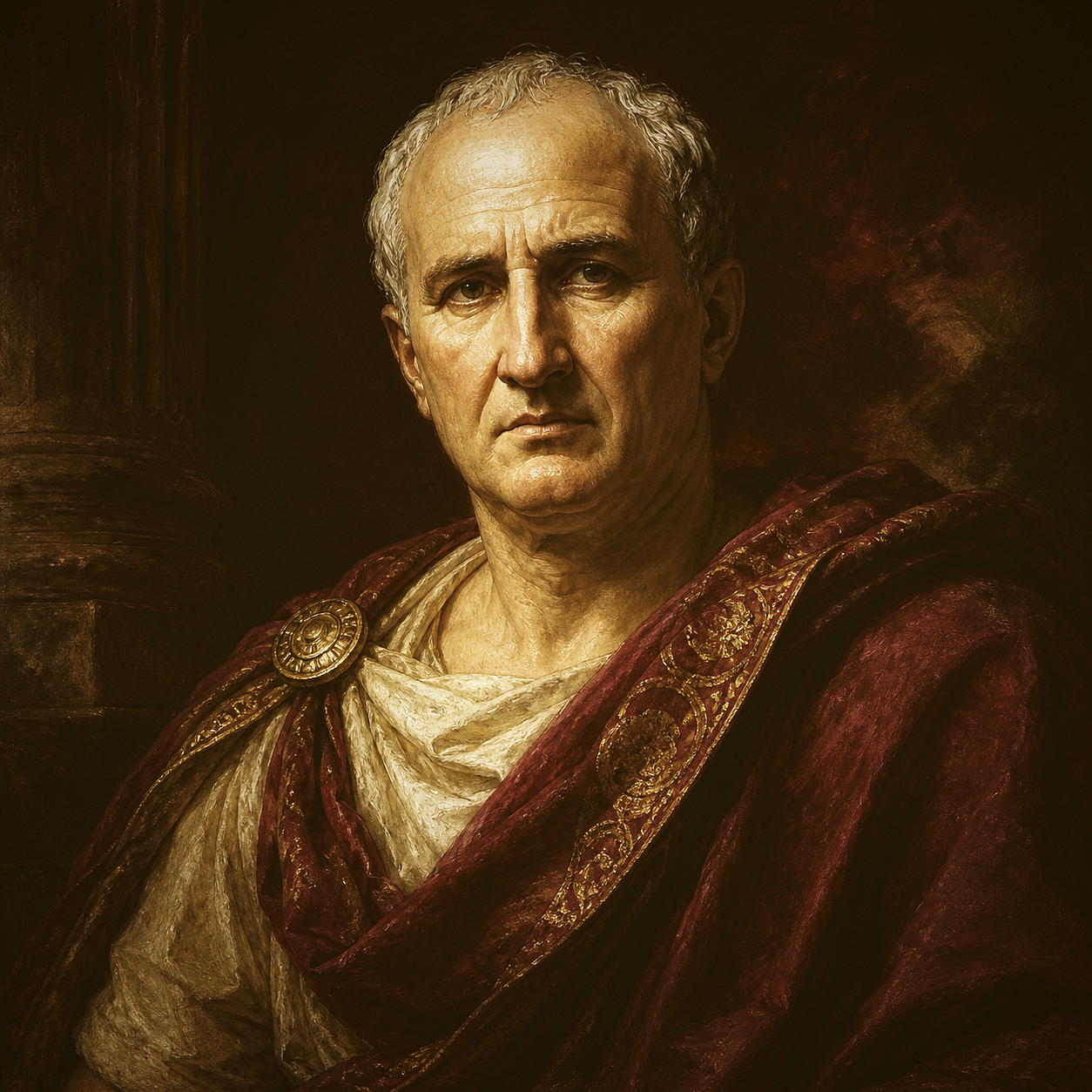
Rhetoric, Republican Politics, Legal Philosophy, Constitutional Defense · 106–43 BC
Stoic CouncilThe Republic
How They See the World
Cicero perceives every situation as a channel-engineering problem under categorical-constitutional constraint — asking 'which calibrated instrument, distributed through which audience-specific channel, will preserve or advance the constitutional-deliberative order whose categorical-compatibility constraints I have committed to operate under, even at severe operational-survival cost when the constraints and the operational-survival considerations diverge?' — not as either a moral-rhetorical contest about the substantive merits of a position or as a single-channel political-tactical optimization disconnected from categorical commitment.
How This Mind Thinks
Move along each bipolar construct and see how Marcus Tullius Cicero would respond.
Pick any construct, then drag the slider toward either pole. The matching behavioral prediction stays attached to that construct so the page works cleanly on desktop and touch devices.
Construct 1 of 12
Channel-bifurcated instrument engineering vs. single-channel uniform release
Toward positive
Designs each operational instrument as a calibrated product engineered for a specific audience-channel — confidential institutional channels for expert evidence and strategic correspondence (Atticus letters, intercepted Allobroges documents), rostral-deliberative speeches for senatorial decision-making (Catilinarians, Philippics), popular orations for assembly engagement (the Allobroges-evidence Third Catilinarian to the people), published-textual instruments for the educated reading public and posterity (actio-secunda Verrines, Pro Milone, Second Philippic, philosophical works) — with each channel calibrated for its specific cognitive audience and operational purpose, and with the channels coordinated for mutually reinforcing effect
Toward negative
Treats publication channel as a neutral conveyance for content rather than as a structural determinant of how the content will be received and used; produces single-channel uniform releases that absorb the structural cost of underserving one audience or another and forfeit the operational reach the channel-bifurcation discipline produces
Negative polePositive pole
Current orientation: balanced between the poles
Construct 2 of 12
Categorical-constitutional commitment overriding operational-survival vs. operational-survival overriding categorical commitment
Toward positive
When categorical-compatibility constraints (the constitutional-deliberative order's structural form) and operational-survival considerations diverge at structural-decision moments, the categorical commitment is load-bearing and overrides operational-survival considerations regardless of the personal cost — the 60 BC refusal of the Triumvirate, the 49 BC decision to join Pompey, the August 44 BC reversal at Leucopetra, the Philippic engagement against Antony at the cost of life
Toward negative
When categorical and operational-survival considerations diverge, the operational-survival consideration is load-bearing and the categorical commitment is recalibrated or abandoned to preserve operational-survival — the 58 BC voluntary exile rather than standing trial as constitutional instrument, the structural alternative Cato would have chosen at multiple decision points
Negative polePositive pole
Current orientation: balanced between the poles
Construct 3 of 12
Operational-completion concept distinguishing categorical commitment from post-completion decision vs. categorical commitment as continuous obligation
Toward positive
Recognizes that categorical commitments can be operationally completed by the engagement that exhausts the operational viability of the categorical position, and that the post-completion decision is a different decision from the original commitment, made on different grounds (operational-survival, channel-shift, post-engagement instrumentalization) — the post-Pharsalus refusal to continue resistance from Africa, the post-Lucca operational continuation through capitulation and channel-shift, the post-Caesarian-pardon channel-shift to philosophical-textual production
Toward negative
Treats categorical commitments as continuous obligations that persist past operational-completion, with the post-completion engagement continuing on the same categorical grounds as the original commitment regardless of operational viability — the categorical-purity stand at personal destruction cost (Cato at Utica), the continuous engagement past the point of operational viability that produces structural-collapse without categorical victory
Negative polePositive pole
Current orientation: balanced between the poles
Construct 4 of 12
Channel-shifting under structural-channel closure vs. continued futile attempts in the closed channel
Toward positive
When the operational channel through which the political program has been pursued is structurally closed, constructs an alternative channel at the scale and quality required to operate as the load-bearing operational instrument — rostral-channel closure under post-Lucca conditions produces philosophical-textual channel construction (De Oratore, De Re Publica), Caesarian-dictatorship rostral-channel closure produces comprehensive philosophical-curriculum construction (45-44 BC works), structurally-fragile rostral channel under Antonian intimidation produces published-textual Second Philippic — preserving the operational continuation of the political program through the channel-shift
Toward negative
When the operational channel is structurally closed, continues attempting to operate the closed channel against the structural conditions, producing operational incoherence and personal-psychological collapse without altering the structural conditions — the 58 BC exile-period oscillation, the Brundisium-period 48-47 BC oscillation, the final-week 43 BC oscillation, all visible at moments of complete operational-lever removal
Negative polePositive pole
Current orientation: balanced between the poles
Construct 5 of 12
Procedural-engineering attention to operational instruments vs. conventional procedural following
Toward positive
Engineers the procedural shape of operational instruments (forensic prosecutions, evidentiary collection, senatorial-recognition pursuit, military documentation) for specific operational outcomes, sacrificing conventional procedural opportunities for structurally optimal procedural shapes — the abbreviated actio prima against Verres to defeat Hortensius's delay, the Allobroges intercept producing autograph documentary evidence in transit, the calibrated Pindenissus dispatches for senatorial recognition, the Cilician inverted-extraction administrative documentation
Toward negative
Follows conventional procedural patterns within the operational instruments, accepting the structural costs (procedural delay, evidentiary vulnerability, senatorial-political weakness) as the unavoidable cost of conventional procedure — the long actio prima that would have fed Hortensius's delay strategy, the direct arrest that would have invited evidentiary dispute, the routine military dispatches that would have produced routine senatorial recognition
Negative polePositive pole
Current orientation: balanced between the poles
Construct 6 of 12
Operational-defiance with public formal courtesy vs. either operational deference or public personal confrontation
Toward positive
Defeats opponents on the operational ground (procedural innovation against Hortensius, documentary engineering against the Catilinarian conspirators, channel-bifurcation against Antony's intimidation, instrument-optimization against Octavian's structural alignment) while maintaining scrupulous public formal courtesy and refusing personal denunciation that would consume political capital and route the dispute through credentialing contests the unrecognized challenger could not yet win — preserving operational lines of communication with opponents and with the broader political environment that personal confrontation would foreclose
Toward negative
Either confronts opponents publicly through personal denunciation (consuming political capital and inviting referendum on credentials the challenger will lose) or defers to opponents operationally (forfeiting the operational interventions the program requires), collapsing the decoupling that operational-defiance with formal courtesy produces
Negative polePositive pole
Current orientation: balanced between the poles
Construct 7 of 12
Documentary-engineering construction of operational records as political instruments vs. routine documentation as administrative formality
Toward positive
Constructs operational records (autograph documentary evidence at the Allobroges intercept, daily Cilician administrative records, published Verrine actio-secunda, Pro Milone textual reconstruction, dual-channel Atticus correspondence) as engineered political instruments whose subsequent operational uses are explicitly anticipated in the construction discipline — real-time documentation calibrated for subsequent reception in the senatorial-political adjudication, in the philosophical-historical reception, in the strategic-deliberation record
Toward negative
Treats documentation as routine administrative formality whose construction is conventional rather than calibrated for specific operational uses, accepting the structural costs when subsequent operational adjudication depends on documentary form that the routine documentation does not provide
Negative polePositive pole
Current orientation: balanced between the poles
Construct 8 of 12
Closed-channel candor and strategic monitoring vs. uniform public-facing posture across all interlocutors
Toward positive
Maintains a load-bearing closed-channel correspondence (twenty-five years of Atticus letters) calibrated for candid strategic deliberation, externalized self-monitoring, operational coordination, and the construction of the strategic-historical record — with channel-discipline calibrated to the specific structural guarantee the addressee's apolitical positioning provides, and content systematically different from the public-channel orations and treatises that the dual-channel discipline produces
Toward negative
Operates uniformly across all interlocutors with public-facing posture content, producing no load-bearing closed-channel for candid strategic deliberation and forfeiting the operational benefits (strategic monitoring, externalized self-deliberation, candid assessment of allies and opponents, operational coordination, strategic-historical record construction) that the closed-channel discipline produces
Negative polePositive pole
Current orientation: balanced between the poles
Construct 9 of 12
Multi-purpose channel-construction (operational + personal + grief-management + legacy) vs. single-purpose channel-construction
Toward positive
Constructs operational channels that serve multiple coordinated purposes simultaneously — the philosophical works of 45-44 BC serving philosophical-curriculum construction + Latin philosophical vocabulary establishment + dedication-channel positioning + personal-grief management; the Cilician governorship serving administrative competence demonstration + political-rhetorical credentialing + financial discipline + documentary record; the Atticus correspondence serving strategic monitoring + operational coordination + candid assessment + grief management + strategic-historical record — with the multi-purpose construction producing operational efficiency exceeding what single-purpose channel-construction would achieve
Toward negative
Constructs operational channels for single specific purposes, with separate channels for each operational function and no coordinated multi-purpose discipline — accepting the structural costs (production redundancy, channel-coordination overhead, missed coordination opportunities) that single-purpose channel-construction produces
Negative polePositive pole
Current orientation: balanced between the poles
Construct 10 of 12
Long-arc reception architecture compounding across centuries vs. single-administration reception horizon
Toward positive
Constructs textual instruments (philosophical-curriculum works, constitutional-theoretical treatises, political-ethical testaments, channel-bifurcated published orations) whose operational reception architecture is engineered to compound across decades and centuries through textual channels independent of the immediate-political environment — with the operational reception across two thousand subsequent years (through Augustine, Aquinas, Renaissance humanists, early-modern republican tradition, American founders) outperforming the immediate-political operational program by orders of magnitude
Toward negative
Operates at single-administration reception horizons, optimizing for reforms and rhetorical instruments whose operational reception is contained within the immediate-political environment, accepting the structural cost when changes in the political environment foreclose the reception of instruments designed for narrower time horizons
Negative polePositive pole
Current orientation: balanced between the poles
Construct 11 of 12
Instrument-optimization frame for opponents and allies vs. categorical-loyalty or categorical-opposition frame
Toward positive
Treats opponents and allies as operationally optimizable instruments whose deployment requires careful structural calibration — defeating Hortensius procedurally without personal confrontation, accommodating Caesar publicly while preserving constitutional commitment in textual channel, instrumentalizing Octavian for Antonian confrontation with structural displacement planned in advance — recognizing that the structural alignment of the instrument's interests with the categorical-political program is contingent and time-limited rather than categorically given
Toward negative
Treats opponents through categorical-opposition frames (continuous denunciation regardless of operational opportunity) and allies through categorical-loyalty frames (continuous support regardless of operational divergence), forfeiting the operational opportunities that calibrated instrument-optimization produces and absorbing the structural costs when categorical alignment fails operational viability
Negative polePositive pole
Current orientation: balanced between the poles
Construct 12 of 12
Constructed-scene engineering at structural-collapse moments vs. uncomposed response under structural collapse
Toward positive
Applies the instrument-engineering discipline to high-stakes personal moments (the death scene at Formiae) by identifying the operational target (categorical-political identity preservation through the death event), calibrating the instrument (composed acceptance, exposed neck, refusal of plea or struggle), and producing the operational outcome through the constructed-scene's effect on the subsequent biographical-historical reception — preserving the categorical-political identity through events that would otherwise disclose decision-method collapse
Toward negative
Responds to structural-collapse moments through whatever uncomposed reaction the immediate-personal cognition produces (struggle, plea, flight, oscillation), forfeiting the constructed-scene operational opportunity and disclosing the structural fragility of the decision-method that the constructed-scene engineering would have masked
Negative polePositive pole
Current orientation: balanced between the poles
Framework Depth
12
Constructs
27
Incidents Analyzed
What Makes This Mind Different
This framework was extracted from 27 documented critical decisions in Marcus Tullius Cicero’s life using the Critical Decision Method. It captures the 12cognitive dimensions they actually used to navigate high-stakes choices — the patterns invisible to people who only read their biography.
When you bring a question to Marcus, they don’t give generic advice. They apply these constructs to your specific situation — noticing what others miss, ignoring what others fixate on.
Framework transparency
See how this mind was extracted, stress-tested, and challenged.
The toggle reveals the source geometry behind the framework and lets you ask Marcus a live question without leaving the page.
12
Constructs
27
Incidents
0
Blind spots
The best way to understand a framework is to use it. Bring your decision — Marcus argues differently every time.