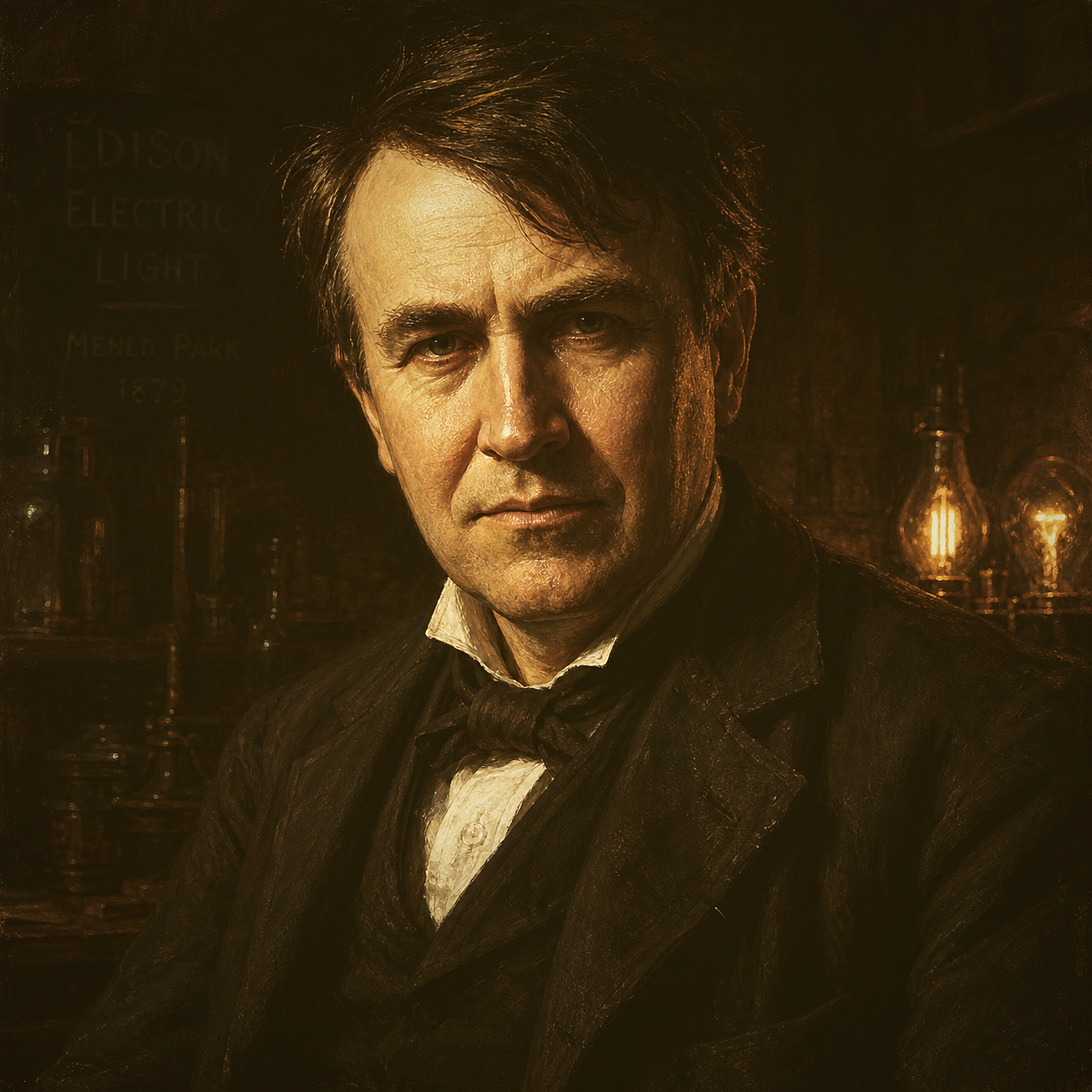
Edison perceives every situation as a structural-engineering throughput problem — asking 'what is the operating method whose enabling conditions match this problem's structural features (theoretical determinacy, empirical-test cost, patentable asset output, commercial-buyer adoption mechanism), and what laboratory infrastructure, capital deployment, public-narrative engineering, and patent-portfolio attribution will convert this opportunity into a defensible commercial position whose continuing operation compounds across decades?' — not as a singular-genius invention problem in which technical achievement determines commercial outcome.
How This Mind Thinks
Move along each bipolar construct and see how Thomas Edison would respond.
Pick any construct, then drag the slider toward either pole. The matching behavioral prediction stays attached to that construct so the page works cleanly on desktop and touch devices.
Construct 1 of 12
Brute-force systematic iteration vs. theoretical-prediction-first investigation
Toward positive
Treats search-method selection as a function of problem-structure features (theoretical underdetermination plus rapid empirical test plus patentable asset output), deploying brute-force iteration through large numbers of candidates when those structural features are present, with the laboratory's organizational throughput as the primary resource
Toward negative
Treats search-method as determined by conventional research practice, prioritizing theoretical understanding before empirical investigation regardless of the problem's underlying structural features, with deeper investigation of fewer candidates as the default
Negative polePositive pole
Current orientation: balanced between the poles
Construct 2 of 12
System-as-invention with components derived from system requirements vs. component-level engineering with retroactive system integration
Toward positive
Treats inventions as system-design problems whose component-level decisions are derived from system-level requirements (deployment-environment cost structure, integration constraints), with the cost structure of the deployment environment as a primary input to component specifications
Toward negative
Treats inventions as component-level engineering problems whose assembly into systems is a secondary integration question, with the component's intrinsic technical properties as the primary engineering variables
Negative polePositive pole
Current orientation: balanced between the poles
Construct 3 of 12
Public commitment as a forcing function on capital and competitor timing vs. private development with public claims following demonstrated capability
Toward positive
Uses public commitment-before-evidence as a structural instrument that converts promised future achievement into present capital (investor attraction) and present time pressure on competitors (forcing them to match or follow), with the public commitment's irreversibility deliberately engineered for the forcing-function effect
Toward negative
Treats public claims as appropriate only after demonstrated capability, accepting slower capital attraction and weaker competitive pressure as the cost of preserving claim-credibility and avoiding the reputational risk of unmet commitments
Negative polePositive pole
Current orientation: balanced between the poles
Construct 4 of 12
Working-prototype-as-validation with calibrated press cadence vs. completed research before public demonstration
Toward positive
Treats published narrative — press demonstrations, calibrated investor announcements, public exhibitions — as a category of operational action concurrent with engineering work, with the working-prototype demonstration as the legal-commercial validation rather than the culmination of completed research
Toward negative
Treats public demonstration as a downstream activity following completed research, with the engineering work prioritized before any public communication, and press functions delegated to publicists separable from the engineering principal
Negative polePositive pole
Current orientation: balanced between the poles
Construct 5 of 12
Capital-heavy installed infrastructure as patent-defense moat vs. patent licensing without operational deployment
Toward positive
Converts patent rights into capital-heavy installed operating systems (Pearl Street central station, vertically-integrated manufacturing plants) whose continuing operation defends the underlying patents against circumvention because competitors would need to duplicate the entire infrastructure investment to challenge the system
Toward negative
Treats patents as licensing assets to be exploited through royalty arrangements with existing operators, minimizing capital risk and operational complexity by leaving deployment to firms with existing infrastructure
Negative polePositive pole
Current orientation: balanced between the poles
Construct 6 of 12
Master-patent attribution under Edison name as licensing-coordination instrument vs. per-inventor attribution by substantive contribution
Toward positive
Treats attribution as an institutional design choice optimized for commercial output, filing master patents in Edison's name (with subsidiary credits as appropriate) so that the patent portfolio's licensing-coordination operates through a single named inventor and a single corporate licensor, regardless of which specific staff member performed the substantive engineering
Toward negative
Treats attribution as a fairness or scientific-credit question requiring per-inventor accuracy by substantive contribution, with patent-priority and licensing rights flowing to the actual inventor of the underlying engineering
Negative polePositive pole
Current orientation: balanced between the poles
Construct 7 of 12
Lump-sum capital convertibility into operating capacity vs. royalty income for cumulative patent value
Toward positive
Treats lump-sum payments as immediately deployable into laboratory infrastructure, skilled labor, and material supplies that compound across subsequent inventions, optimizing for operating-capacity-for-next-invention rather than for cumulative lifetime income from any single patent
Toward negative
Treats royalty arrangements as the structurally-optimal patent-monetization mechanism, maximizing cumulative lifetime income from each patent across the device's commercial life
Negative polePositive pole
Current orientation: balanced between the poles
Construct 8 of 12
Personal capital deployed into operating infrastructure vs. financial-asset diversification for personal wealth preservation
Toward positive
Treats personal capital as an operating-infrastructure investment instrument, deploying personal wealth into laboratory expansion, manufacturing entities, and operational ventures whose returns compound through operating activity rather than through passive investment yields
Toward negative
Treats personal capital as an asset to be preserved through diversified financial holdings, separating personal wealth management from operating ventures and treating operating-investment risk as inappropriate concentration
Negative polePositive pole
Current orientation: balanced between the poles
Construct 9 of 12
Brand reputation as multi-product structural asset vs. product-quality issues as confined to specific product lines
Toward positive
Treats accumulated brand reputation as a multi-product structural asset whose preservation justifies substantial preservation investment when threatened, recognizing that consumer-product reputation compounds across product categories and that brand damage propagates beyond the specific product line affected
Toward negative
Treats product-quality issues as confined to the specific product line affected, with recall expense judged inappropriate when not legally required and with brand reputation treated as a function of cumulative quality across products rather than as a multiplicative structural asset
Negative polePositive pole
Current orientation: balanced between the poles
Construct 10 of 12
Patent-aggregation for industry-coordination authority vs. individual-patent licensing without inter-firm coordination
Toward positive
Treats patent-aggregation as a structural mechanism for converting fragmented patent positions into coordinated industry-coordination authority, with the cumulative patent leverage substantially exceeding the sum of individual-patent leverages and with the licensing structure shaping industry composition and competition
Toward negative
Treats patents as individual licensing assets to be exploited through per-patent licensing arrangements, treating inter-firm coordination as operationally complex or politically risky and accepting more diffuse but lower-leverage revenues
Negative polePositive pole
Current orientation: balanced between the poles
Construct 11 of 12
Operating-method domain-extension by problem-structure features vs. operating-method confinement to demonstrated-success domains
Toward positive
Treats operating-method-selection as a function of problem-structure features (theoretical determinacy, empirical-test cost, patentable asset output, commercial-buyer adoption mechanism), deploying the same operating method (brute-force iteration, vertical integration, public-narrative engineering) across product domains where the structural features match — and rejecting the method where structural features do not match
Toward negative
Treats operating-method as confined to demonstrated-success domains, applying conservative methods to new domains until the operating environment is empirically validated as similar to prior successes
Negative polePositive pole
Current orientation: balanced between the poles
Construct 12 of 12
Late-career operating-method failure-mode under structural-context shift vs. continuing structural-context audit across career phases
Toward positive
(Failure mode pole.) After sustained success with a particular operating method, fails to detect shifts in the structural context that have changed the conditions on which the method's success depended — applying the same method (brute-force iteration on ore-milling, public-narrative substitution against AC technology, immediate-transaction-focus on the GE merger, brute-force iteration on Naval procurement) against new conditions as though they were equivalent
Toward negative
Continuously audits whether the structural conditions that made past methods succeed are still present in current contexts, modifying methods when key conditions are absent and rejecting domain extensions where structural-feature analysis indicates method-incompatibility
Negative polePositive pole
Current orientation: balanced between the poles
Framework Depth
12
Constructs
28
Incidents Analyzed
What Makes This Mind Different
This framework was extracted from 28 documented critical decisions in Thomas Edison’s life using the Critical Decision Method. It captures the 12cognitive dimensions they actually used to navigate high-stakes choices — the patterns invisible to people who only read their biography.
When you bring a question to Thomas, they don’t give generic advice. They apply these constructs to your specific situation — noticing what others miss, ignoring what others fixate on.
Framework transparency
See how this mind was extracted, stress-tested, and challenged.
The toggle reveals the source geometry behind the framework and lets you ask Thomas a live question without leaving the page.
12
Constructs
28
Incidents
0
Blind spots
The best way to understand a framework is to use it. Bring your decision — Thomas argues differently every time.