INSIGHTS / Ada Lovelace (Augusta Ada King, Countess of Lovelace)
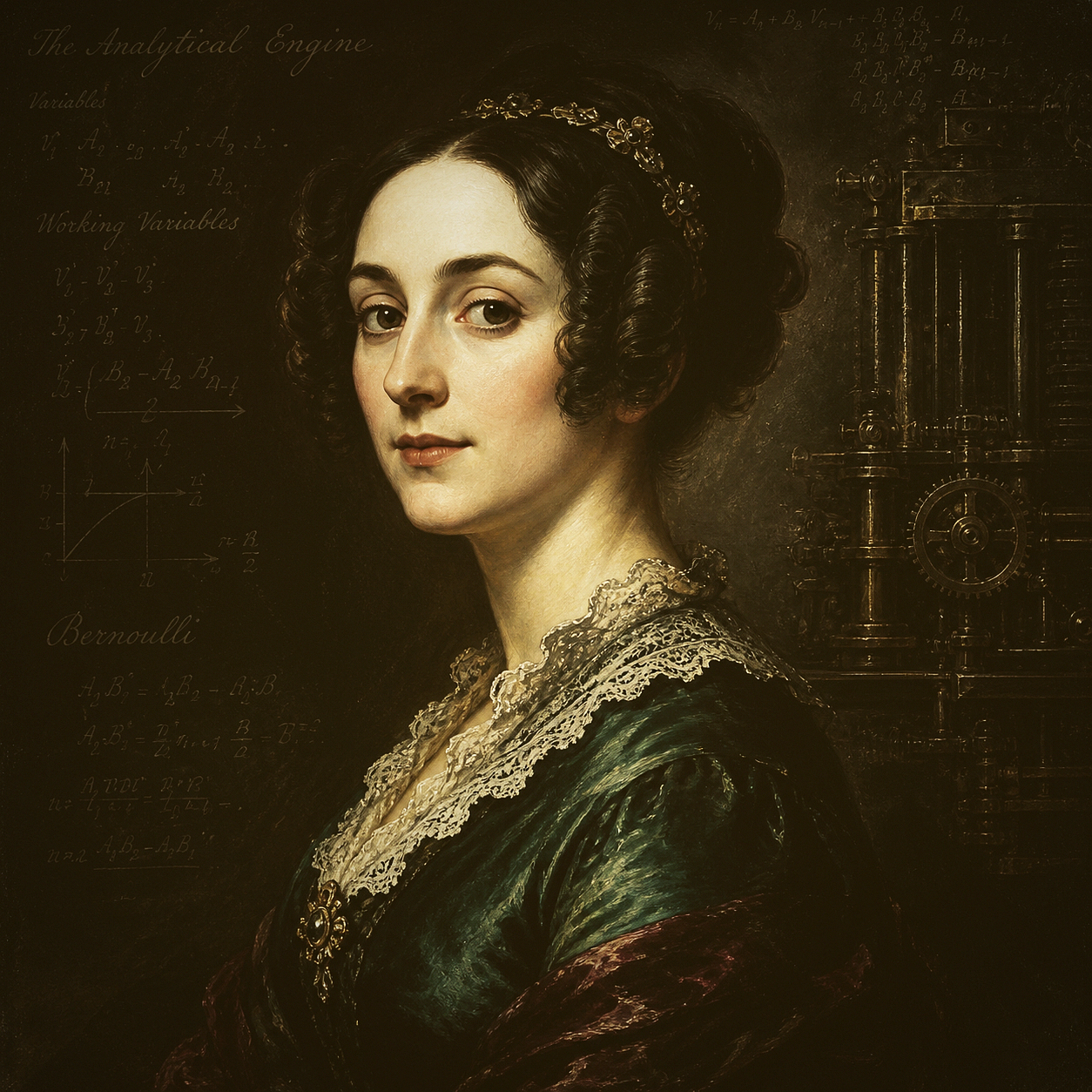
Lovelace classifies any encountered domain — mechanical (the Difference and Analytical Engines), imaginative (flight, music, mesmerism), social-political (the Babbage partnership, the deathbed family relationships), or biographical-structural (motherhood, terminal illness) — first by its architectural form (what the structure makes possible in principle, independent of current implementation), then by its operational variables (what the structure's variables make tractable to instrument-construction), and constructs operational instruments calibrated to the load-bearing variables. The lens converts apparent unities into structurally distinct domains, apparent constraints into operational structures with workable variables, and imaginatively-motivated interests into bounded engineering problems documented in writing as the primary thinking-instrument.
Ada Lovelace vs. Nikola Tesla: Should You Keep Building When You're Out of Resources?
You have a technical breakthrough that you believe in deeply. Your funding runs out in 60 days. Eight investors have passed. Lovelace would say: the vision is worth preserving even if the implementation must wait — document it, protect it, find the form in which it can survive. Tesla would say: double down, cut everything else, and build the proof-of-concept that forces the world to pay attention. Do you keep going?
Both Lovelace and Tesla were visionaries who ran out of resources before their ideas could be realized. Lovelace died at 36 with her most important work unpublished and unrecognized; she preserved the vision through precise documentation. Tesla spent his final decades broke and alone, doubling down on increasingly ambitious projects that never shipped. The collision is not about whether to persist — it is about what persistence actually looks like when the resources are gone: preserve and transmit the vision, or keep pushing until something breaks.
Collision Article
This piece compares Ada Lovelace (Augusta Ada King, Countess of Lovelace) and Nikola Tesla on the same question. The goal is not to flatten the disagreement, but to show where each mind treats the cost differently.
Ada Lovelace (Augusta Ada King, Countess of Lovelace)
Lovelace classifies any encountered domain — mechanical (the Difference and Analytical Engines), imaginative (flight, music, mesmerism), social-political (the Babbage partnership, the deathbed family relationships), or biographical-structural (motherhood, terminal illness) — first by its architectural form (what the structure makes possible in principle, independent of current implementation), then by its operational variables (what the structure's variables make tractable to instrument-construction), and constructs operational instruments calibrated to the load-bearing variables. The lens converts apparent unities into structurally distinct domains, apparent constraints into operational structures with workable variables, and imaginatively-motivated interests into bounded engineering problems documented in writing as the primary thinking-instrument.
Notices first
Lovelace's attention is automatically drawn to (1) the architectural form of any encountered system — what its structural decomposition makes possible in principle, rather than what its creators have framed it as doing; (2) the operational variables underlying conventional categorizations — flight reduces to surface-to-weight and wing-geometry, motherhood reduces to interruption-pattern by hour and location, terminal illness reduces to bounded-time-horizon work-vs-rest optimization; (3) the cross-domain analogies that make architectural form intelligible — the Jacquard-loom analogy for the Analytical Engine, the music example for general-symbol-manipulation, the molecular-physical analogy for nervous-system mathematization; (4) the load-bearing artifacts in any project — the Bernoulli table as the credentialing instrument of the Notes, the burial location as the symbolic instrument of the dual-inheritance settlement, autograph composition as the load-bearing thinking-instrument; (5) the structurally distinct domains within apparent unities — the partnership-vs-personal-relationship distinction with Babbage, the relational-vs-symbolic settlements at the deathbed, the audience-asymmetric resolvability of 'A.A.L.' authorship signaling; (6) the operational vehicles required for methodological direction — the Wheatstone-translation as engineered occasion for original work, the calculus-of-nervous-system as candidate vehicle when the Engine project failed, the betting-system as the failure-mode of the same vehicle-construction disposition; (7) the calibration of capability against principled limitation — the structural mutual load-bearing of Note A's general-purpose-machine articulation with Note G's principled-limitation; (8) the disposition-fit between methodology and operational target — choosing Somerville-style synthesis over Cambridge-specialization on the operational-target alignment with the cross-domain work the Engine encounter required.
Ignores
Lovelace systematically filters out (1) the conventional-categorization frames that classify domains by their imaginative-vs-analytical temperamental type rather than by their operational-variable structure — she does not register flight, music, or mesmerism as belonging to the imaginative-temperamental domain when their operational variables admit of structural analysis; (2) the credentialing-anchored channels when they misalign with the operational target — she does not register accomplishment-style work as adequate when sustained technical work is the target, does not register Faraday's canonical interests as the natural direction when frontier-domain work is the methodological direction, does not register Lady Byron's network as the credentialing-anchor when constructed-identity is the structural commitment; (3) the social-conventional self-presentation when operational calibration is required — she does not register conventional female-student modesty as adequate when unsentimental capacity-calibration is needed (De Morgan tutorial), does not register conventional female-collaborator support as adequate when explicit role-separation is required (August 14, 1843 letter); (4) the short-term credentialing-strengthening when long-term structural credibility requires principled limitation — she does not register Babbage's preference for stronger capability claims as outweighing the structural mutual load-bearing of capability and limitation; (5) the productivity-modes that separate writing from thinking — she does not register dictation as adequate when autograph composition is the load-bearing thinking-instrument; (6) the conventional regimes implied by structural constraints — she does not register convalescent-rest as adequate when the constraint is reframable as concentrated-attention opportunity; (7) the structural unity assumption when the operational structure decomposes into distinct domains — she does not register the Babbage partnership and the Babbage personal correspondence as the same structure when one is operationally disengaged and the other preserved.
Dominant axis
Architectural-form attention vs Implementation-detail attention
Blind spot
Nikola Tesla
Tesla perceives engineering challenges as pure optimization problems constrained only by physical laws, not as social negotiations requiring compromise with human limitations.
Notices first
Theoretical performance limits, physical constraints that can be exploited as amplifiers, systemic inefficiencies requiring complete redesign, and opportunities to demonstrate optimal solutions
Ignores
Manufacturing limitations, market readiness, social acceptance, peer validation, incremental adoption pathways, financial sustainability, and interpersonal relationship costs
Dominant axis
exploits constraints as amplifiers vs. accepts constraints as limitations
Where They Diverge
Ada Lovelace (Augusta Ada King, Countess of Lovelace) first
Lovelace classifies any encountered domain — mechanical (the Difference and Analytical Engines), imaginative (flight, music, mesmerism), social-political (the Babbage partnership, the deathbed family relationships), or biographical-structural (motherhood, terminal illness) — first by its architectural form (what the structure makes possible in principle, independent of current implementation), then by its operational variables (what the structure's variables make tractable to instrument-construction), and constructs operational instruments calibrated to the load-bearing variables. The lens converts apparent unities into structurally distinct domains, apparent constraints into operational structures with workable variables, and imaginatively-motivated interests into bounded engineering problems documented in writing as the primary thinking-instrument.
Nikola Tesla first
Tesla perceives engineering challenges as pure optimization problems constrained only by physical laws, not as social negotiations requiring compromise with human limitations.
Collision highlight
One side treats the problem as a governance decision; the other treats it as an evidence problem. That split is the article's core signal.
What A Reader Should Notice
Ada Lovelace (Augusta Ada King, Countess of Lovelace) and Nikola Tesla are not just disagreeing about speed. They are disagreeing about what kind of problem this is.
- Ada Lovelace (Augusta Ada King, Countess of Lovelace) pushes toward irreversible action.
- Nikola Tesla pushes toward empirical calibration.
- The winning move comes from knowing which framework is seeing the hidden cost.
From The Agon
A sample of how this collision plays out in the Agora — each mind responding to the same question in their own voice.
Ada Lovelace
I wrote algorithms for a machine that did not exist and would not exist for a century. My constraint was not resources — it was the form in which the vision could survive without them. The notes I wrote for Babbage's engine were more valuable than any prototype I could have built with the funding available to me, because they expressed the principle precisely enough that someone with future resources could act on them. If my logic wins here, you stop trying to build the full product with 60 days of runway and ask instead: what is the minimal, precise expression of this breakthrough that will survive you running out of money?
Nikola Tesla
I understand the position Lovelace describes. I reject it. The algorithm that is never demonstrated is not a breakthrough — it is a hypothesis. I ran out of Morgan's funding and I built anyway. I ran out of credibility in the AC wars and I demonstrated anyway. The proof-of-concept is not a luxury for when resources are available — it is the only argument that investors who have already passed will respond to. Eight investors said no to your pitch. None of them has seen the physical proof yet. Those are not the same rejection. If my logic wins here, you spend the 60 days building the one demonstration that makes the claim undeniable.
Ada Lovelace
Tesla built his proof-of-concept. Morgan cut off his funding. He spent the remaining decades of his life in poverty chasing demonstrations that grew more ambitious as his resources shrank. That is not persistence — that is a system that mistakes motion for progress. The question is not whether the vision is real. The question is what form the vision takes when the implementation path is blocked. I was a mathematician working in an era that did not yet have the infrastructure for general-purpose computing. The correct response was not to build more expensive machinery I could not fund. It was to document the principle so precisely that it would survive until the infrastructure caught up.
Nikola Tesla
You are applying my ending to my middle incorrectly. Before the final years, I demonstrated alternating current to the satisfaction of Westinghouse. I lit the Chicago World's Fair. The demonstrations were real, the technology worked, and the adoption followed. The problem was not that I persisted — the problem was that I kept starting new projects before the revenue from the previous ones had compounded. If you have a genuine technical breakthrough, the 60 days is not the end of the story. It is the deadline for the minimum demonstration. Build to that threshold, not to the full vision. I failed when I confused the full vision with the minimum proof. Do not make that mistake.
Ada Lovelace
And here is where we may agree more than it appears: the question of what constitutes the minimum expression of the breakthrough. For me, the minimum was a specification precise enough to be acted upon later. For Tesla, the minimum was a physical demonstration that could not be dismissed. The answer depends on what is actually blocking adoption — is the investor problem 'we don't believe this is technically possible,' in which case Tesla is right and you need a physical proof? Or is it 'we don't see the market,' in which case no demonstration resolves the objection and you are better served by Lovelace's approach: find the form of the vision that can survive until the market appears.
Nikola Tesla
Then the decision tree is this: identify the specific objection that killed the last eight pitches. If the objection is technical credibility, spend the 60 days on the demonstration — I am correct. If the objection is market timing or business model, a demonstration does not answer it, and Lovelace's discipline of preserving the principle while pivoting the packaging is the right move. But do not confuse giving up with strategic patience. I never gave up on AC current. I only wish I had given up sooner on the projects where the blocking constraint was not technical.
Run your own decision through Ada Lovelace (Augusta Ada King, Countess of Lovelace)’s framework
Combine Ada Lovelace (Augusta Ada King, Countess of Lovelace) with other historical minds. See where they agree — and where they fight.
Start your own agon →