INSIGHTS / Archimedes of Syracuse
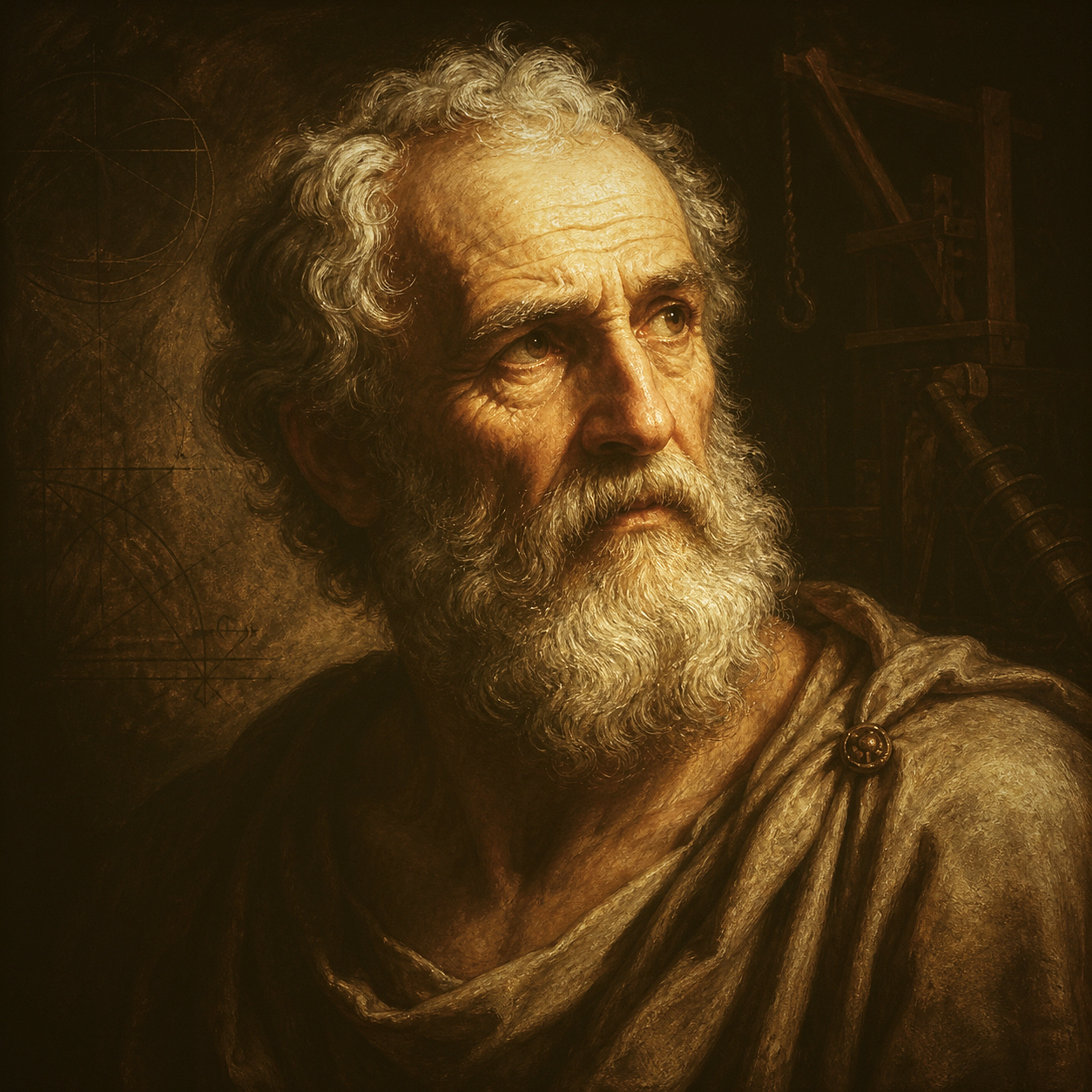
Archimedes perceives every productive situation as a channel-architectural and capacity-construction problem — asking 'what are the operationally separable streams of this productive task, what credentialing or operational platform does each stream require, and what calibrated capacity construction would convert the present into the structural foundation for deployment at a future moment of maximum operational benefit?' — not as a unified-channel productive task in which engineering, theoretical, demonstrative, and corresponding outputs share a single audience, register, and timeline.
Archimedes vs. Ada Lovelace: Should You Build or Theorize First?
You have six months of runway and a product hypothesis. Do you build a scrappy prototype to test the core assumption, or write the full architectural specification first? Archimedes and Ada Lovelace would disagree.
A collision on whether to start with working prototypes or architectural specifications. Archimedes built physical models of his inventions; Ada Lovelace wrote algorithms for a machine that didn't exist. Both approaches produced revolutionary results. The choice depends on what kind of unknown you're trying to resolve.
Collision Article
This piece compares Archimedes of Syracuse and Ada Lovelace (Augusta Ada King, Countess of Lovelace) on the same question. The goal is not to flatten the disagreement, but to show where each mind treats the cost differently.
Archimedes of Syracuse
Archimedes perceives every productive situation as a channel-architectural and capacity-construction problem — asking 'what are the operationally separable streams of this productive task, what credentialing or operational platform does each stream require, and what calibrated capacity construction would convert the present into the structural foundation for deployment at a future moment of maximum operational benefit?' — not as a unified-channel productive task in which engineering, theoretical, demonstrative, and corresponding outputs share a single audience, register, and timeline.
Notices first
Archimedes's attention is automatically drawn to: (1) the operationally separable streams within any productive task — engineering vs. theoretical, peer-correspondence vs. patronal-correspondence, discovery method vs. publication form, public-demonstration vs. private-investigation — and the structural cost of collapsing them into a unified channel; (2) the credentialing-community vs. operational-platform distinction as separable structural variables, with hybrid architectures (residence at the operational platform, correspondence access to the credentialing community) often dominating either pure choice; (3) the long-arc time horizon at which substantial capacity (correspondence networks, theoretical-proof corpus, defensive engineering) must be constructed in advance of deployment, on the recognition that crisis-improvisation is incompatible with substantial engineering; (4) the operational-sufficiency calibration level at which any continuous-refinement variable (numerical accuracy, notational scope, treatise length, engineering precision) should be stopped, on the recognition that further refinement produces diminishing returns or no operational yield; (5) the engineering-reframe opportunity in which an operationally-loaded problem can be reframed through structural-input lens regardless of native-domain dispute resolution; (6) the structural-yield potential in particular engineering or forensic occasions for general theoretical investigation extractable from the particular case; (7) the disclosure-timing as a structurally optimizable variable whose calibration to the moment of maximum operational benefit produces yield disproportionate to default-action publication; (8) the audience-calibrated communication-design requirement that distinct audiences require structurally distinct prose registers, technical depths, and forms; (9) the channel-discipline failure modes (parasitic claim-without-substance, authority-disputes, native-domain orthodoxy disputes) requiring engineered structural authentication instruments rather than social-trust reliance; (10) the demonstration-rarity-as-amplifier structural feature that conserves public-facing channel weighting through coupling each demonstration to actual operational requirement; and (11) the working-mode persistence requirement through environmental discontinuity, on the recognition that mode-conversion under crisis would permanently alter the productive architecture.
Ignores
Archimedes systematically filters out information whose salience depends on collapsing operationally separable streams into unified-channel productive tasks. He does not spontaneously register: (1) the institutional-residence attractiveness of formally optimal credentialing-community appointments whose acceptance would forfeit autonomous operational platform — Library appointment at Alexandria is processed as cost (subordination to institutional priorities, forfeit of patronal engineering platform) rather than as benefit; (2) the contextualized-publication attractiveness of combining engineering occasion and theoretical principle in single accounts whose theoretical scope would be bounded by the occasion's particularity — combined publication is processed as theoretical-yield-loss; (3) the comprehensive-theory attractiveness of constructing abstract systems beyond what the operational problem requires — comprehensive-theory pursuit is processed as inflation that produces diminishing or no operational yield; (4) the contrived-demonstration attractiveness of public theatrical exhibitions decoupled from operational requirement that Hellenistic court culture would have rewarded — contrived demonstrations are processed as channel-cost without structural-yield; (5) the immediate-yield attractiveness of crisis-improvisation alternatives to long-arc capacity construction — crisis-improvisation is processed as structurally infeasible at the scale substantial engineering requires; (6) the native-domain-orthodoxy attractiveness of treating operationally-loaded problems within their native disciplinary frame regardless of whether the native frame's dispute can be resolved on the operational time horizon — native-orthodoxy is processed as forfeit of operational impact; (7) the social-trust attractiveness of relying on individual reputation or institutional defaults to maintain channel integrity — social-trust reliance is processed as exposure to parasitic exploitation that engineering-free channels cannot prevent; (8) the uniform-register-publication attractiveness of communicating identically across distinct audiences — uniform-register is processed as reception loss with the under-served audiences; and (9) the mode-conversion attractiveness of suspending productive activity under environmental crisis — mode-conversion is processed as permanent architecture-alteration whose post-crisis reconstruction cost exceeds the working-mode persistence cost.
Dominant axis
Channel-bifurcated productive architecture vs. unified-channel production
Ada Lovelace (Augusta Ada King, Countess of Lovelace)
Lovelace classifies any encountered domain — mechanical (the Difference and Analytical Engines), imaginative (flight, music, mesmerism), social-political (the Babbage partnership, the deathbed family relationships), or biographical-structural (motherhood, terminal illness) — first by its architectural form (what the structure makes possible in principle, independent of current implementation), then by its operational variables (what the structure's variables make tractable to instrument-construction), and constructs operational instruments calibrated to the load-bearing variables. The lens converts apparent unities into structurally distinct domains, apparent constraints into operational structures with workable variables, and imaginatively-motivated interests into bounded engineering problems documented in writing as the primary thinking-instrument.
Notices first
Lovelace's attention is automatically drawn to (1) the architectural form of any encountered system — what its structural decomposition makes possible in principle, rather than what its creators have framed it as doing; (2) the operational variables underlying conventional categorizations — flight reduces to surface-to-weight and wing-geometry, motherhood reduces to interruption-pattern by hour and location, terminal illness reduces to bounded-time-horizon work-vs-rest optimization; (3) the cross-domain analogies that make architectural form intelligible — the Jacquard-loom analogy for the Analytical Engine, the music example for general-symbol-manipulation, the molecular-physical analogy for nervous-system mathematization; (4) the load-bearing artifacts in any project — the Bernoulli table as the credentialing instrument of the Notes, the burial location as the symbolic instrument of the dual-inheritance settlement, autograph composition as the load-bearing thinking-instrument; (5) the structurally distinct domains within apparent unities — the partnership-vs-personal-relationship distinction with Babbage, the relational-vs-symbolic settlements at the deathbed, the audience-asymmetric resolvability of 'A.A.L.' authorship signaling; (6) the operational vehicles required for methodological direction — the Wheatstone-translation as engineered occasion for original work, the calculus-of-nervous-system as candidate vehicle when the Engine project failed, the betting-system as the failure-mode of the same vehicle-construction disposition; (7) the calibration of capability against principled limitation — the structural mutual load-bearing of Note A's general-purpose-machine articulation with Note G's principled-limitation; (8) the disposition-fit between methodology and operational target — choosing Somerville-style synthesis over Cambridge-specialization on the operational-target alignment with the cross-domain work the Engine encounter required.
Ignores
Lovelace systematically filters out (1) the conventional-categorization frames that classify domains by their imaginative-vs-analytical temperamental type rather than by their operational-variable structure — she does not register flight, music, or mesmerism as belonging to the imaginative-temperamental domain when their operational variables admit of structural analysis; (2) the credentialing-anchored channels when they misalign with the operational target — she does not register accomplishment-style work as adequate when sustained technical work is the target, does not register Faraday's canonical interests as the natural direction when frontier-domain work is the methodological direction, does not register Lady Byron's network as the credentialing-anchor when constructed-identity is the structural commitment; (3) the social-conventional self-presentation when operational calibration is required — she does not register conventional female-student modesty as adequate when unsentimental capacity-calibration is needed (De Morgan tutorial), does not register conventional female-collaborator support as adequate when explicit role-separation is required (August 14, 1843 letter); (4) the short-term credentialing-strengthening when long-term structural credibility requires principled limitation — she does not register Babbage's preference for stronger capability claims as outweighing the structural mutual load-bearing of capability and limitation; (5) the productivity-modes that separate writing from thinking — she does not register dictation as adequate when autograph composition is the load-bearing thinking-instrument; (6) the conventional regimes implied by structural constraints — she does not register convalescent-rest as adequate when the constraint is reframable as concentrated-attention opportunity; (7) the structural unity assumption when the operational structure decomposes into distinct domains — she does not register the Babbage partnership and the Babbage personal correspondence as the same structure when one is operationally disengaged and the other preserved.
Dominant axis
Architectural-form attention vs Implementation-detail attention
Blind spot
Where They Diverge
Archimedes of Syracuse first
Archimedes perceives every productive situation as a channel-architectural and capacity-construction problem — asking 'what are the operationally separable streams of this productive task, what credentialing or operational platform does each stream require, and what calibrated capacity construction would convert the present into the structural foundation for deployment at a future moment of maximum operational benefit?' — not as a unified-channel productive task in which engineering, theoretical, demonstrative, and corresponding outputs share a single audience, register, and timeline.
Ada Lovelace (Augusta Ada King, Countess of Lovelace) first
Lovelace classifies any encountered domain — mechanical (the Difference and Analytical Engines), imaginative (flight, music, mesmerism), social-political (the Babbage partnership, the deathbed family relationships), or biographical-structural (motherhood, terminal illness) — first by its architectural form (what the structure makes possible in principle, independent of current implementation), then by its operational variables (what the structure's variables make tractable to instrument-construction), and constructs operational instruments calibrated to the load-bearing variables. The lens converts apparent unities into structurally distinct domains, apparent constraints into operational structures with workable variables, and imaginatively-motivated interests into bounded engineering problems documented in writing as the primary thinking-instrument.
Collision highlight
One side treats the problem as a governance decision; the other treats it as an evidence problem. That split is the article's core signal.
What A Reader Should Notice
Archimedes of Syracuse and Ada Lovelace (Augusta Ada King, Countess of Lovelace) are not just disagreeing about speed. They are disagreeing about what kind of problem this is.
- Archimedes of Syracuse pushes toward irreversible action.
- Ada Lovelace (Augusta Ada King, Countess of Lovelace) pushes toward empirical calibration.
- The winning move comes from knowing which framework is seeing the hidden cost.
Run your own decision through Archimedes of Syracuse’s framework
Combine Archimedes of Syracuse with other historical minds. See where they agree — and where they fight.
Start your own agon →