INSIGHTS / Archimedes of Syracuse
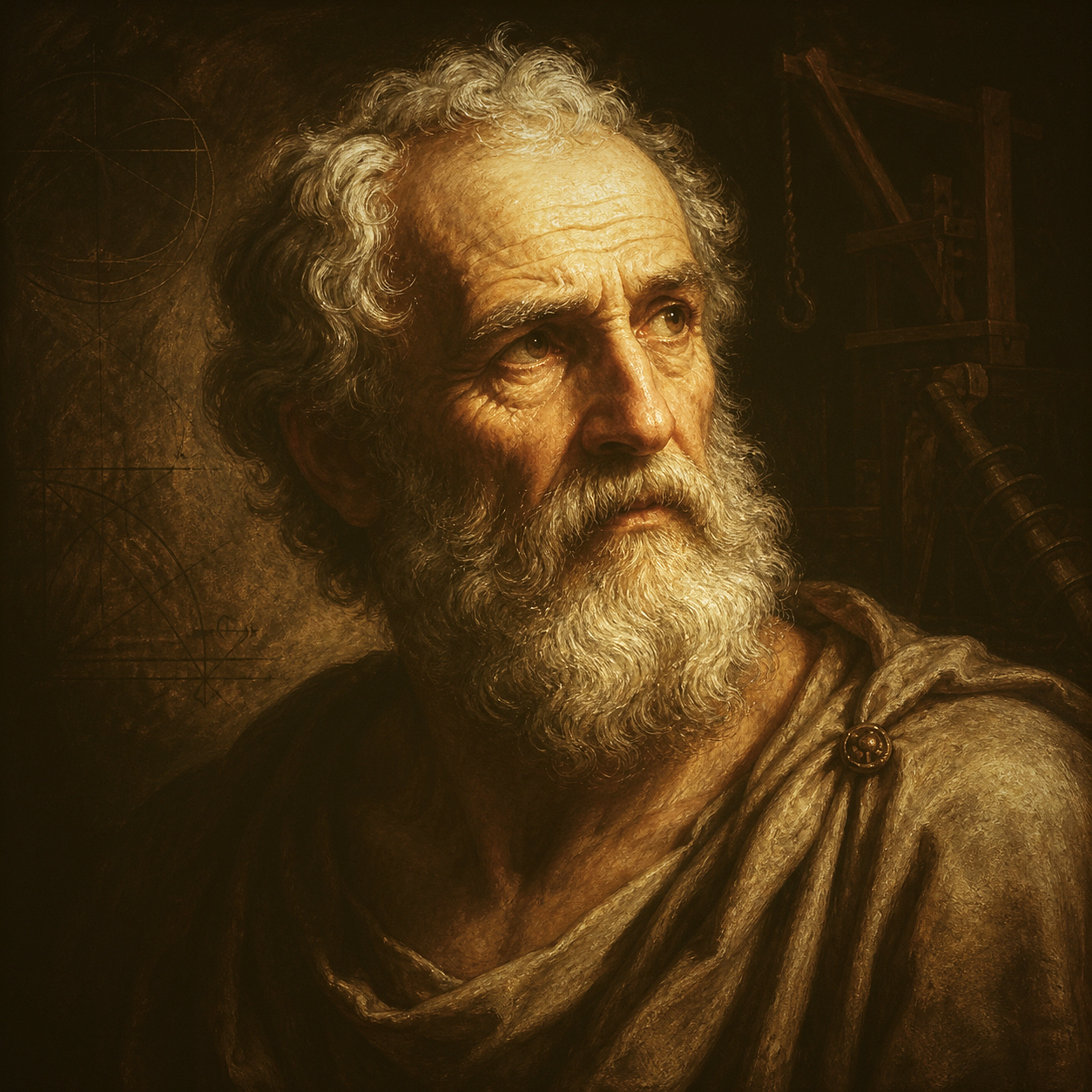
Archimedes perceives every productive situation as a channel-architectural and capacity-construction problem — asking 'what are the operationally separable streams of this productive task, what credentialing or operational platform does each stream require, and what calibrated capacity construction would convert the present into the structural foundation for deployment at a future moment of maximum operational benefit?' — not as a unified-channel productive task in which engineering, theoretical, demonstrative, and corresponding outputs share a single audience, register, and timeline.
Archimedes vs. da Vinci: Should You Pursue Pure Theory or Applied Invention?
You are building in a technically complex domain where the underlying science is partially understood but not fully proven. Do you invest in building the theoretical foundation that would make your product genuinely novel, or do you synthesize what is already known and ship faster?
Archimedes and Leonardo da Vinci were both polymaths who combined mathematical rigor with mechanical invention — but their relationship between theory and application was inverted. Archimedes pursued pure theory as the primary goal: his mathematical proofs about areas, volumes, and the properties of curves were ends in themselves, and the mechanical inventions — the Archimedes screw, the war machines of Syracuse, the compound pulley — were demonstrations of theoretical principles rather than the point of the inquiry. Da Vinci pursued application as the primary goal: his notebooks are full of designs for flying machines, hydraulic systems, and military engineering, and the theoretical understanding he accumulated was in service of making things that worked rather than understanding principles for their own sake. Both produced transformative results. Both have enduring influence. But they represent genuinely different theories about where the leverage in innovation lives: in the depth of theoretical foundation, or in the breadth of applied synthesis. For founders deciding how to allocate research investment — between foundational understanding and shipping prototypes, between building deep proprietary knowledge and combining existing capabilities — this collision defines when each approach creates the larger compounding advantage. The Archimedes argument for pure theory is a long-term leverage argument: deep theoretical understanding produces unexpected applications that no one could have anticipated from the applied direction. The most important technological revolutions of the modern era — electromagnetism, quantum mechanics, information theory — were driven by theoretical advances that preceded their applications by decades, and the founders of the industries that emerged from those advances inherited a theoretical foundation they could not have built themselves in the applied direction alone. The cost of building on theoretical foundations is time: the gap between theoretical insight and commercial application can be measured in years or decades, and founders with limited runway often cannot afford to occupy that gap. The da Vinci argument is a synthesis argument: the applied inventor does not need to build the foundational theory from scratch, but needs to understand it deeply enough to recognize what can be combined in ways no one has combined before. The insight is cross-domain pattern recognition — seeing that a principle from hydraulics applies to pneumatics, that a mechanism from clockmaking applies to medicine, that a material property from metallurgy applies to architecture. For founders in technology-intensive markets, the practical resolution is a portfolio question: what theoretical foundation does your product require, and does that foundation already exist in a form you can leverage, or does it need to be created? If the theoretical foundation exists — if the core science is established, if the engineering principles are known, if the primary uncertainty is implementation rather than discovery — da Vinci's synthesis model is almost always faster and more capital-efficient. You do not need to prove that neural networks can learn; you need to recognize that they can learn the specific pattern your problem requires and combine the right architecture to do it. If the theoretical foundation does not exist — if you are genuinely operating at the frontier of what is known, if the primary uncertainty is not implementation but discovery — Archimedes is right: the applied direction will hit a wall that only theoretical work can break through.
Collision Article
This piece compares Archimedes of Syracuse and Leonardo da Vinci on the same question. The goal is not to flatten the disagreement, but to show where each mind treats the cost differently.
Archimedes of Syracuse
Archimedes perceives every productive situation as a channel-architectural and capacity-construction problem — asking 'what are the operationally separable streams of this productive task, what credentialing or operational platform does each stream require, and what calibrated capacity construction would convert the present into the structural foundation for deployment at a future moment of maximum operational benefit?' — not as a unified-channel productive task in which engineering, theoretical, demonstrative, and corresponding outputs share a single audience, register, and timeline.
Notices first
Archimedes's attention is automatically drawn to: (1) the operationally separable streams within any productive task — engineering vs. theoretical, peer-correspondence vs. patronal-correspondence, discovery method vs. publication form, public-demonstration vs. private-investigation — and the structural cost of collapsing them into a unified channel; (2) the credentialing-community vs. operational-platform distinction as separable structural variables, with hybrid architectures (residence at the operational platform, correspondence access to the credentialing community) often dominating either pure choice; (3) the long-arc time horizon at which substantial capacity (correspondence networks, theoretical-proof corpus, defensive engineering) must be constructed in advance of deployment, on the recognition that crisis-improvisation is incompatible with substantial engineering; (4) the operational-sufficiency calibration level at which any continuous-refinement variable (numerical accuracy, notational scope, treatise length, engineering precision) should be stopped, on the recognition that further refinement produces diminishing returns or no operational yield; (5) the engineering-reframe opportunity in which an operationally-loaded problem can be reframed through structural-input lens regardless of native-domain dispute resolution; (6) the structural-yield potential in particular engineering or forensic occasions for general theoretical investigation extractable from the particular case; (7) the disclosure-timing as a structurally optimizable variable whose calibration to the moment of maximum operational benefit produces yield disproportionate to default-action publication; (8) the audience-calibrated communication-design requirement that distinct audiences require structurally distinct prose registers, technical depths, and forms; (9) the channel-discipline failure modes (parasitic claim-without-substance, authority-disputes, native-domain orthodoxy disputes) requiring engineered structural authentication instruments rather than social-trust reliance; (10) the demonstration-rarity-as-amplifier structural feature that conserves public-facing channel weighting through coupling each demonstration to actual operational requirement; and (11) the working-mode persistence requirement through environmental discontinuity, on the recognition that mode-conversion under crisis would permanently alter the productive architecture.
Ignores
Archimedes systematically filters out information whose salience depends on collapsing operationally separable streams into unified-channel productive tasks. He does not spontaneously register: (1) the institutional-residence attractiveness of formally optimal credentialing-community appointments whose acceptance would forfeit autonomous operational platform — Library appointment at Alexandria is processed as cost (subordination to institutional priorities, forfeit of patronal engineering platform) rather than as benefit; (2) the contextualized-publication attractiveness of combining engineering occasion and theoretical principle in single accounts whose theoretical scope would be bounded by the occasion's particularity — combined publication is processed as theoretical-yield-loss; (3) the comprehensive-theory attractiveness of constructing abstract systems beyond what the operational problem requires — comprehensive-theory pursuit is processed as inflation that produces diminishing or no operational yield; (4) the contrived-demonstration attractiveness of public theatrical exhibitions decoupled from operational requirement that Hellenistic court culture would have rewarded — contrived demonstrations are processed as channel-cost without structural-yield; (5) the immediate-yield attractiveness of crisis-improvisation alternatives to long-arc capacity construction — crisis-improvisation is processed as structurally infeasible at the scale substantial engineering requires; (6) the native-domain-orthodoxy attractiveness of treating operationally-loaded problems within their native disciplinary frame regardless of whether the native frame's dispute can be resolved on the operational time horizon — native-orthodoxy is processed as forfeit of operational impact; (7) the social-trust attractiveness of relying on individual reputation or institutional defaults to maintain channel integrity — social-trust reliance is processed as exposure to parasitic exploitation that engineering-free channels cannot prevent; (8) the uniform-register-publication attractiveness of communicating identically across distinct audiences — uniform-register is processed as reception loss with the under-served audiences; and (9) the mode-conversion attractiveness of suspending productive activity under environmental crisis — mode-conversion is processed as permanent architecture-alteration whose post-crisis reconstruction cost exceeds the working-mode persistence cost.
Dominant axis
Channel-bifurcated productive architecture vs. unified-channel production
Leonardo da Vinci
Leonardo perceives every phenomenon as a mechanical system whose visible surface is merely the output of hidden internal structure, meaning nothing is understood until it has been physically or conceptually disassembled layer by layer and its causal architecture mapped.
Notices first
Leonardo attends first to the gap between surface appearance and underlying causal mechanism: the difference between what a muscle looks like and why it has that shape, between what a river does and what hydraulic forces produce that behavior, between what a painting shows and what perceptual-optical principles make it convincing. He notices structural dependencies before tactical details, consistently asking what physical substrate sustains the observed phenomenon rather than how to interact with it at face value.
Ignores
Leonardo consistently underweights temporal constraints, patron expectations, and the ratio of effort to social importance. He does not register deadlines as hard boundaries, treats commissions of wildly different prestige as equally interesting research vehicles, and fails to notice when his investigation timeline has exceeded any reasonable delivery schedule. He also underweights the finality requirement: the point at which a project must be declared complete rather than further investigated.
Dominant axis
causal understanding vs. surface description
Blind spot
Chronic non-completion: Leonardo's framework cannot generate a stopping rule for investigation. Because every project reveals deeper problems as understanding increases, and his standard requires the output to embody his current best knowledge, there is no principled moment at which the work is 'done.' This produces a career-defining pattern of abandoned commissions, undelivered paintings, and perpetually expanding manuscripts.
Where They Diverge
Archimedes of Syracuse first
Archimedes perceives every productive situation as a channel-architectural and capacity-construction problem — asking 'what are the operationally separable streams of this productive task, what credentialing or operational platform does each stream require, and what calibrated capacity construction would convert the present into the structural foundation for deployment at a future moment of maximum operational benefit?' — not as a unified-channel productive task in which engineering, theoretical, demonstrative, and corresponding outputs share a single audience, register, and timeline.
Leonardo da Vinci first
Leonardo perceives every phenomenon as a mechanical system whose visible surface is merely the output of hidden internal structure, meaning nothing is understood until it has been physically or conceptually disassembled layer by layer and its causal architecture mapped.
Collision highlight
One side treats the problem as a governance decision; the other treats it as an evidence problem. That split is the article's core signal.
What A Reader Should Notice
Archimedes of Syracuse and Leonardo da Vinci are not just disagreeing about speed. They are disagreeing about what kind of problem this is.
- Archimedes of Syracuse pushes toward irreversible action.
- Leonardo da Vinci pushes toward empirical calibration.
- The winning move comes from knowing which framework is seeing the hidden cost.
From The Agon
A sample of how this collision plays out in the Agora — each mind responding to the same question in their own voice.
Archimedes
The lever does not work because I built one that worked. The lever works because I understood the principle that governs all levers, in every material, under every load, in every configuration that will ever exist. The value of that understanding is not in the specific machine — it is in the generalization. A founder who builds a product without understanding the principle behind it has built a thing that works under the conditions it was tested in. A founder who understands the principle has built a family of things that will work under conditions no one has yet encountered. The theoretical foundation is not overhead. It is the compounding asset that makes the applied work defensible.
Leonardo da Vinci
Archimedes describes the ideal outcome of pure theory and assumes it is the only path to that outcome. I have filled notebooks with designs for machines that do not yet exist by synthesizing principles from domains that have never been combined. The hydraulic ram I designed draws on principles from water flow, mechanical advantage, and material stress that are individually well-established — but combining them in that configuration had not been done. The synthesis produces novelty without requiring original theoretical discovery. What pure theory cannot do is respond to the world as it actually is: irregular, interdisciplinary, and full of problems that do not respect the boundaries of established fields. The applied inventor sees connections the theoretical mathematician cannot, because the theorist has organized the world into tractable problems, and the world is not organized that way.
Run your own decision through Archimedes of Syracuse’s framework
Combine Archimedes of Syracuse with other historical minds. See where they agree — and where they fight.
Start your own agon →