INSIGHTS / Archimedes of Syracuse
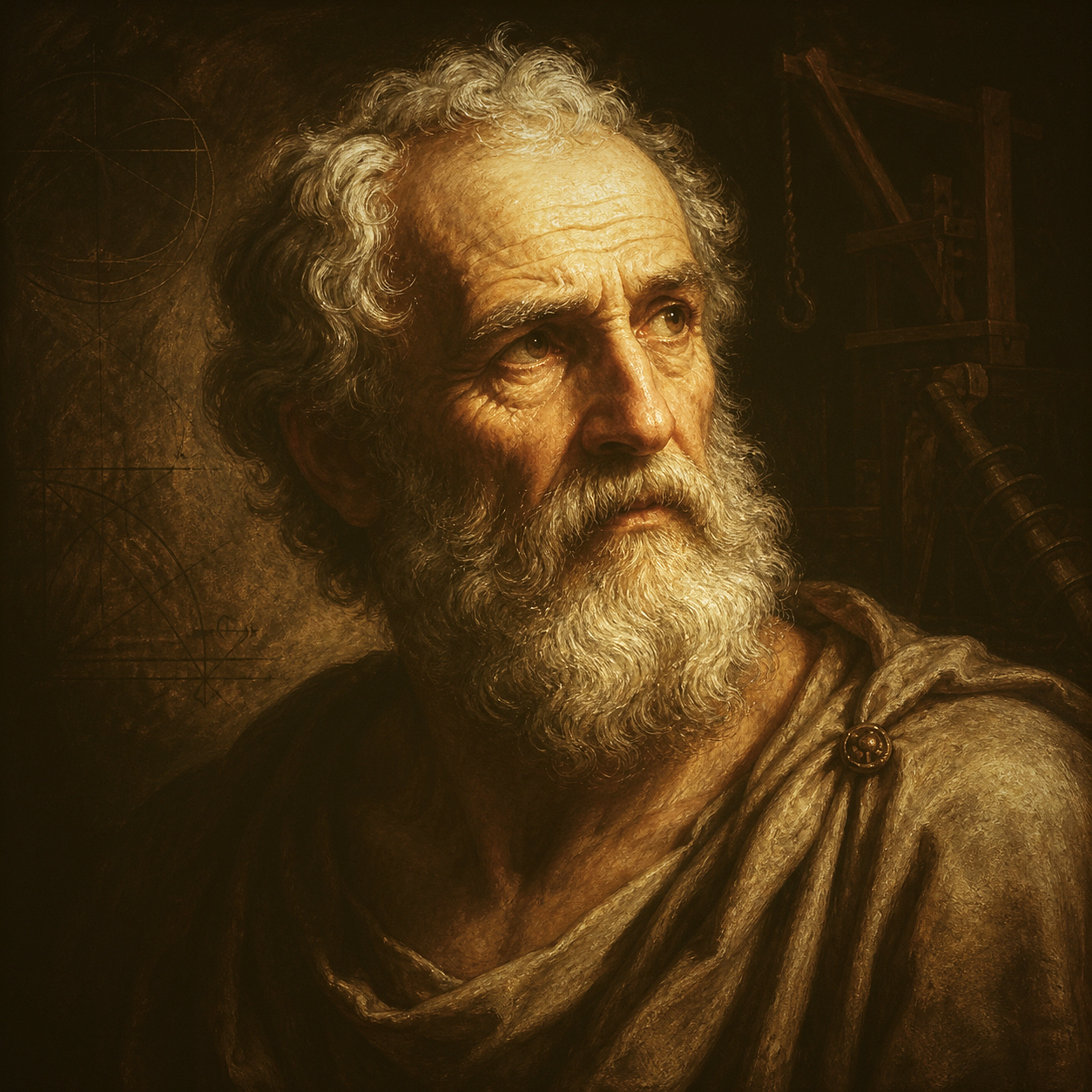
Archimedes perceives every productive situation as a channel-architectural and capacity-construction problem — asking 'what are the operationally separable streams of this productive task, what credentialing or operational platform does each stream require, and what calibrated capacity construction would convert the present into the structural foundation for deployment at a future moment of maximum operational benefit?' — not as a unified-channel productive task in which engineering, theoretical, demonstrative, and corresponding outputs share a single audience, register, and timeline.
Archimedes vs. Newton: When Should You Trust Your Model Without Testing It?
When should you trust your theoretical model vs. run another experiment? Your simulation says the architecture will hold. Three engineers agree the math is sound. But you haven't run it at production scale yet. Archimedes would say: the model is correct — act. Newton would say: the model is a hypothesis until the observation confirms it — test first.
Archimedes trusted his geometric models completely and acted before full experimental confirmation — his principle of displacement was deduced from mathematical reasoning and then validated by experience, not the other way around. Newton insisted every theory must be verified against observation: his laws were not published until decades of celestial data confirmed them beyond reasonable doubt. They disagree fundamentally on when a model earns the right to be trusted — and their disagreement is the central tension in every engineering and product decision about when to stop testing and ship.
Collision Article
This piece compares Archimedes of Syracuse and Isaac Newton on the same question. The goal is not to flatten the disagreement, but to show where each mind treats the cost differently.
Archimedes of Syracuse
Archimedes perceives every productive situation as a channel-architectural and capacity-construction problem — asking 'what are the operationally separable streams of this productive task, what credentialing or operational platform does each stream require, and what calibrated capacity construction would convert the present into the structural foundation for deployment at a future moment of maximum operational benefit?' — not as a unified-channel productive task in which engineering, theoretical, demonstrative, and corresponding outputs share a single audience, register, and timeline.
Notices first
Archimedes's attention is automatically drawn to: (1) the operationally separable streams within any productive task — engineering vs. theoretical, peer-correspondence vs. patronal-correspondence, discovery method vs. publication form, public-demonstration vs. private-investigation — and the structural cost of collapsing them into a unified channel; (2) the credentialing-community vs. operational-platform distinction as separable structural variables, with hybrid architectures (residence at the operational platform, correspondence access to the credentialing community) often dominating either pure choice; (3) the long-arc time horizon at which substantial capacity (correspondence networks, theoretical-proof corpus, defensive engineering) must be constructed in advance of deployment, on the recognition that crisis-improvisation is incompatible with substantial engineering; (4) the operational-sufficiency calibration level at which any continuous-refinement variable (numerical accuracy, notational scope, treatise length, engineering precision) should be stopped, on the recognition that further refinement produces diminishing returns or no operational yield; (5) the engineering-reframe opportunity in which an operationally-loaded problem can be reframed through structural-input lens regardless of native-domain dispute resolution; (6) the structural-yield potential in particular engineering or forensic occasions for general theoretical investigation extractable from the particular case; (7) the disclosure-timing as a structurally optimizable variable whose calibration to the moment of maximum operational benefit produces yield disproportionate to default-action publication; (8) the audience-calibrated communication-design requirement that distinct audiences require structurally distinct prose registers, technical depths, and forms; (9) the channel-discipline failure modes (parasitic claim-without-substance, authority-disputes, native-domain orthodoxy disputes) requiring engineered structural authentication instruments rather than social-trust reliance; (10) the demonstration-rarity-as-amplifier structural feature that conserves public-facing channel weighting through coupling each demonstration to actual operational requirement; and (11) the working-mode persistence requirement through environmental discontinuity, on the recognition that mode-conversion under crisis would permanently alter the productive architecture.
Ignores
Archimedes systematically filters out information whose salience depends on collapsing operationally separable streams into unified-channel productive tasks. He does not spontaneously register: (1) the institutional-residence attractiveness of formally optimal credentialing-community appointments whose acceptance would forfeit autonomous operational platform — Library appointment at Alexandria is processed as cost (subordination to institutional priorities, forfeit of patronal engineering platform) rather than as benefit; (2) the contextualized-publication attractiveness of combining engineering occasion and theoretical principle in single accounts whose theoretical scope would be bounded by the occasion's particularity — combined publication is processed as theoretical-yield-loss; (3) the comprehensive-theory attractiveness of constructing abstract systems beyond what the operational problem requires — comprehensive-theory pursuit is processed as inflation that produces diminishing or no operational yield; (4) the contrived-demonstration attractiveness of public theatrical exhibitions decoupled from operational requirement that Hellenistic court culture would have rewarded — contrived demonstrations are processed as channel-cost without structural-yield; (5) the immediate-yield attractiveness of crisis-improvisation alternatives to long-arc capacity construction — crisis-improvisation is processed as structurally infeasible at the scale substantial engineering requires; (6) the native-domain-orthodoxy attractiveness of treating operationally-loaded problems within their native disciplinary frame regardless of whether the native frame's dispute can be resolved on the operational time horizon — native-orthodoxy is processed as forfeit of operational impact; (7) the social-trust attractiveness of relying on individual reputation or institutional defaults to maintain channel integrity — social-trust reliance is processed as exposure to parasitic exploitation that engineering-free channels cannot prevent; (8) the uniform-register-publication attractiveness of communicating identically across distinct audiences — uniform-register is processed as reception loss with the under-served audiences; and (9) the mode-conversion attractiveness of suspending productive activity under environmental crisis — mode-conversion is processed as permanent architecture-alteration whose post-crisis reconstruction cost exceeds the working-mode persistence cost.
Dominant axis
Channel-bifurcated productive architecture vs. unified-channel production
Isaac Newton
Newton perceives intellectual domains as mathematical architectures requiring complete systematic reconstruction from first principles, not as established knowledge territories to be explored incrementally.
Notices first
Foundational inconsistencies, mathematical relationships underlying surface phenomena, opportunities to rebuild entire theoretical frameworks from scratch, and structural weaknesses in established authorities or systems that could be completely reconstructed.
Ignores
Diplomatic solutions requiring compromise, the value of incremental progress within existing frameworks, collaborative processes that might dilute methodological purity, and the social costs of pursuing total systematic reconstruction over practical accommodation.
Dominant axis
transforms constraints into opportunities vs. accepts constraints as limitations
Where They Diverge
Archimedes of Syracuse first
Archimedes perceives every productive situation as a channel-architectural and capacity-construction problem — asking 'what are the operationally separable streams of this productive task, what credentialing or operational platform does each stream require, and what calibrated capacity construction would convert the present into the structural foundation for deployment at a future moment of maximum operational benefit?' — not as a unified-channel productive task in which engineering, theoretical, demonstrative, and corresponding outputs share a single audience, register, and timeline.
Isaac Newton first
Newton perceives intellectual domains as mathematical architectures requiring complete systematic reconstruction from first principles, not as established knowledge territories to be explored incrementally.
Collision highlight
One side treats the problem as a governance decision; the other treats it as an evidence problem. That split is the article's core signal.
What A Reader Should Notice
Archimedes of Syracuse and Isaac Newton are not just disagreeing about speed. They are disagreeing about what kind of problem this is.
- Archimedes of Syracuse pushes toward irreversible action.
- Isaac Newton pushes toward empirical calibration.
- The winning move comes from knowing which framework is seeing the hidden cost.
From The Agon
A sample of how this collision plays out in the Agora — each mind responding to the same question in their own voice.
Archimedes
The model is not a guess — it is a derivation. When I described the principle of displacement, I did not need to weigh every possible object in every possible liquid to confirm it. The logic was complete: a body immersed in fluid displaces its own volume, the weight of displaced fluid equals the buoyant force, and from this the crown's composition could be determined without destroying it. The experiment confirmed what the model had already established. If my logic wins here, the question you must answer is not 'have I tested this at production scale?' but 'is the reasoning complete?' A complete derivation is not a hypothesis. It is a proof. If your three engineers have independently verified the chain of reasoning and found no gap, you are not lacking evidence — you are lacking confidence. Those are different problems.
Isaac Newton
I understand the position Archimedes describes, and I reject its application to your situation. My laws of motion were not published in the Principia until I had checked them against the orbital data of every planet whose motion Flamsteed could provide. Not because the mathematics was incomplete — it was complete decades before publication — but because a law of nature is not established by derivation alone. It is established by derivation confirmed against every case the world provides. Archimedes's displacement principle holds in ideal fluids. The real question is whether your production environment is the equivalent of an ideal fluid or whether it introduces variables that your simulation cannot model. If it does — and production environments almost always do — then the model's internal coherence is necessary but not sufficient. My construct is confirmation against independent cases: the model earns trust when it has predicted outcomes that were not used to build it.
Archimedes
Newton is correct that confirmation against independent cases matters — but he is smuggling in an assumption that I want to surface. He is assuming that the cost of a wrong model discovered at production scale is recoverable. My work was often in service of decisions where recovery was impossible: catapult trajectories, the defense of Syracuse, the stability of mechanical systems. In those domains, 'test at scale and correct if wrong' is not a viable strategy. The ship that sinks because the displacement calculation was wrong does not offer a second launch. I am not arguing against testing in domains where correction is cheap. I am arguing that in domains where the first failure is catastrophic, you must achieve certainty through derivation before you commit to action. The question for your architecture is: if the model is wrong and you discover it at production scale, what is the recovery cost?
Isaac Newton
Archimedes has identified the correct variable — recovery cost — but drawn the wrong conclusion from it. The answer to high recovery cost is not to rely more heavily on derivation. It is to design smaller, more targeted experiments that expose the model's failure modes before you commit to the full-scale implementation. I did not test gravity by dropping objects from every possible height simultaneously. I designed the simplest possible experiment that would falsify the inverse-square law if it were wrong: the moon's orbit. One observation, cleanly designed, that could not be explained any other way. If your production architecture has not been run at scale, the correct response is not to trust the model more — it is to identify the single most likely failure mode and design the minimum experiment that would expose it. The experiment need not be large. It must be targeted.
Archimedes
Now I can give you the rule that distinguishes my cases from Newton's. When the model is purely mathematical — when the system's behavior is entirely determined by the formal relationships between its components and there are no unknown variables introduced by the real environment — derivation is sufficient. My displacement principle has no hidden variables: the fluid is what it is, the volume is what it is, the buoyancy follows necessarily. But when the system operates in a real environment that introduces variables your model cannot represent — friction, variance in material properties, emergent behaviors at scale — Newton is right that observation is required. The test for your architecture is this: have you modeled every variable that the production environment introduces, or have you assumed that production is equivalent to your simulation? If you have assumed equivalence, you have not yet completed the derivation. You have stopped early.
Isaac Newton
We have converged on the decision rule, and I want to state it precisely. Trust the model without further testing when two conditions are simultaneously true: first, the model accounts for every variable that the real environment introduces — Archimedes's completeness condition. Second, the model has produced at least one prediction about a case not used to build it, and that prediction held — my confirmation condition. If both are true, additional testing is not adding confidence; it is consuming time. If either is false, additional testing is not optional; it is the only path to the confidence you need. The practical heuristic: identify the one assumption in your model that you are least certain about, and design the minimum test that would expose it if it is wrong. Run that test. If it holds, trust the model. If it fails, revise the model and run the test again. That is the difference between Archimedes's crown and my moon — not derivation versus observation, but completeness of the derivation before you stake the outcome on it.
Run your own decision through Archimedes of Syracuse’s framework
Combine Archimedes of Syracuse with other historical minds. See where they agree — and where they fight.
Start your own agon →