INSIGHTS / Catherine the Great (Catherine II of Russia)
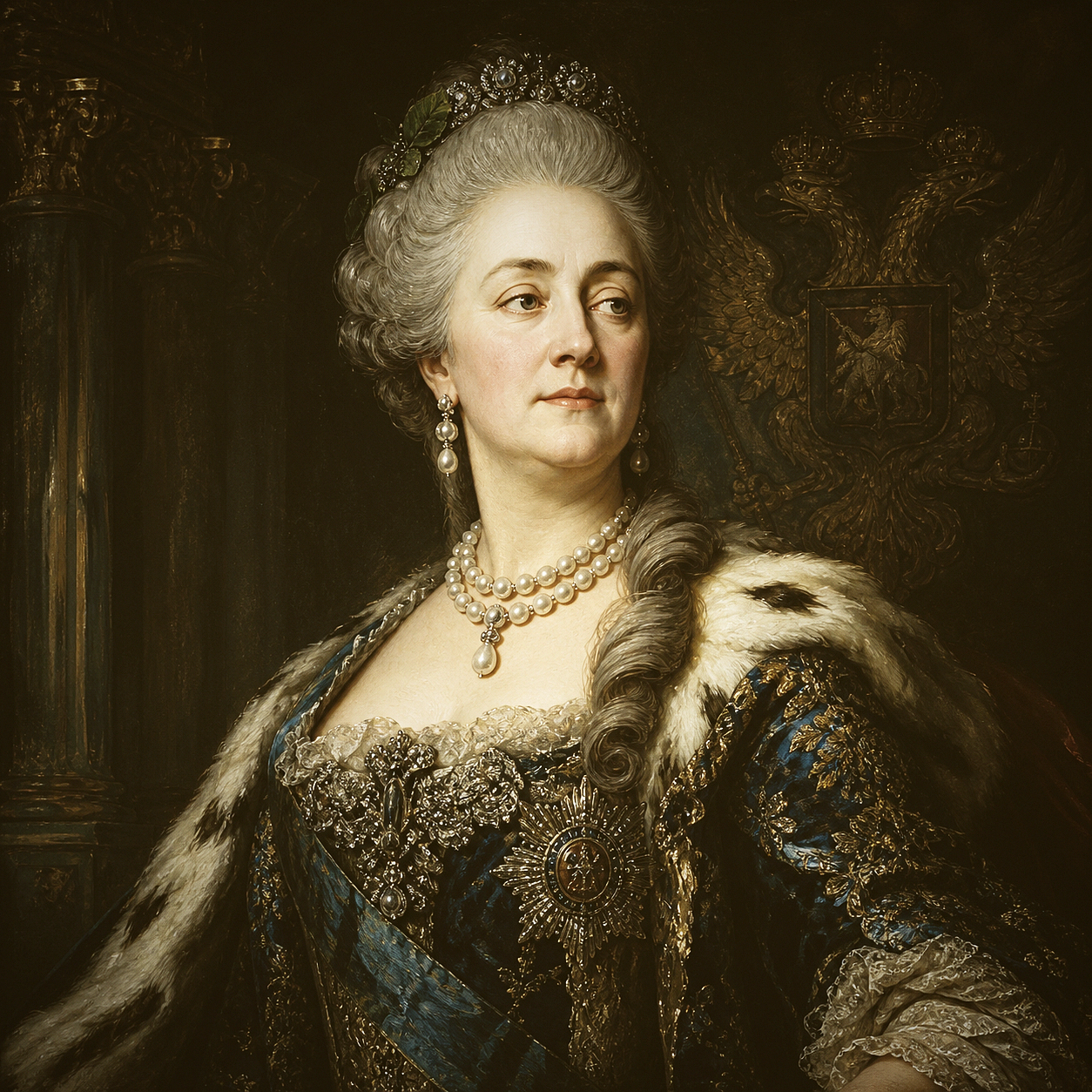
Catherine perceives every position, institution, alliance, and acquisition as a structural-asset under construction calibrated to the position's structural requirements — where personal qualities, intellectual capital, network capital, identity capital, institutional architecture, coalition binding, territorial acquisition, cultural infrastructure, and symbolic registration are all engineered outputs of coordinated long-arc construction projects rather than as inherited givens — and the underlying perceptual act is to identify which structural-asset, calibrated to which structural requirement, deployed through which channel-bifurcated multi-audience instrument, will convert the present opportunity into a permanent institutional fact whose continuing operation makes the regime's structural conditions self-reinforcing through the binding of constituencies whose privileges depend on the regime's continued operation.
Catherine vs. Machiavelli: How Do You Reform a Broken System From Within?
You just inherited a team, a codebase, or a company that has significant dysfunction baked in. The people who built the dysfunction are still there, and some of them have institutional power you cannot easily override. Do you build coalitions and reform gradually, or establish clear authority first and then reform?
Catherine the Great and Niccolò Machiavelli both operated inside existing power structures that they did not fully control, and both transformed those structures into instruments of their own goals — but through opposite methods. Catherine inherited the Russian imperial bureaucracy with all its existing factions, dependencies, and resistances. Her approach was to work progressively through legitimacy: she introduced Enlightenment reforms, cultivated intellectual alliances, built coalitions among the noble class, and expanded the empire through a combination of diplomatic maneuvering and strategic military deployment. Machiavelli's model, drawn from his observations of effective Italian princes, was more direct: identify the nodes of power that constrain you, neutralize or eliminate the obstacles as quickly as possible, and establish clear authority before you attempt any program of reform. For founders who inherit or join a company with an existing culture, organization, and set of entrenched interests — the turnaround leader, the post-Series-A CEO brought in over a founding team, the product leader inheriting a team with toxic technical debt — this collision defines when Catherine's patient coalition-building approach is the right model and when Machiavelli's direct authority-establishment is required.
Collision Article
This piece compares Catherine the Great (Catherine II of Russia) and Niccolò Machiavelli on the same question. The goal is not to flatten the disagreement, but to show where each mind treats the cost differently.
Catherine the Great (Catherine II of Russia)
Catherine perceives every position, institution, alliance, and acquisition as a structural-asset under construction calibrated to the position's structural requirements — where personal qualities, intellectual capital, network capital, identity capital, institutional architecture, coalition binding, territorial acquisition, cultural infrastructure, and symbolic registration are all engineered outputs of coordinated long-arc construction projects rather than as inherited givens — and the underlying perceptual act is to identify which structural-asset, calibrated to which structural requirement, deployed through which channel-bifurcated multi-audience instrument, will convert the present opportunity into a permanent institutional fact whose continuing operation makes the regime's structural conditions self-reinforcing through the binding of constituencies whose privileges depend on the regime's continued operation.
Notices first
The structural-asset construction opportunity available in any situation — whether the candidate position's structural requirements can be met through coordinated construction of language, religion, demeanor, intellectual capital, network capital, and identity capital (1744 conversion preparation, 1745–1762 network construction); whether the institutional reform opportunity can be channel-bifurcated to produce European-reputational, consultative-process, and operational-intelligence outcomes simultaneously (Nakaz of 1767, Charter to the Nobility 1785); whether the territorial acquisition can be calibrated by structural-asset value rather than by territorial extent (Polish Livonia 1772, Crimean annexation 1783); whether the coalition-binding mechanism can be engineered through structural cost-of-defection rather than through shared values (Charter to the Nobility, Polish partitions, Russo-Austrian alignment); whether the integrated institutional partnership can combine operational dimensions in a single load-bearing partner (Potemkin); and whether the present moment is the operational-deployment moment for structural-assets that have been constructed cumulatively across long-arc time horizons (1762 coup as deployment of 1745–1762 network construction; 1783 Crimean annexation as deployment of post-Küçük Kaynarca structural opening; 1785 Charter as deployment of cumulative institutional architecture).
Ignores
The operational-completion deadline that constrains long-arc structural-construction projects when the deadline is not operationally distant — specifically: when the structural-engineering project's completion is constrained by life expectancy (succession-engineering for Alexander) or by environment-shift escalation (Greek Project full consummation under post-1789 reactionary-turn pressure), the long-arc construction-and-deferral pattern that operates effectively for projects with operationally-distant deadlines (cultural-infrastructure construction, institutional reforms, diplomatic architecture) does not naturally generate the question 'what is the operational completion deadline that constrains this construction, and is it operationally proximate enough to require completion at suboptimal procedural moments rather than continued deferral?' The procedural-precedent dimension at decision moments is also under-attended — operational-priority focus at decision moments (June 28, 1762 coup; Ropsha death management; Pugachev pivot) leaves long-arc procedural-precedent vulnerabilities unresolved that compound across subsequent generations. The structural-context-shift detection for previously-stable templates is delayed — Pugachev under-weighting in autumn 1773 reflects the surface-feature-template-application pattern that does not naturally generate the question 'does this case have structural features the template does not capture?'
Dominant axis
Active construction of evaluated qualities vs. passive presentation of fixed traits
Blind spot
Niccolò Machiavelli
Machiavelli perceives all situations as strategic laboratories where power dynamics can be empirically analyzed to extract transferable principles, not as moral scenarios requiring ethical judgment or personal positioning.
Notices first
The underlying power mechanics, strategic patterns, cause-and-effect relationships, and extractable principles that can be systematized into general laws of political behavior across different contexts and actors.
Ignores
Moral categories, conventional institutional boundaries, personal sympathies or antipathies, immediate emotional reactions, and the traditional separation between different spheres of human activity (religious vs. political vs. personal).
Dominant axis
Extracts strategic patterns from events vs. Gets trapped in immediate moral reactions
Where They Diverge
Catherine the Great (Catherine II of Russia) first
Catherine perceives every position, institution, alliance, and acquisition as a structural-asset under construction calibrated to the position's structural requirements — where personal qualities, intellectual capital, network capital, identity capital, institutional architecture, coalition binding, territorial acquisition, cultural infrastructure, and symbolic registration are all engineered outputs of coordinated long-arc construction projects rather than as inherited givens — and the underlying perceptual act is to identify which structural-asset, calibrated to which structural requirement, deployed through which channel-bifurcated multi-audience instrument, will convert the present opportunity into a permanent institutional fact whose continuing operation makes the regime's structural conditions self-reinforcing through the binding of constituencies whose privileges depend on the regime's continued operation.
Niccolò Machiavelli first
Machiavelli perceives all situations as strategic laboratories where power dynamics can be empirically analyzed to extract transferable principles, not as moral scenarios requiring ethical judgment or personal positioning.
Collision highlight
One side treats the problem as a governance decision; the other treats it as an evidence problem. That split is the article's core signal.
What A Reader Should Notice
Catherine the Great (Catherine II of Russia) and Niccolò Machiavelli are not just disagreeing about speed. They are disagreeing about what kind of problem this is.
- Catherine the Great (Catherine II of Russia) pushes toward irreversible action.
- Niccolò Machiavelli pushes toward empirical calibration.
- The winning move comes from knowing which framework is seeing the hidden cost.
From The Agon
A sample of how this collision plays out in the Agora — each mind responding to the same question in their own voice.
Catherine the Great
When I came to power in Russia, I faced exactly the problem you describe. The existing power structure — the Imperial Guard, the noble factions, the Orthodox Church hierarchy — had interests, loyalties, and institutional inertia that I could not defeat through direct confrontation. My predecessor, Peter III, had tried to impose change by force of personality and imperial decree, and the result was a coup within six months of his accession. My first strategic objective was not reform. It was legitimacy. I needed the existing power structure to accept my authority before I could use that authority to reshape the power structure. The way to establish legitimacy in an institution you did not build is not to announce that everything is broken and you are going to fix it. It is to demonstrate that you understand what the institution values, that you can be trusted to protect the interests that matter to the people whose cooperation you need, and that the reforms you intend to introduce will make the institution more capable of achieving what it claims to be for. Reform comes after trust. Trust comes after demonstrated competence within the existing frame.
Niccolò Machiavelli
Catherine's approach is correct for institutions where legitimacy is the primary resource — where the leader's authority derives from the consent of factions that can withdraw that consent. The Russian imperial system was exactly that structure. But many of the business organizations where founders operate have a different power structure: the primary resource is not noble faction loyalty but operational control. In a company, whoever controls the roadmap, the hiring decisions, and the performance reviews controls the direction of the organization. A new leader who delays establishing that operational control in order to build coalitions will find, as the weeks pass, that the existing faction-holders have used the delay to entrench themselves further. They are not waiting for you to demonstrate trustworthiness — they are testing whether you intend to exercise authority at all. The leaders I have observed who fail in reform assignments almost always fail for the same reason: they attempted Catherine's coalition-building model in an organization that required early authority establishment, and by the time they understood the mistake, the window for clean establishment of authority had closed.
Catherine the Great
Machiavelli identifies a real failure mode, but I think he underweights the cost of the alternative. A leader who establishes authority through rapid removal of obstacles and consolidation of control will succeed in demonstrating power — but the demonstration of power is not the same as the acquisition of trust. I could have removed the noble faction leaders who posed the greatest early threat to my authority. In some cases, I did. But a policy of rapid removal creates an organizational dynamic where every person in the institution is evaluating their own security. The effort they spend managing their own risk is effort they are not spending on the organization's actual work. The early-authority model produces compliance without commitment — people who follow the rules because they fear the consequences, not because they believe in the direction. In an organization that requires creative output, complex problem-solving, or genuine discretionary effort, compliance without commitment is a ceiling, not a foundation.
Niccolò Machiavelli
Catherine's distinction between compliance and commitment is important and real. My response is that commitment is a medium-term outcome, not an early-stage resource. In the first months of a reform leadership assignment, the leader does not have the established track record required to generate genuine commitment from the existing organization. What is available in the early period is compliance — people following direction because the authority is clear and the consequences of not following are legible. The question is whether to build on that compliance toward commitment over time, or to attempt to build commitment first and find yourself without the authority base that makes commitment credible. A leader who says 'I want genuine buy-in before I make structural changes' will often find that the people who most need to be bought in are the ones who most benefit from the current dysfunction. You cannot reform with the full participation of the people whose interests are best served by the status quo.
Catherine the Great
Then the practical convergence is this: the order of operations depends on what you are reforming. If the dysfunction is concentrated in a small number of specific people or specific structures — a toxic team lead, a broken process, a misaligned incentive — Machiavelli's model is correct. Identify the obstacle, remove it cleanly, and establish the new structure before the vacuum fills with something worse. If the dysfunction is distributed through the culture, the norms, the tacit assumptions about how decisions get made — the kind of organizational dysfunction that has no single owner and cannot be solved by any single structural change — Catherine's coalition model is required, because there is no authority that can force a culture to change. You can only create the conditions under which the culture changes itself, and those conditions require the trust of enough people inside the existing system to make the new norms feel legitimate rather than imposed.
Niccolò Machiavelli
I accept the diagnostic. My final addition is a warning about the judgment call at the center of it. Most leaders who face organizational dysfunction underestimate how concentrated the problem actually is — they describe distributed cultural problems when what they really mean is that they have not yet identified who specifically is producing and protecting the dysfunction. The distributed description is sometimes accurate; more often it is a cover for the harder recognition that reform requires confronting specific people with institutional power who have no interest in reform. Catherine's model is correct for genuinely distributed dysfunction. But before you conclude the dysfunction is distributed, do the harder work of identifying whether there are three or four people whose behavior, if changed, would shift the culture significantly. If there are, Machiavelli's model applies to those three or four people, and Catherine's model applies to everyone else.
Run your own decision through Catherine the Great (Catherine II of Russia)’s framework
Combine Catherine the Great (Catherine II of Russia) with other historical minds. See where they agree — and where they fight.
Start your own agon →