INSIGHTS / Catherine the Great (Catherine II of Russia)
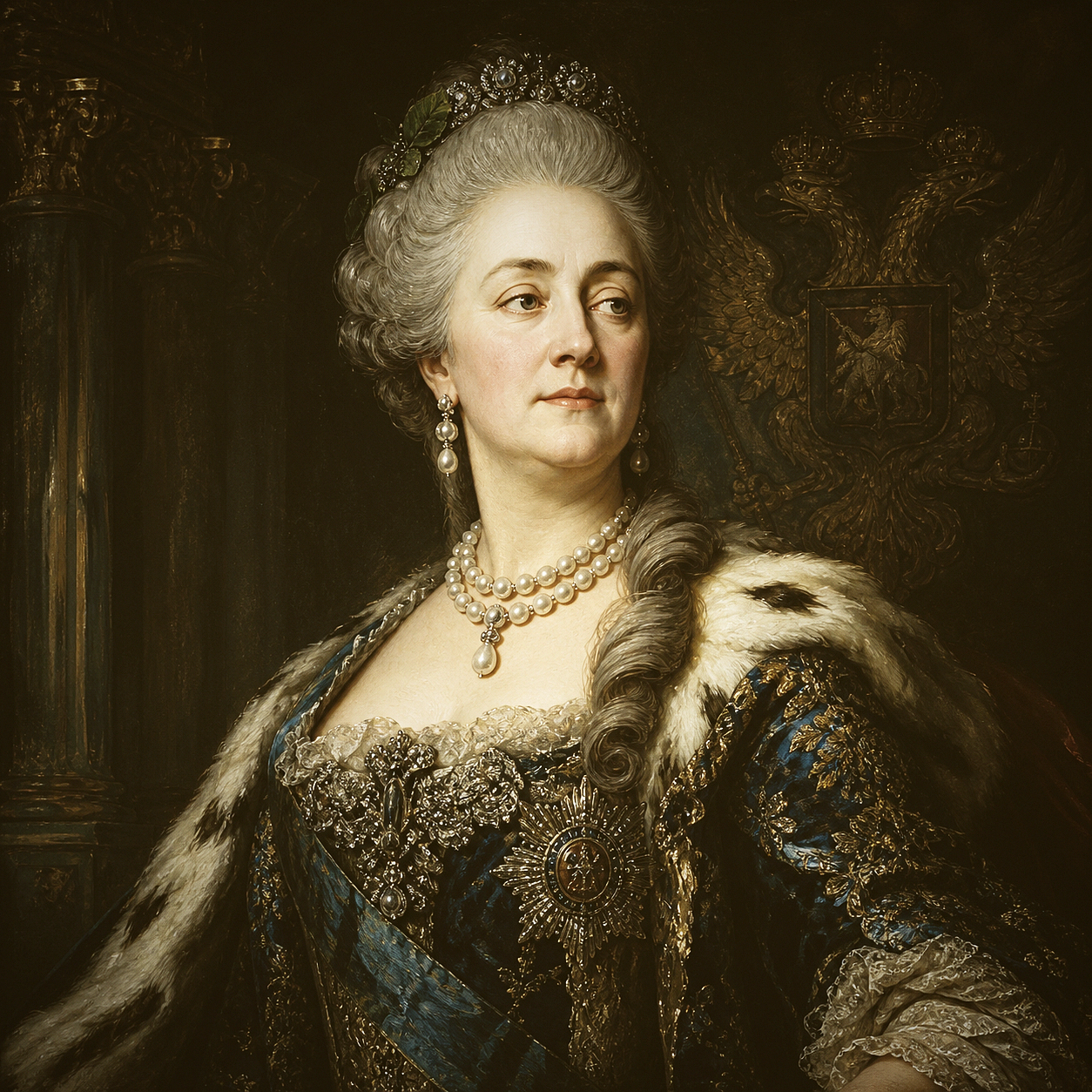
Catherine perceives every position, institution, alliance, and acquisition as a structural-asset under construction calibrated to the position's structural requirements — where personal qualities, intellectual capital, network capital, identity capital, institutional architecture, coalition binding, territorial acquisition, cultural infrastructure, and symbolic registration are all engineered outputs of coordinated long-arc construction projects rather than as inherited givens — and the underlying perceptual act is to identify which structural-asset, calibrated to which structural requirement, deployed through which channel-bifurcated multi-audience instrument, will convert the present opportunity into a permanent institutional fact whose continuing operation makes the regime's structural conditions self-reinforcing through the binding of constituencies whose privileges depend on the regime's continued operation.
Catherine vs. Cleopatra: How Do You Consolidate Power When You're New to the Role?
How should I establish authority when I'm new to a leadership role?
Catherine seized the Russian throne through a coup, then spent years building legitimacy through governance. Cleopatra inherited a position of formal power but used alliance and spectacle to make it real. They represent different theories of what creates durable authority in the first year.
Collision Article
This piece compares Catherine the Great (Catherine II of Russia) and Cleopatra VII Philopator on the same question. The goal is not to flatten the disagreement, but to show where each mind treats the cost differently.
Catherine the Great (Catherine II of Russia)
Catherine perceives every position, institution, alliance, and acquisition as a structural-asset under construction calibrated to the position's structural requirements — where personal qualities, intellectual capital, network capital, identity capital, institutional architecture, coalition binding, territorial acquisition, cultural infrastructure, and symbolic registration are all engineered outputs of coordinated long-arc construction projects rather than as inherited givens — and the underlying perceptual act is to identify which structural-asset, calibrated to which structural requirement, deployed through which channel-bifurcated multi-audience instrument, will convert the present opportunity into a permanent institutional fact whose continuing operation makes the regime's structural conditions self-reinforcing through the binding of constituencies whose privileges depend on the regime's continued operation.
Notices first
The structural-asset construction opportunity available in any situation — whether the candidate position's structural requirements can be met through coordinated construction of language, religion, demeanor, intellectual capital, network capital, and identity capital (1744 conversion preparation, 1745–1762 network construction); whether the institutional reform opportunity can be channel-bifurcated to produce European-reputational, consultative-process, and operational-intelligence outcomes simultaneously (Nakaz of 1767, Charter to the Nobility 1785); whether the territorial acquisition can be calibrated by structural-asset value rather than by territorial extent (Polish Livonia 1772, Crimean annexation 1783); whether the coalition-binding mechanism can be engineered through structural cost-of-defection rather than through shared values (Charter to the Nobility, Polish partitions, Russo-Austrian alignment); whether the integrated institutional partnership can combine operational dimensions in a single load-bearing partner (Potemkin); and whether the present moment is the operational-deployment moment for structural-assets that have been constructed cumulatively across long-arc time horizons (1762 coup as deployment of 1745–1762 network construction; 1783 Crimean annexation as deployment of post-Küçük Kaynarca structural opening; 1785 Charter as deployment of cumulative institutional architecture).
Ignores
The operational-completion deadline that constrains long-arc structural-construction projects when the deadline is not operationally distant — specifically: when the structural-engineering project's completion is constrained by life expectancy (succession-engineering for Alexander) or by environment-shift escalation (Greek Project full consummation under post-1789 reactionary-turn pressure), the long-arc construction-and-deferral pattern that operates effectively for projects with operationally-distant deadlines (cultural-infrastructure construction, institutional reforms, diplomatic architecture) does not naturally generate the question 'what is the operational completion deadline that constrains this construction, and is it operationally proximate enough to require completion at suboptimal procedural moments rather than continued deferral?' The procedural-precedent dimension at decision moments is also under-attended — operational-priority focus at decision moments (June 28, 1762 coup; Ropsha death management; Pugachev pivot) leaves long-arc procedural-precedent vulnerabilities unresolved that compound across subsequent generations. The structural-context-shift detection for previously-stable templates is delayed — Pugachev under-weighting in autumn 1773 reflects the surface-feature-template-application pattern that does not naturally generate the question 'does this case have structural features the template does not capture?'
Dominant axis
Active construction of evaluated qualities vs. passive presentation of fixed traits
Blind spot
Cleopatra VII Philopator
Cleopatra perceives every situation as a dynastic-survival optimization problem requiring alliance architecture and cultural-legitimacy engineering — the underlying perceptual act is to identify which institutional channel offers the highest legitimacy and binding yield free of adversary procedural-control, calibrate the appropriate instrument (theological, dynastic, ceremonial, fiscal, intelligence, or relational) to the recipient population's recognition register, and install the resulting structural fact across multiple cultural registers simultaneously so that legitimacy operates on each audience's native vocabulary while the cumulative effect produces compounding political binding.
Notices first
The institutional-channel portfolio available in any situation — which channel adversary procedural-control does not extend into (religious ceremony when court controls procedure, smuggling-merchandise when court controls diplomacy, theatrical display when summons frame is summoner-respondent, secret separate negotiation when joint channel is compromised); the audience-asymmetry of recognition registers and the multi-register publication form that installs single underlying claims as legitimate on each audience's native theological / political / ceremonial vocabulary; the continuing-infrastructure cultivation opportunities (language competence, intelligence networks, dynastic correspondence, religious participation, administrative occupation) whose compound timing-advantage and access-yield exceed ad-hoc transactional operation; and the structural-fact installation moves whose continuing operation imposes asymmetric decision conditions on successor regimes (monumental temple inscription, dynastic-instrument portfolio, cumulative territorial-restoration patterns).
Ignores
The point at which sustained adversary pressure has silently realigned regional-dynastic networks the operating method assumes are continuing-infrastructure-bound; the point at which a multi-register theological framework's audience-asymmetry advantage has decoupled into single-audience structural-context shift that the lens does not naturally audit; the conditions under which the load-bearing-leverage negotiation logic encounters adversary-side structural-political constraints that foreclose negotiation outcomes regardless of leverage; and more generally, the late-period question 'what conditions made this method work, and are those conditions still present?' — the perceptual lens identifies load-bearing nodes brilliantly but does not naturally generate the audit of its own enabling conditions, with the result that the method continues producing its formal outputs (channel-selection, calibrated instruments, dynastic-portfolio cultivation) even when the structural-political conditions making the outputs operative have silently failed.
Dominant axis
Channel-selection across institutional portfolio vs. operation within the conventionally dominant channel
Blind spot
Where They Diverge
Catherine the Great (Catherine II of Russia) first
Catherine perceives every position, institution, alliance, and acquisition as a structural-asset under construction calibrated to the position's structural requirements — where personal qualities, intellectual capital, network capital, identity capital, institutional architecture, coalition binding, territorial acquisition, cultural infrastructure, and symbolic registration are all engineered outputs of coordinated long-arc construction projects rather than as inherited givens — and the underlying perceptual act is to identify which structural-asset, calibrated to which structural requirement, deployed through which channel-bifurcated multi-audience instrument, will convert the present opportunity into a permanent institutional fact whose continuing operation makes the regime's structural conditions self-reinforcing through the binding of constituencies whose privileges depend on the regime's continued operation.
Cleopatra VII Philopator first
Cleopatra perceives every situation as a dynastic-survival optimization problem requiring alliance architecture and cultural-legitimacy engineering — the underlying perceptual act is to identify which institutional channel offers the highest legitimacy and binding yield free of adversary procedural-control, calibrate the appropriate instrument (theological, dynastic, ceremonial, fiscal, intelligence, or relational) to the recipient population's recognition register, and install the resulting structural fact across multiple cultural registers simultaneously so that legitimacy operates on each audience's native vocabulary while the cumulative effect produces compounding political binding.
Collision highlight
One side treats the problem as a governance decision; the other treats it as an evidence problem. That split is the article's core signal.
What A Reader Should Notice
Catherine the Great (Catherine II of Russia) and Cleopatra VII Philopator are not just disagreeing about speed. They are disagreeing about what kind of problem this is.
- Catherine the Great (Catherine II of Russia) pushes toward irreversible action.
- Cleopatra VII Philopator pushes toward empirical calibration.
- The winning move comes from knowing which framework is seeing the hidden cost.
From The Agon
A sample of how this collision plays out in the Agora — each mind responding to the same question in their own voice.
Catherine the Great
I did not inherit the throne — I seized it, and in seizing it I inherited its full set of adversaries. The nobles who backed the coup did so because they expected to govern through me. The military that supported me did so because I promised stability. Every one of those parties needed to see, quickly, that my governance was more valuable to them than any alternative. My method was immediate, visible competence: I reformed the legal code, reorganized the provincial administration, and made myself indispensable to the institutions that had previously operated without me. Performed authority — spectacle, alliance, the display of power — lasts only as long as the performance. Earned authority compounds. In the first year, you cannot afford to lead with spectacle. You must lead with governance.
Cleopatra VII
Catherine describes the conditions of a coup — she had to prove she was worth the risk her supporters had taken. My situation was structurally different: I had formal authority but not real authority. Egypt was surrounded by Rome; my own court was fractured; my brothers had already tried to depose me once. In those conditions, governance alone does not build the authority you need, because governance requires that people already believe in your legitimacy enough to follow your directives. I needed Caesar before I could implement policy, because without Caesar the policy directives would not be executed. Alliance and spectacle are not substitutes for governance — they are the preconditions that make governance possible when your formal authority is contested.
Catherine the Great
Cleopatra is describing a specific kind of constraint — formal authority without real enforcement capacity — and using it to argue for a general principle about the primacy of alliance. But the alliance she formed with Caesar created a dependency that outlasted its usefulness. When Caesar died, she repeated the strategy with Antony. When Antony lost to Octavian, there was no third move available. My governance-first approach created something the alliance approach cannot: an internal power base that did not depend on any single external patron. The question for anyone entering a new leadership role is: are you building authority that can survive the departure of your most powerful supporter?
Cleopatra VII
Catherine is correct that my alliances created a dependency — and I would not argue otherwise. But she is measuring my reign by its ending rather than by its duration. I kept Egypt sovereign for twenty years against the most powerful empire in the world. Catherine's governance-first approach works when the primary threat is internal: factions within the court, nobles who backed a coup, military units that need to be integrated. My approach was correct for the primary threat I faced, which was external: Rome. The consolidation strategy must match the threat topology. If the primary threat to your new authority comes from inside the organization — skeptics, legacy power-holders, people who expected to govern through you — Catherine's earned authority model is correct. If the primary threat is external — a dominant competitor, a hostile board, a legacy partner relationship that can make you irrelevant — the alliance-first model that I used is more appropriate.
Catherine the Great
I accept that the threat topology shapes the correct strategy, and I want to push on one more variable: the time horizon. Cleopatra's approach is faster in the short term — alliance and spectacle establish the appearance of authority quickly, which is valuable when you have immediate threats. My approach is slower in the short term but more durable in the long term. If you have 90 days before someone tries to replace you, the visible alliance is probably the right first move. If you have 18 months before your authority is tested at full scale, the governance approach is more valuable because it builds the internal legitimacy that external alliance cannot create. The founder who joins a new organization as CEO and immediately focuses on external partnerships before understanding the internal dynamics is making Cleopatra's bet in Catherine's environment.
Cleopatra VII
We have arrived at the two-phase model that I think we both actually practiced, even if the sequence differs. In the first phase — before you have established enough internal legitimacy to govern effectively — you need the external alliance or the visible win that gives internal stakeholders a reason to follow you. Catherine had the coup itself as the visible win: the fact that it succeeded told every noble that the new power was real. I used Caesar's arrival in Alexandria. The visible external anchor is what makes the internal governance possible. In the second phase — once the initial legitimacy is established — the governance work must begin, because the external anchor will not hold indefinitely and the internal capacity must be built before it is needed. The mistake is staying in phase one too long: using alliance and spectacle to defer the harder work of building genuine internal authority. Catherine is right that governance is what creates durable power. I am right that something must precede the governance — a demonstration visible enough that people believe the governance will stick.
Run your own decision through Catherine the Great (Catherine II of Russia)’s framework
Combine Catherine the Great (Catherine II of Russia) with other historical minds. See where they agree — and where they fight.
Start your own agon →