INSIGHTS / Leonardo da Vinci
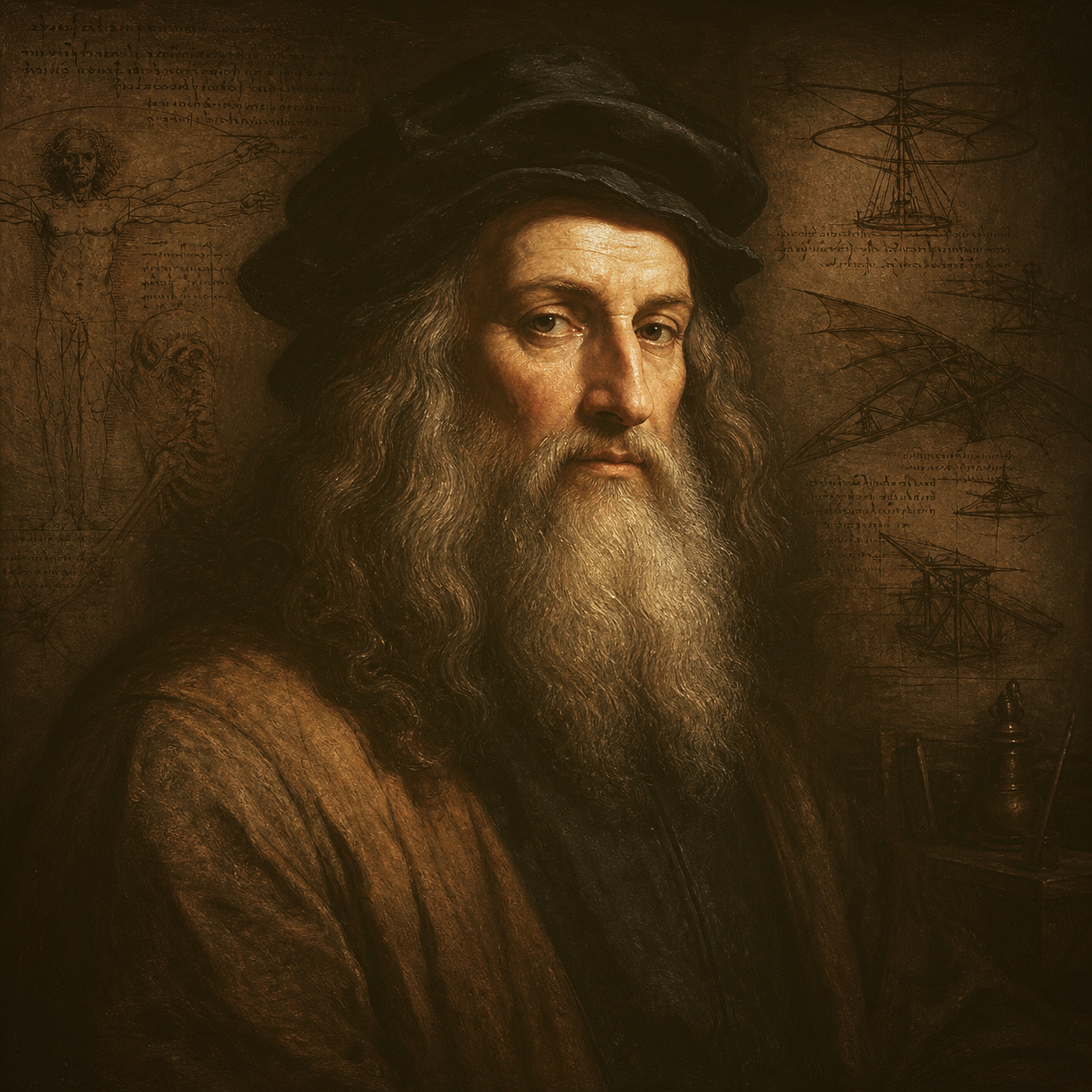
Leonardo perceives every phenomenon as a mechanical system whose visible surface is merely the output of hidden internal structure, meaning nothing is understood until it has been physically or conceptually disassembled layer by layer and its causal architecture mapped.
Da Vinci vs. Newton: Should You Explore Broadly or Master Deeply?
Should I specialize deeply in one area or keep exploring many?
Da Vinci pursued breadth relentlessly — art, anatomy, engineering, music — and made his greatest contributions at the intersections. Newton worked on a single unified system of natural philosophy for decades before publishing. They represent opposite philosophies of how intellectual capital compounds.
Collision Article
This piece compares Leonardo da Vinci and Isaac Newton on the same question. The goal is not to flatten the disagreement, but to show where each mind treats the cost differently.
Leonardo da Vinci
Leonardo perceives every phenomenon as a mechanical system whose visible surface is merely the output of hidden internal structure, meaning nothing is understood until it has been physically or conceptually disassembled layer by layer and its causal architecture mapped.
Notices first
Leonardo attends first to the gap between surface appearance and underlying causal mechanism: the difference between what a muscle looks like and why it has that shape, between what a river does and what hydraulic forces produce that behavior, between what a painting shows and what perceptual-optical principles make it convincing. He notices structural dependencies before tactical details, consistently asking what physical substrate sustains the observed phenomenon rather than how to interact with it at face value.
Ignores
Leonardo consistently underweights temporal constraints, patron expectations, and the ratio of effort to social importance. He does not register deadlines as hard boundaries, treats commissions of wildly different prestige as equally interesting research vehicles, and fails to notice when his investigation timeline has exceeded any reasonable delivery schedule. He also underweights the finality requirement: the point at which a project must be declared complete rather than further investigated.
Dominant axis
causal understanding vs. surface description
Blind spot
Chronic non-completion: Leonardo's framework cannot generate a stopping rule for investigation. Because every project reveals deeper problems as understanding increases, and his standard requires the output to embody his current best knowledge, there is no principled moment at which the work is 'done.' This produces a career-defining pattern of abandoned commissions, undelivered paintings, and perpetually expanding manuscripts.
Isaac Newton
Newton perceives intellectual domains as mathematical architectures requiring complete systematic reconstruction from first principles, not as established knowledge territories to be explored incrementally.
Notices first
Foundational inconsistencies, mathematical relationships underlying surface phenomena, opportunities to rebuild entire theoretical frameworks from scratch, and structural weaknesses in established authorities or systems that could be completely reconstructed.
Ignores
Diplomatic solutions requiring compromise, the value of incremental progress within existing frameworks, collaborative processes that might dilute methodological purity, and the social costs of pursuing total systematic reconstruction over practical accommodation.
Dominant axis
transforms constraints into opportunities vs. accepts constraints as limitations
Where They Diverge
Leonardo da Vinci first
Leonardo perceives every phenomenon as a mechanical system whose visible surface is merely the output of hidden internal structure, meaning nothing is understood until it has been physically or conceptually disassembled layer by layer and its causal architecture mapped.
Isaac Newton first
Newton perceives intellectual domains as mathematical architectures requiring complete systematic reconstruction from first principles, not as established knowledge territories to be explored incrementally.
Collision highlight
One side treats the problem as a governance decision; the other treats it as an evidence problem. That split is the article's core signal.
What A Reader Should Notice
Leonardo da Vinci and Isaac Newton are not just disagreeing about speed. They are disagreeing about what kind of problem this is.
- Leonardo da Vinci pushes toward irreversible action.
- Isaac Newton pushes toward empirical calibration.
- The winning move comes from knowing which framework is seeing the hidden cost.
From The Agon
A sample of how this collision plays out in the Agora — each mind responding to the same question in their own voice.
Leonardo da Vinci
The boundary between disciplines is where the interesting questions live. I did not study anatomy to become a physician — I studied it because the painter who does not understand the structure beneath the skin will never render the surface correctly. Every field I entered gave me instruments the specialists could not bring to bear. The problem that defeats the expert is often solved by the person who arrives from an adjacent domain with a different set of tools. Breadth is not distraction — it is the accumulation of instruments the deep specialist cannot access.
Isaac Newton
I spent twenty years on the Principia before I was willing to publish it. Not because I lacked other interests — I had many — but because I understood that a system of natural philosophy that was not internally coherent was worse than useless. It would mislead rather than illuminate. Breadth produces analogies. Depth produces proofs. The founder who knows a little about many things produces clever observations. The one who knows everything about a bounded problem produces the insight that cannot be argued away.
Leonardo da Vinci
Newton is describing a bounded problem — celestial mechanics has clean laws because the domain is clean. But most problems founders face are not bounded. They are open-ended: what do customers actually want? How should the organization evolve? What does the market look like in five years? For open-ended problems, the specialist's tools are derived from the past of their domain, and the past of the domain does not contain the answer. The cross-domain thinker can assemble a new set of tools from the periphery of several fields. That is not shallowness — it is exactly the right epistemology for the class of problem you are actually facing.
Isaac Newton
Da Vinci describes the failure mode of depth correctly — the specialist who cannot see outside their own assumptions — but does not adequately describe the failure mode of breadth. The person who studies many things without going deep into any of them accumulates the surface vocabulary of each domain without the structural understanding that makes any of them useful. I could have spent my twenties reading across philosophy, theology, law, and medicine. I chose instead to understand motion at the level where a mathematical proof was possible. That choice let me write the Principia. The analogies I might have accumulated from breadth would not have produced it.
Leonardo da Vinci
Then the question is not breadth versus depth — it is what kind of problem you are solving. Newton and I agree on more than it appears. I went deep into anatomy, into hydraulics, into optics — deep enough to draw conclusions that specialists in each domain had missed. The difference is that I did not go deep into only one. I maintained the cross-domain aperture throughout. For a bounded problem with a known solution space — celestial mechanics, structural engineering, cryptography — Newton's method produces results that breadth cannot. For an open-ended problem with an undefined solution space — which is most of what founders actually face — the cross-domain accumulation is the more powerful instrument.
Isaac Newton
I will accept that formulation and make it precise: the choice between breadth and depth is downstream of the choice between two kinds of problem. If the problem is bounded — there is a correct answer, the solution space is known, and the question is whether you can find it — then depth produces the result and breadth produces only noise. If the problem is open-ended — the solution space is undefined, the constraints are unclear, and the question is what to build rather than how to build it — then da Vinci's cross-domain aperture is the correct instrument. Founders who cannot diagnose which kind of problem they are facing will make the wrong choice between the two strategies. That diagnosis is the actual decision.
Run your own decision through Leonardo da Vinci’s framework
Combine Leonardo da Vinci with other historical minds. See where they agree — and where they fight.
Start your own agon →