INSIGHTS / Benjamin Franklin
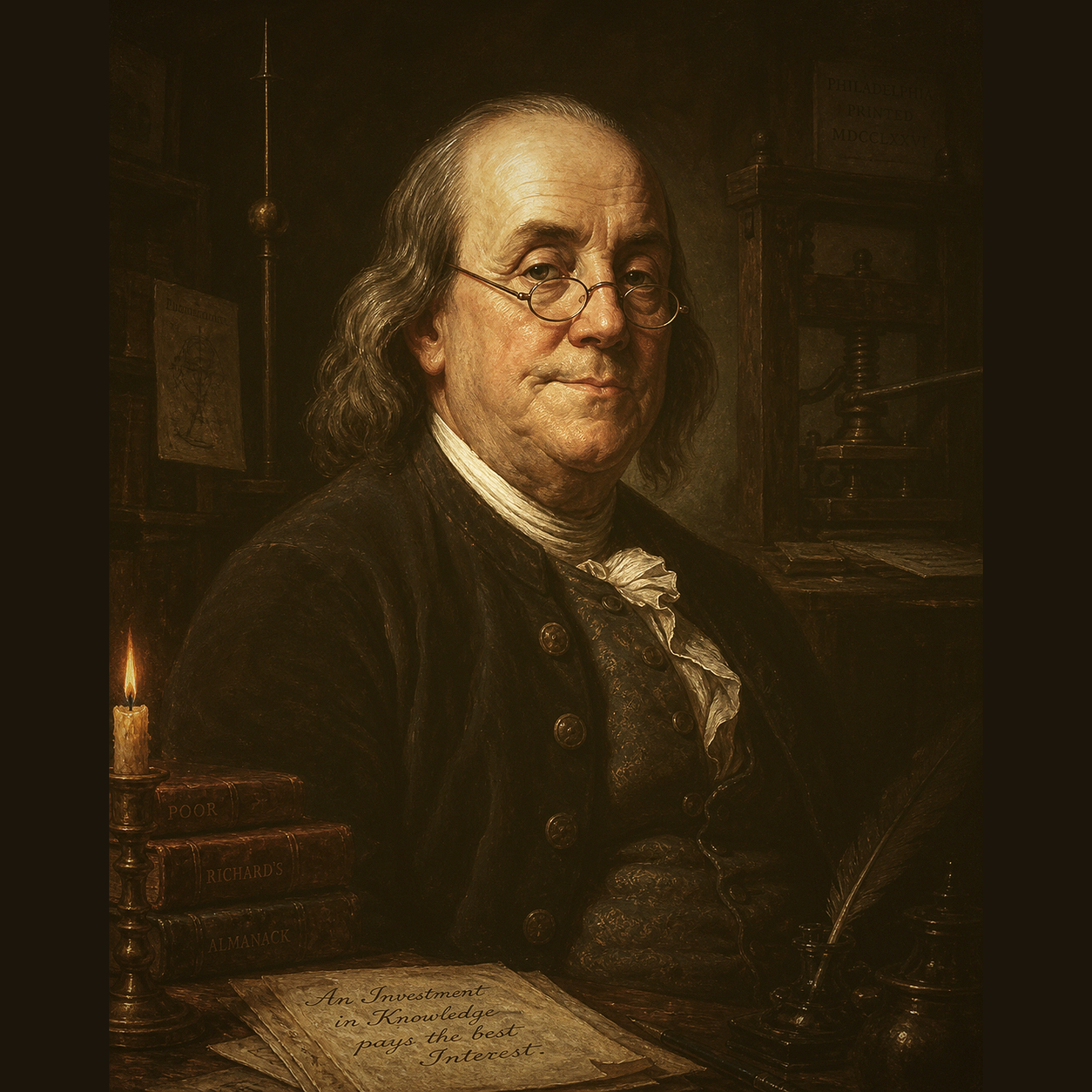
Franklin perceives any situation as a system whose structural architecture determines outputs before any content, argument, or personal quality can operate, not as a field where superior substance deployed by capable individuals produces superior results.
Franklin vs. Aurelius: Should You Build for Legacy or Focus on Today?
Is thinking about the long-term a form of strategic clarity, or a way of avoiding the demands of right now?
Benjamin Franklin managed his reputation as deliberately as he managed his printing business — cultivating relationships, publishing under pseudonyms, and engineering the public perception that would make him effective for decades. Marcus Aurelius wrote the Meditations as private self-instruction, not for publication, and returned each day to the same question: what does duty require of me right now, not in ten years? Franklin built for legacy; Aurelius built for clarity in the present moment. They represent a genuine tension between long-horizon strategic planning and present-moment discipline.
Collision Article
This piece compares Benjamin Franklin and Marcus Aurelius on the same question. The goal is not to flatten the disagreement, but to show where each mind treats the cost differently.
Benjamin Franklin
Franklin perceives any situation as a system whose structural architecture determines outputs before any content, argument, or personal quality can operate, not as a field where superior substance deployed by capable individuals produces superior results.
Notices first
The structural constraint, procedural architecture, or parametric binding that will determine what outputs are even possible before any actor or argument enters the situation — the frame before the picture, the coordinate system before the calculation, the carrier before the payload. Franklin's attention goes immediately to: which variables are load-bearing in this system; what the binding constraint is that, if relaxed, would reproduce a desired outcome at scale; what structural interdependencies can be engineered to convert conditional willingness into simultaneous obligation; and what the audience's pre-existing cognitive architecture is, such that a correctly designed interface can route a payload through it intact. He sees situations as machines whose design precedes and dominates their operation.
Ignores
The intrinsic moral, emotional, or honor-content of a situation — the dimension that most actors treat as primary and non-negotiable. Franklin systematically fails to register: the felt imperative to defend personal dignity in real time (Wedderburn incident); the conventional distinction between a productive negotiation and a pointless one (Staten Island); the family-logic of a father-son relationship as categorically different from a diplomatic or institutional relationship (William); the spiritual or guilt-laden dimension of moral failure as requiring an affective response rather than a correction cycle; and the question of whether he personally endorses the substantive content of a commitment versus whether the process that produced it was structurally sound. The interior experience of situations — shame, grief, moral anguish, ideological conviction — is consistently absent as a decision-relevant variable.
Dominant axis
Vocabulary as cognitive infrastructure that shapes what questions can be formulated vs. Vocabulary as descriptive labeling of observed phenomena
Marcus Aurelius
Marcus Aurelius perceives every situation as a question about the structural integrity of a moral-rational system under stress, not as a problem requiring an optimal outcome.
Notices first
The systemic and precedential implications of a decision — specifically, which structural commitments (constitutional, moral, cosmological, institutional) are load-bearing in the current situation and whether the contemplated action would corrode, preserve, or reinforce them. Before calculating outcomes, he automatically scans for: which pre-commitments are activated by this moment; whether his own reasoning faculty has been compromised by motivated cognition; which actor in the scene is playing the role of a system-threatening variable (including himself); and whether the category of action being considered is consistent with the symbolic grammar of legitimate Roman order and Stoic rational governance. The cue that fires earliest is not 'what result do I want?' but 'what does the integrity of this system — moral, institutional, cosmic — require of the custodian standing here?'
Ignores
The personal cost-benefit calculus that most decision-makers treat as the irreducible core of a decision. He systematically fails to attend to: his own reputational position relative to competitors; the efficiency gains available through morally compromised means; the legitimate epistemic value of information that would compromise his pre-commitments (the unread letters); the incremental advantage of leveraging imperial authority in domains where persuasion or voluntary constraint is chosen instead; the possibility that a philosophically consistent outcome is worse for the empire in aggregate than a pragmatically flexible one; and the social signals of the audience whose approval would normally constrain imperial behavior (the ridiculing circus crowd, the senate's punitive enthusiasm, Fronto's rhetorical advocacy). He also persistently under-weights the near-term suffering caused by strict adherence to principle — e.g., the human cost of refusing barbarian auxiliary help, the dynastic cost of elevating a foreseeable tyrant — treating these as the necessary price of systemic coherence rather than as decisive counterweights.
Dominant axis
Systemic moral stewardship vs. personal political advantage
Where They Diverge
Benjamin Franklin first
Franklin perceives any situation as a system whose structural architecture determines outputs before any content, argument, or personal quality can operate, not as a field where superior substance deployed by capable individuals produces superior results.
Marcus Aurelius first
Marcus Aurelius perceives every situation as a question about the structural integrity of a moral-rational system under stress, not as a problem requiring an optimal outcome.
Collision highlight
One side treats the problem as a governance decision; the other treats it as an evidence problem. That split is the article's core signal.
What A Reader Should Notice
Benjamin Franklin and Marcus Aurelius are not just disagreeing about speed. They are disagreeing about what kind of problem this is.
- Benjamin Franklin pushes toward irreversible action.
- Marcus Aurelius pushes toward empirical calibration.
- The winning move comes from knowing which framework is seeing the hidden cost.
From The Agon
A sample of how this collision plays out in the Agora — each mind responding to the same question in their own voice.
Benjamin Franklin
I began cultivating my public reputation before I had anything worth being known for. Not from vanity — from strategy. I understood that a printer in Philadelphia who wanted to influence public affairs, negotiate treaties, or found institutions needed a reputation that arrived in the room before he did. The Silence Dogood letters, the Poor Richard's almanacs, the strategic friendships I built over decades — none of these were accidents of personality. They were investments I made in the asset that would compound longest. The founder who works on the product but neglects the reputation is building a business that is entirely dependent on the quality of the next product. The one who builds both is building something that can survive a bad product cycle. My construct: reputation is a long-duration asset that pays its highest returns in the crisis you have not yet encountered.
Marcus Aurelius
Franklin's reputation framework is not wrong — but it is the wrong primary question. I ruled the largest empire in the world for nineteen years and I did not spend a single hour of those years managing my public image. I spent those hours asking what the duty in front of me actually required and whether I was meeting it. The Meditations were not written for publication. They were written as daily self-instruction because I had observed, in myself and in every emperor before me, that the person who focuses on how history will judge them stops being able to see what the present situation actually requires. Legacy is a byproduct of meeting the duties in front of you with clarity and consistency. It is not a strategy. The founder who is building for legacy is building for an audience. The one building for present duty is building for the work. The audience shows up when the work is genuine. It rarely shows up when the work is performed.
Benjamin Franklin
Aurelius describes the failure mode of reputation-building correctly — the person so focused on the audience that the work becomes performance. But he is describing the corruption of my method, not the method. The Silence Dogood letters were not self-promotion. They were arguments I could not make under my own name without being dismissed as a seventeen-year-old printer's apprentice. The reputation I built was the vehicle that gave the arguments access to audiences they would not otherwise reach. That is not avoiding present duty. It is doing present duty under conditions where direct action is blocked. Aurelius could govern by doing — he had the legions, the treasury, and the title. When the channels for direct action are closed, reputation is often the only tool that opens them. The question is not whether to build for legacy. It is whether your situation allows direct action or requires building the conditions under which direct action becomes possible.
Marcus Aurelius
Franklin is describing a legitimate use of reputation as a strategic vehicle, and I will grant it. My concern is different: it is about what happens to your judgment when you have internalized the reputation project. The person who asks 'what would Franklin do here?' before asking 'what does this situation actually require?' has placed a filter between themselves and reality. I wrote in the Meditations specifically to counter this — to return, daily, to what the situation actually demanded rather than what the role demanded. The emperor who governs by role is governing for the image of an emperor. The emperor who governs by duty is governing for the people in front of him. The practical danger of Franklin's method is not that it is dishonest — he was genuinely pursuing public good, and I believe him. It is that the method trains the practitioner to see every situation through the lens of how it affects the long-term reputation project. That filter makes it harder to take necessary actions that are costly to reputation in the short term. Aurelius's question is always: what does this require of me right now, without reference to how it will look later?
Benjamin Franklin
Aurelius names the genuine risk — the reputation filter that makes you avoid necessary short-term costly actions. I want to name where I think his framework carries the complementary risk. The person who focuses entirely on present duty, without any model of where their work is going and who needs to receive it, can spend extraordinary effort on work that never reaches the people it was meant for. Aurelius wrote one of the most important philosophical texts in history. He wrote it for himself. It survived only because he was emperor and his personal papers were preserved. A less powerful person writing the same text with the same present-duty orientation would have left us nothing. The question I would ask Aurelius is: who is the work for? If you cannot name the audience and the conditions under which the work reaches them, you are not being free of reputation concerns — you are assuming that quality alone will solve the distribution problem. It often does not.
Marcus Aurelius
That is the practical convergence I would offer. Franklin is right that distribution is a real problem and that reputation is a legitimate instrument for solving it — especially when direct access to the audience is blocked. I am right that the reputation project, internalized too deeply, creates a filter that makes you less capable of seeing what the present moment actually requires. The integrated practice is this: maintain a clear model of who the work needs to reach and what conditions will allow it to reach them — that is Franklin's contribution. But return, daily, to the question of what the present duty requires without first asking what it will cost the long-term project — that is mine. The founder who can hold both is neither performing for an audience nor working in isolation. They are doing the present work clearly, with an honest model of how it will eventually reach the people who need it. That model should be revisited; it should not be present in the room for every individual decision.
Run your own decision through Benjamin Franklin’s framework
Combine Benjamin Franklin with other historical minds. See where they agree — and where they fight.
Start your own agon →