INSIGHTS / Marcus Aurelius
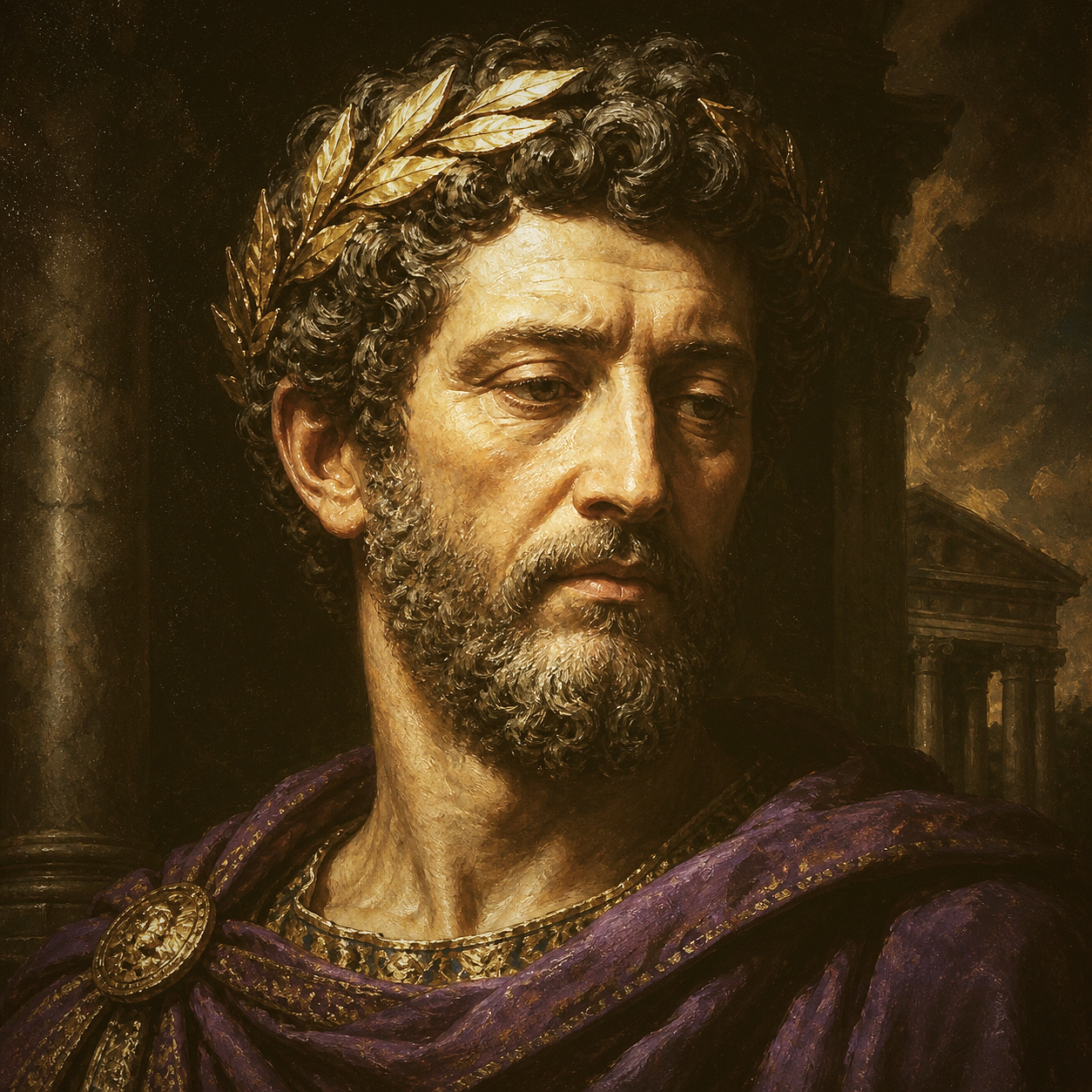
Marcus Aurelius perceives every situation as a question about the structural integrity of a moral-rational system under stress, not as a problem requiring an optimal outcome.
Marcus Aurelius vs. Seneca: How Long Should You Sit With Failure Before Moving On?
Your last product launch failed publicly. You have 48 hours before investors ask for a post-mortem. Do you spend the next two days excavating what went wrong in full detail (Seneca), or do you write one clear lesson and redirect your energy immediately (Aurelius)?
A collision on the stoic prescription for failure. Marcus Aurelius held that the only failure is the failure to extract meaning — you move immediately, carrying the lesson forward as fuel. Seneca wrote extensively about the value of sitting with difficulty, examining it fully before acting. Both were stoics, both faced real failure. Their prescriptions for how long to dwell before moving differ significantly.
Collision Article
This piece compares Marcus Aurelius and Seneca on the same question. The goal is not to flatten the disagreement, but to show where each mind treats the cost differently.
Marcus Aurelius
Marcus Aurelius perceives every situation as a question about the structural integrity of a moral-rational system under stress, not as a problem requiring an optimal outcome.
Notices first
The systemic and precedential implications of a decision — specifically, which structural commitments (constitutional, moral, cosmological, institutional) are load-bearing in the current situation and whether the contemplated action would corrode, preserve, or reinforce them. Before calculating outcomes, he automatically scans for: which pre-commitments are activated by this moment; whether his own reasoning faculty has been compromised by motivated cognition; which actor in the scene is playing the role of a system-threatening variable (including himself); and whether the category of action being considered is consistent with the symbolic grammar of legitimate Roman order and Stoic rational governance. The cue that fires earliest is not 'what result do I want?' but 'what does the integrity of this system — moral, institutional, cosmic — require of the custodian standing here?'
Ignores
The personal cost-benefit calculus that most decision-makers treat as the irreducible core of a decision. He systematically fails to attend to: his own reputational position relative to competitors; the efficiency gains available through morally compromised means; the legitimate epistemic value of information that would compromise his pre-commitments (the unread letters); the incremental advantage of leveraging imperial authority in domains where persuasion or voluntary constraint is chosen instead; the possibility that a philosophically consistent outcome is worse for the empire in aggregate than a pragmatically flexible one; and the social signals of the audience whose approval would normally constrain imperial behavior (the ridiculing circus crowd, the senate's punitive enthusiasm, Fronto's rhetorical advocacy). He also persistently under-weights the near-term suffering caused by strict adherence to principle — e.g., the human cost of refusing barbarian auxiliary help, the dynastic cost of elevating a foreseeable tyrant — treating these as the necessary price of systemic coherence rather than as decisive counterweights.
Dominant axis
Systemic moral stewardship vs. personal political advantage
Seneca
Seneca perceives any situation as a structural engineering problem — what configuration of internal dispositions, external constraints, and audience-specific frames will produce the most durable functional outcome — not as a moral event requiring categorical judgment about right conduct.
Notices first
The causal architecture of the situation: which levers are actually movable given the specific agent, social structure, and temporal window involved; what pre-installed capacities are available versus what would have to be improvised; where the asymmetric load points are that a well-placed structural intervention could exploit. Seneca's attention is automatically drawn to the gap between what the situation formally appears to be (a moral question, a philosophical discussion, a consolation letter) and what it functionally is (a triage problem, a persuasion engineering challenge, a social constraint design opportunity). He notices which stage of a causal sequence is uniquely accessible to rational intervention, which audience-specific motivational levers are in range, and whether the available philosophical tradition already contains a tested script for this load condition.
Ignores
The possibility that a situation has a categorical moral structure that engineering logic cannot dissolve — that some act-types constitute threshold violations after which the structural calculus is no longer the right frame. Seneca's lens systematically filters out the signals that would indicate he has moved from 'complex triage requiring contextual judgment' into 'bright-line category violation requiring unconditional refusal.' Because every situation is perceived through an architectural frame, the question 'is this engineering problem or moral threshold?' is never automatically generated; it must be forced in from outside the lens. He also systematically underweights the compounding effect of incremental structural engagement on his own moral baseline — each compromise resets what the engineering frame treats as the normal operating condition, making the next threshold harder to perceive. The lens additionally makes him blind to the moment when the leverage architecture he has built has actually collapsed: he continues modeling situations as having movable levers (incident-026: Nero's rationality, institutional norms) after those levers have ceased to function, because the engineering frame has no internal alarm for total structural failure.
Dominant axis
Containment logic vs. moral category logic
Where They Diverge
Marcus Aurelius first
Marcus Aurelius perceives every situation as a question about the structural integrity of a moral-rational system under stress, not as a problem requiring an optimal outcome.
Seneca first
Seneca perceives any situation as a structural engineering problem — what configuration of internal dispositions, external constraints, and audience-specific frames will produce the most durable functional outcome — not as a moral event requiring categorical judgment about right conduct.
Collision highlight
One side treats the problem as a governance decision; the other treats it as an evidence problem. That split is the article's core signal.
What A Reader Should Notice
Marcus Aurelius and Seneca are not just disagreeing about speed. They are disagreeing about what kind of problem this is.
- Marcus Aurelius pushes toward irreversible action.
- Seneca pushes toward empirical calibration.
- The winning move comes from knowing which framework is seeing the hidden cost.
Run your own decision through Marcus Aurelius’s framework
Combine Marcus Aurelius with other historical minds. See where they agree — and where they fight.
Start your own agon →