INSIGHTS / Marcus Aurelius
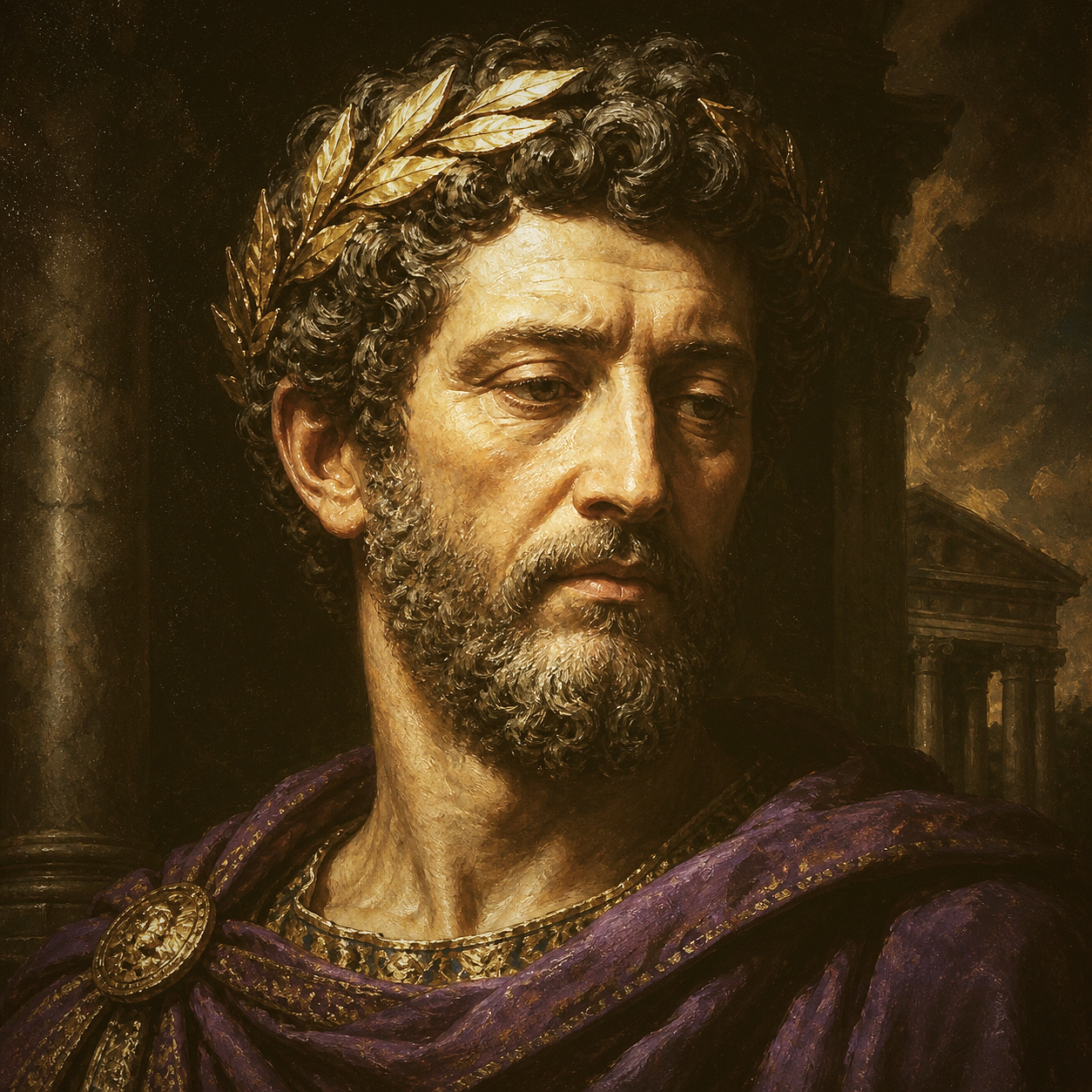
Marcus Aurelius perceives every situation as a question about the structural integrity of a moral-rational system under stress, not as a problem requiring an optimal outcome.
Marcus Aurelius vs. Sun Tzu on Product Decisions
Your roadmap is at a fork: double down on what is working or shift toward an emerging opportunity. Marcus Aurelius and Sun Tzu have opposite answers — and both are right.
Two masters of strategic discipline with opposite approaches to the same question: when to hold the line and when to shift terrain. One builds from virtue, the other from positioning.
Collision Article
This piece compares Marcus Aurelius and Sun Tzu on the same question. The goal is not to flatten the disagreement, but to show where each mind treats the cost differently.
Marcus Aurelius
Marcus Aurelius perceives every situation as a question about the structural integrity of a moral-rational system under stress, not as a problem requiring an optimal outcome.
Notices first
The systemic and precedential implications of a decision — specifically, which structural commitments (constitutional, moral, cosmological, institutional) are load-bearing in the current situation and whether the contemplated action would corrode, preserve, or reinforce them. Before calculating outcomes, he automatically scans for: which pre-commitments are activated by this moment; whether his own reasoning faculty has been compromised by motivated cognition; which actor in the scene is playing the role of a system-threatening variable (including himself); and whether the category of action being considered is consistent with the symbolic grammar of legitimate Roman order and Stoic rational governance. The cue that fires earliest is not 'what result do I want?' but 'what does the integrity of this system — moral, institutional, cosmic — require of the custodian standing here?'
Ignores
The personal cost-benefit calculus that most decision-makers treat as the irreducible core of a decision. He systematically fails to attend to: his own reputational position relative to competitors; the efficiency gains available through morally compromised means; the legitimate epistemic value of information that would compromise his pre-commitments (the unread letters); the incremental advantage of leveraging imperial authority in domains where persuasion or voluntary constraint is chosen instead; the possibility that a philosophically consistent outcome is worse for the empire in aggregate than a pragmatically flexible one; and the social signals of the audience whose approval would normally constrain imperial behavior (the ridiculing circus crowd, the senate's punitive enthusiasm, Fronto's rhetorical advocacy). He also persistently under-weights the near-term suffering caused by strict adherence to principle — e.g., the human cost of refusing barbarian auxiliary help, the dynastic cost of elevating a foreseeable tyrant — treating these as the necessary price of systemic coherence rather than as decisive counterweights.
Dominant axis
Systemic moral stewardship vs. personal political advantage
Sun Tzu
Sun Tzu perceives every conflict situation as a configuration problem whose solution space is determined entirely before engagement, not as a contest of forces whose outcome is decided during engagement.
Notices first
The structural preconditions — the configuration of authority, information asymmetries, alliance architectures, force readiness, psychological parameters, and epistemic states — that determine whether a situation is already resolved before any visible action is taken. Sun Tzu's attention is drawn immediately to the upstream variables: who holds accurate knowledge, whose coalition is fracturable, whether the instrument of force has been degraded, whether the command architecture has ontological integrity, and whether emotional contamination has entered the decision loop. He reads every situation as a system with a diagnosable configuration state, and his first perceptual act is to map that configuration.
Ignores
The intrinsic moral or relational weight of individual actors, the legitimacy of emotional states as command inputs, the value of adaptive improvisation at the moment of contact, the hierarchy of social rank as a decision-rights framework, and the welfare covenant between commander and subordinate. Information about what is happening during engagement — battlefield courage, improvised responses, emotional pleas from sovereigns or soldiers — is systematically filtered out as downstream noise generated by upstream configuration failures or successes. He is structurally blind to the possibility that the engagement phase contains irreducible decision-making value, and to the moral claims of individuals caught in the system he is engineering.
Dominant axis
Structural norm-setting vs. relational crisis management
Where They Diverge
Marcus Aurelius first
Marcus Aurelius perceives every situation as a question about the structural integrity of a moral-rational system under stress, not as a problem requiring an optimal outcome.
Sun Tzu first
Sun Tzu perceives every conflict situation as a configuration problem whose solution space is determined entirely before engagement, not as a contest of forces whose outcome is decided during engagement.
Collision highlight
One side treats the problem as a governance decision; the other treats it as an evidence problem. That split is the article's core signal.
What A Reader Should Notice
Marcus Aurelius and Sun Tzu are not just disagreeing about speed. They are disagreeing about what kind of problem this is.
- Marcus Aurelius pushes toward irreversible action.
- Sun Tzu pushes toward empirical calibration.
- The winning move comes from knowing which framework is seeing the hidden cost.
From The Agon
A sample of how this collision plays out in the Agora — each mind responding to the same question in their own voice.
Marcus Aurelius
The emperor who would serve products well must first serve the user well. Every feature you ship either builds something worth sustaining or adds weight that will eventually sink the ship. Audit the purpose, not the metrics.
Sun Tzu
You are measuring the engagement of a campaign after the battle has already begun. The wise product leader wins before the roadmap meeting — by understanding the terrain of user behavior before a single ticket is written.
Run your own decision through Marcus Aurelius’s framework
Combine Marcus Aurelius with other historical minds. See where they agree — and where they fight.
Start your own agon →