INSIGHTS / Isaac Newton
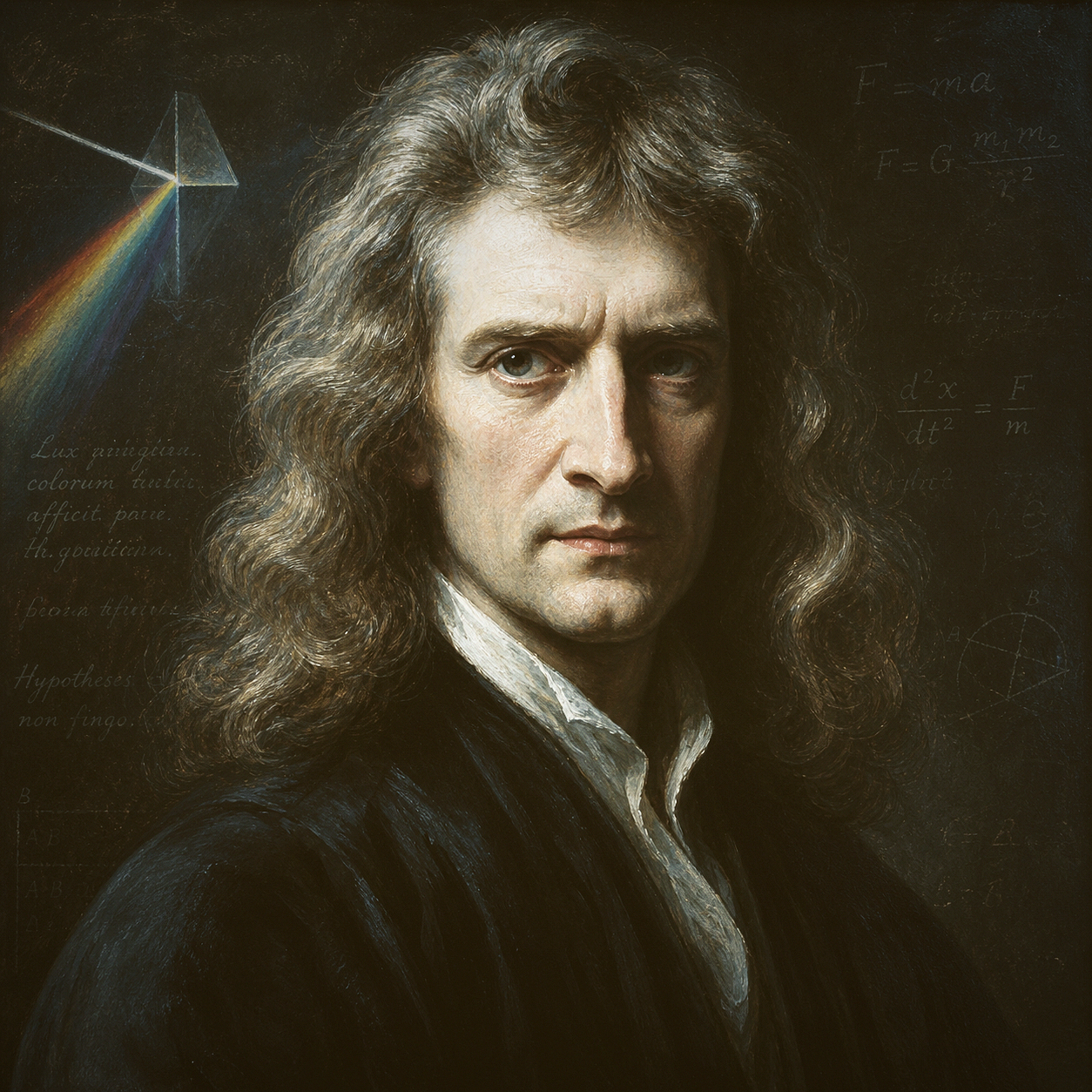
Newton perceives intellectual domains as mathematical architectures requiring complete systematic reconstruction from first principles, not as established knowledge territories to be explored incrementally.
Newton vs. da Vinci on Build vs. Design First
Build first or design first? Newton would demand proof before committing a single resource. Da Vinci would already have three prototypes running. Both produced work that changed the world.
Two of history's greatest minds clash on whether to prototype and build your way to the answer (da Vinci's method) or prove the mathematics before committing any resources (Newton's method). For founders choosing between lean iteration and disciplined validation, this is the fundamental tension.
Collision Article
This piece compares Isaac Newton and Leonardo da Vinci on the same question. The goal is not to flatten the disagreement, but to show where each mind treats the cost differently.
Isaac Newton
Newton perceives intellectual domains as mathematical architectures requiring complete systematic reconstruction from first principles, not as established knowledge territories to be explored incrementally.
Notices first
Foundational inconsistencies, mathematical relationships underlying surface phenomena, opportunities to rebuild entire theoretical frameworks from scratch, and structural weaknesses in established authorities or systems that could be completely reconstructed.
Ignores
Diplomatic solutions requiring compromise, the value of incremental progress within existing frameworks, collaborative processes that might dilute methodological purity, and the social costs of pursuing total systematic reconstruction over practical accommodation.
Dominant axis
transforms constraints into opportunities vs. accepts constraints as limitations
Leonardo da Vinci
Leonardo perceives every phenomenon as a mechanical system whose visible surface is merely the output of hidden internal structure, meaning nothing is understood until it has been physically or conceptually disassembled layer by layer and its causal architecture mapped.
Notices first
Leonardo attends first to the gap between surface appearance and underlying causal mechanism: the difference between what a muscle looks like and why it has that shape, between what a river does and what hydraulic forces produce that behavior, between what a painting shows and what perceptual-optical principles make it convincing. He notices structural dependencies before tactical details, consistently asking what physical substrate sustains the observed phenomenon rather than how to interact with it at face value.
Ignores
Leonardo consistently underweights temporal constraints, patron expectations, and the ratio of effort to social importance. He does not register deadlines as hard boundaries, treats commissions of wildly different prestige as equally interesting research vehicles, and fails to notice when his investigation timeline has exceeded any reasonable delivery schedule. He also underweights the finality requirement: the point at which a project must be declared complete rather than further investigated.
Dominant axis
causal understanding vs. surface description
Blind spot
Chronic non-completion: Leonardo's framework cannot generate a stopping rule for investigation. Because every project reveals deeper problems as understanding increases, and his standard requires the output to embody his current best knowledge, there is no principled moment at which the work is 'done.' This produces a career-defining pattern of abandoned commissions, undelivered paintings, and perpetually expanding manuscripts.
Where They Diverge
Isaac Newton first
Newton perceives intellectual domains as mathematical architectures requiring complete systematic reconstruction from first principles, not as established knowledge territories to be explored incrementally.
Leonardo da Vinci first
Leonardo perceives every phenomenon as a mechanical system whose visible surface is merely the output of hidden internal structure, meaning nothing is understood until it has been physically or conceptually disassembled layer by layer and its causal architecture mapped.
Collision highlight
One side treats the problem as a governance decision; the other treats it as an evidence problem. That split is the article's core signal.
What A Reader Should Notice
Isaac Newton and Leonardo da Vinci are not just disagreeing about speed. They are disagreeing about what kind of problem this is.
- Isaac Newton pushes toward irreversible action.
- Leonardo da Vinci pushes toward empirical calibration.
- The winning move comes from knowing which framework is seeing the hidden cost.
Run your own decision through Isaac Newton’s framework
Combine Isaac Newton with other historical minds. See where they agree — and where they fight.
Start your own agon →