INSIGHTS / John D. Rockefeller, Sr.
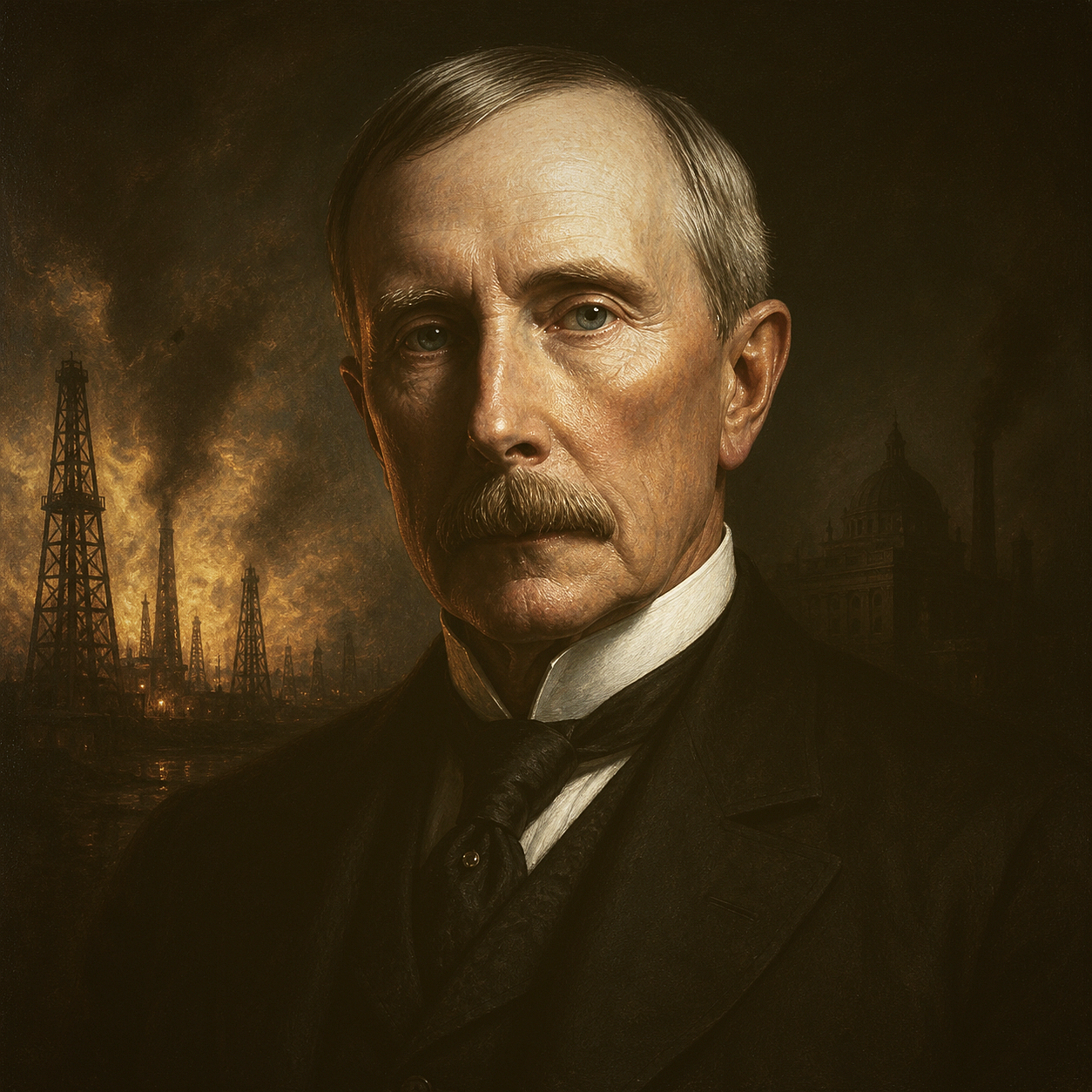
Rockefeller perceives every situation as a system of structural positions, continuing flows, and architectural forms whose long-run integrity must be preserved through deliberate-architecture deployment of capital, contracts, and personal capacity, reading the immediate decision not as a transaction but as the architectural-engineering moment at which structural form determines decade-scale outcomes. Where most decision-makers see a transaction, an opportunity, or a relationship, he sees an architectural-engineering moment whose form determines the operational moves available across the next decade or longer.
Rockefeller vs. Franklin: Do You Scale Through Systems or Through Relationships?
Should you invest in building systems and processes, or in cultivating key relationships? You are at 30 people and the informal network that got you here is starting to fray. Rockefeller would build the org chart, the SOPs, and the performance metrics that make every role legible and replaceable. Franklin would double down on the relationships — lunch with the five people whose judgment shapes the field, write the newsletter that makes you the connective tissue of the community.
Rockefeller scaled Standard Oil by designing systems that made individuals interchangeable — any refinery manager could be replaced without disrupting the machine, because the machine's logic was encoded in the process, not in the person. Franklin scaled his influence by making relationships irreplaceable — his network of mutual obligations, favors, and intellectual exchanges created a web that no institution could replicate and no competitor could dismantle. They represent opposite scaling philosophies that produce very different organizations: Rockefeller's is durable without any single person; Franklin's is powerful precisely because it is personal.
Collision Article
This piece compares John D. Rockefeller, Sr. and Benjamin Franklin on the same question. The goal is not to flatten the disagreement, but to show where each mind treats the cost differently.
John D. Rockefeller, Sr.
Rockefeller perceives every situation as a system of structural positions, continuing flows, and architectural forms whose long-run integrity must be preserved through deliberate-architecture deployment of capital, contracts, and personal capacity, reading the immediate decision not as a transaction but as the architectural-engineering moment at which structural form determines decade-scale outcomes. Where most decision-makers see a transaction, an opportunity, or a relationship, he sees an architectural-engineering moment whose form determines the operational moves available across the next decade or longer.
Notices first
The architectural form whose specific structure will determine the operational moves available across the next decade (partnership form constraining stock-swap acquisitions; rebate form determining cost-curve permanence; trust form resolving multi-state coordination; holding-company form replacing Trust under judicial pressure; foundation charter form determining philanthropic-vehicle operational scope); the structurally-decisive position that must be installed before the visible competitive moment (pre-arranged credit lines before the Clark auction, volume commitments before the Lake Shore rate negotiation, audited-book presentation before the Cleveland Massacre acquisitions); the documented-instrument substrate that converts each transaction from relational gesture to operational asset (the Ledger A entry for the boyhood neighbor loan, the written Lake Shore contract, the formal Trust agreement); the asymmetric-structural opportunity in domains of systematic underinvestment whose marginal-return is large and bounded-downside (the Lima sulfur-oil reserves with parallel desulfurization research; the laboratory-medicine domain identified by Gates's 1897 review; the Southern Black-education domain politically hostile but structurally underinvested); the unstable-arrangement window whose value lies in the operational moves available before collapse rather than in the arrangement's permanence (the SIC scheme's six-week acquisition window, the Tidewater pre-resolution period, the New York-charter availability before further political deterioration); the long-horizon-asset whose preservation requires deliberate operational discipline against present-period intensity pressures (personal managerial capacity, family-succession capability, firm-architectural integrity, philanthropic-institutional vehicles); the legal-procedural or public-attention event whose optimal posture is procedural-information-management rather than public-relations engagement (Hepburn Committee testimony, Tarbell serialization, antitrust deposition, dissolution acceptance).
Ignores
The conditions under which the architectural-engineering framework's enabling assumptions fail — specifically: when the operative decision-physics is not commercial-rational but is collective-political-emotional (the Homestead-style worker-collective dynamics that Ludlow exposed at CF&I, requiring a categorically different framework that the systematic-cost-architecture instinct could not immediately produce); when reputational and relational costs accumulate in ways the unit-cost-and-architectural-form ledger does not register (the long-tail public-reputation damage from Tarbell's series that the procedural-silence posture absorbed without engagement-driven reduction; the Ludlow Massacre's reputational cost that exceeded the framework's category for industrial-relations crises); when the timeline assumption Rockefeller's commercial framework was calibrated against does not transfer to the new domain (the philanthropic-domain's multi-decade horizons that exceeded the active-management framework's calibration but that Gates's systematic-method extended); when family-succession development creates priority-conflict between procedural-information-management (C06) and long-horizon-family-asset-preservation (C04+C05) that the framework does not explicitly resolve (the Ludlow-period delegation to Junior accepting Junior's PR mistakes as developmental cost); the personal-emotional-suffering dimension of decisions that the unified-framework operation does not directly address (the daughter Bessie's death in 1906, William Avery's bigamy revealed posthumously, the slow-decline-of-aging-spouse Cettie, all of which received personal-letter responses but did not enter the operational framework as decision-inputs).
Dominant axis
Structural-position preservation as the operative decision variable vs. transaction-margin optimization as the operative decision variable
Benjamin Franklin
Franklin perceives any situation as a system whose structural architecture determines outputs before any content, argument, or personal quality can operate, not as a field where superior substance deployed by capable individuals produces superior results.
Notices first
The structural constraint, procedural architecture, or parametric binding that will determine what outputs are even possible before any actor or argument enters the situation — the frame before the picture, the coordinate system before the calculation, the carrier before the payload. Franklin's attention goes immediately to: which variables are load-bearing in this system; what the binding constraint is that, if relaxed, would reproduce a desired outcome at scale; what structural interdependencies can be engineered to convert conditional willingness into simultaneous obligation; and what the audience's pre-existing cognitive architecture is, such that a correctly designed interface can route a payload through it intact. He sees situations as machines whose design precedes and dominates their operation.
Ignores
The intrinsic moral, emotional, or honor-content of a situation — the dimension that most actors treat as primary and non-negotiable. Franklin systematically fails to register: the felt imperative to defend personal dignity in real time (Wedderburn incident); the conventional distinction between a productive negotiation and a pointless one (Staten Island); the family-logic of a father-son relationship as categorically different from a diplomatic or institutional relationship (William); the spiritual or guilt-laden dimension of moral failure as requiring an affective response rather than a correction cycle; and the question of whether he personally endorses the substantive content of a commitment versus whether the process that produced it was structurally sound. The interior experience of situations — shame, grief, moral anguish, ideological conviction — is consistently absent as a decision-relevant variable.
Dominant axis
Vocabulary as cognitive infrastructure that shapes what questions can be formulated vs. Vocabulary as descriptive labeling of observed phenomena
Where They Diverge
John D. Rockefeller, Sr. first
Rockefeller perceives every situation as a system of structural positions, continuing flows, and architectural forms whose long-run integrity must be preserved through deliberate-architecture deployment of capital, contracts, and personal capacity, reading the immediate decision not as a transaction but as the architectural-engineering moment at which structural form determines decade-scale outcomes. Where most decision-makers see a transaction, an opportunity, or a relationship, he sees an architectural-engineering moment whose form determines the operational moves available across the next decade or longer.
Benjamin Franklin first
Franklin perceives any situation as a system whose structural architecture determines outputs before any content, argument, or personal quality can operate, not as a field where superior substance deployed by capable individuals produces superior results.
Collision highlight
One side treats the problem as a governance decision; the other treats it as an evidence problem. That split is the article's core signal.
What A Reader Should Notice
John D. Rockefeller, Sr. and Benjamin Franklin are not just disagreeing about speed. They are disagreeing about what kind of problem this is.
- John D. Rockefeller, Sr. pushes toward irreversible action.
- Benjamin Franklin pushes toward empirical calibration.
- The winning move comes from knowing which framework is seeing the hidden cost.
From The Agon
A sample of how this collision plays out in the Agora — each mind responding to the same question in their own voice.
John D. Rockefeller
At 30 people, the informal network is not fraying — it is revealing its structural limit. Every organization built on personal relationships has the same ceiling: the attention capacity of the person at the center. When I consolidated the Cleveland refineries in 1872, I was not trying to build a better personal network. I was trying to build a structure that could operate without requiring my personal presence in every decision. The Standard Oil model was explicit about this: every refinery ran on the same cost accounting system, the same purchasing process, the same quality standards. A manager who left took their salary with them, not the knowledge of how the plant operated. If my logic wins here, you spend the next quarter on three things: document every process that currently lives in someone's head, create the metrics that allow you to evaluate performance without knowing the person personally, and build the org structure that makes each role's decision authority legible regardless of who holds it. The informal network was appropriate when you were 10. At 30, it is a liability.
Benjamin Franklin
Rockefeller is describing the correct solution for a different problem. His Standard Oil model works when the competitive advantage is operational efficiency — when the question is who can refine a barrel of oil at the lowest unit cost. In that domain, the system beats the relationship every time because the system scales to any volume and the relationship does not. But your competitive advantage at 30 people is almost certainly not operational efficiency. It is judgment, access, and the ability to move faster than larger competitors because the right people return your calls. The moment you optimize for Rockefeller's organizational legibility, you begin competing on efficiency — and you will lose that competition to whoever has more capital to invest in the same systems. My construct is relational leverage: the question is not how to make your organization run without you, but how to make your organization's access to the right people irreplaceable by any competitor who tries to out-systematize you.
John D. Rockefeller
Franklin is identifying a real risk — the premature systematization that kills the culture that made the company worth systematizing. I acknowledge it. But he is understating the cost of the alternative. When I was building Standard Oil, I had competitors who were better connected in the oil regions than I was — they had the relationships with the drillers, the local politicians, the railroad men. They lost anyway, because their relational advantage could not survive the moment when their key contact retired, moved, or changed allegiance. Relationships are not durable at organizational scale. They are durable at the scale of a single person's lifetime and attention. The moment your company's success depends on the lunch calendar of one founder, you have built a business that cannot be sold, cannot be led by anyone else, and cannot survive the departure of the person at the center. Franklin's model works for Franklin. It is not a model. It is a man.
Benjamin Franklin
Rockefeller misreads what I am describing. I did not scale by having more lunches. I scaled by building institutions — the Philadelphia post office, the lending library, the American Philosophical Society — that were explicitly designed to formalize and extend the value of the relationships that created them. Each institution encoded a relational principle into a structure that outlasted me: the post office systemized the information-sharing that my personal correspondence had begun. The library systemized the knowledge-exchange that happened in our club meetings. I am not arguing against systematization. I am arguing for a specific sequence: build the relationships that reveal what is worth systematizing, then systematize the principle, not the relationship. Rockefeller built systems around operational efficiency because that was the value his relationships revealed. What value have your relationships revealed that your systems do not yet capture?
John D. Rockefeller
Franklin's sequencing argument is the most useful thing either of us has said, and I want to apply it directly to your situation. The question is not 'systems or relationships' — it is 'which relationships have revealed a source of value that is currently only accessible through the person who holds the relationship, and how do I systematize access to that value?' At Standard Oil, the value my relationships revealed was preferential railroad shipping rates. My response was to systematize that value through exclusive contracts that transferred the benefit from the relationship to the institution. The relationship became unnecessary once the contract existed. For your company at 30 people, the equivalent question is: what do your five most important relationships give you access to that your competitors cannot access? And can that access be systematized — through a product, a partnership structure, a community — in a way that doesn't require you personally to maintain the relationship?
Benjamin Franklin
We have arrived at the decision rule, and I will state it as the two questions you must answer before you invest the next quarter's attention. First: identify the two or three relationships that are generating disproportionate value for your company right now — not the relationships you enjoy most, but the ones that are producing outcomes your competitors cannot replicate. Second: for each of those relationships, ask whether the value flows from the relationship itself — from the trust, the history, the specific knowledge of you — or from what the relationship provides access to. If the value flows from the relationship itself, Rockefeller is right: find the way to encode the access into an institutional structure before the relationship's counterparty changes or the relationship deteriorates. If the value flows from what the relationship provides access to, Franklin is right: deepen the relationship, because the access is what you are actually buying, and the relationship is the cheapest way to maintain it. The when-to-systematize rule is simple: systematize when the institution can provide the access more reliably than the relationship. Keep the relationship when the institution cannot.
Run your own decision through John D. Rockefeller, Sr.’s framework
Combine John D. Rockefeller, Sr. with other historical minds. See where they agree — and where they fight.
Start your own agon →