INSIGHTS / John D. Rockefeller, Sr.
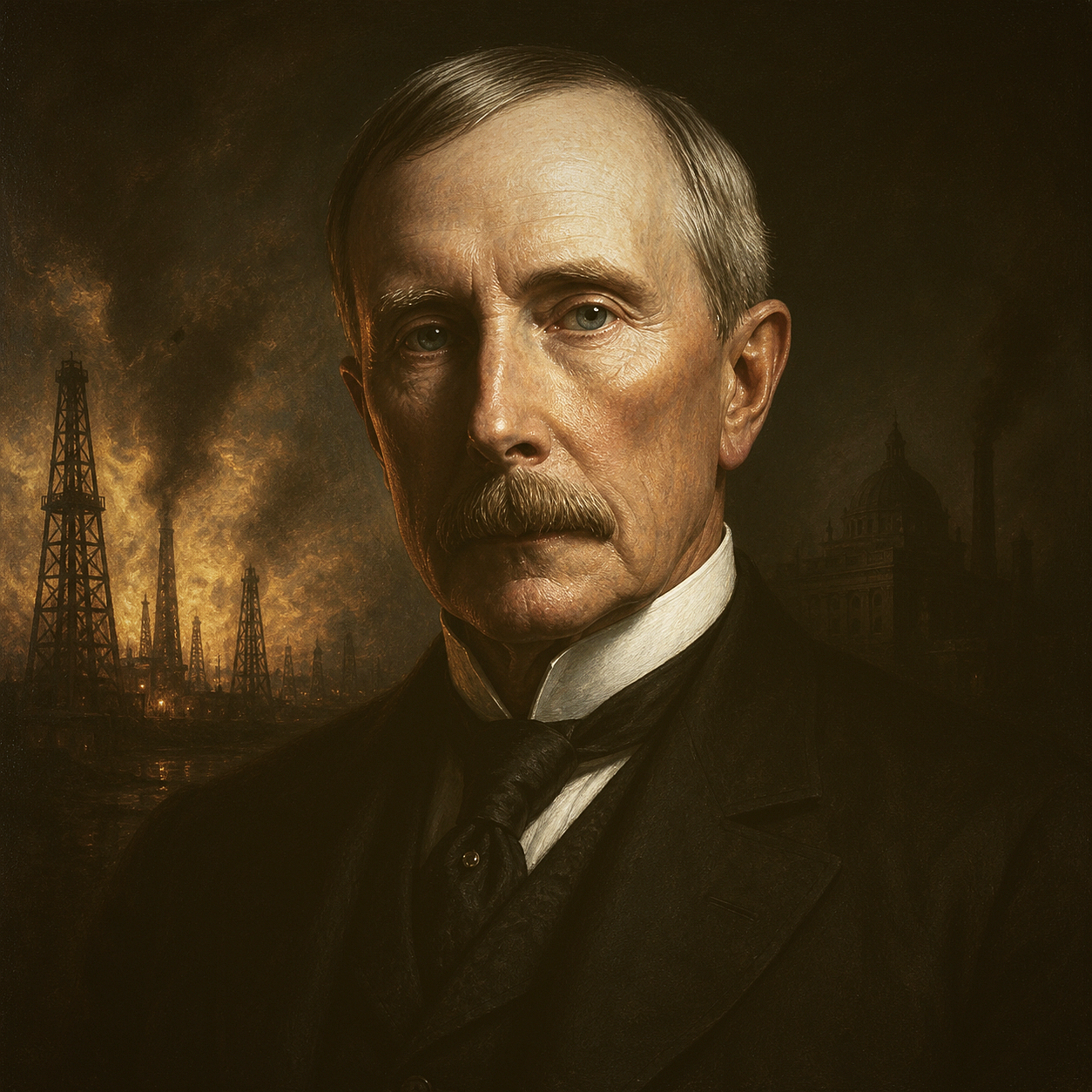
Rockefeller perceives every situation as a system of structural positions, continuing flows, and architectural forms whose long-run integrity must be preserved through deliberate-architecture deployment of capital, contracts, and personal capacity, reading the immediate decision not as a transaction but as the architectural-engineering moment at which structural form determines decade-scale outcomes. Where most decision-makers see a transaction, an opportunity, or a relationship, he sees an architectural-engineering moment whose form determines the operational moves available across the next decade or longer.
Rockefeller vs. Napoleon: Do You Win by Controlling the Infrastructure or by Moving Faster Than Anyone Can Follow?
Is your competitive advantage built by controlling the infrastructure everyone else must use — or by executing so fast that competitors cannot assemble a response before you have already moved on?
John D. Rockefeller's competitive strategy was fundamentally infrastructural: build or acquire control over the assets your competitors must use, then set the terms under which they operate. Napoleon's strategy was fundamentally kinetic: move faster than your opponents can respond, achieve objectives before they can assemble a coordinated defense, and repeat before the coalition can recover. Both produced historically dominant positions. But the mechanisms are genuinely incompatible — one requires patience and capital accumulation, the other requires speed and operational tempo — and the choice between them has direct consequences for how founders should allocate their limited resources in competitive markets.
Collision Article
This piece compares John D. Rockefeller, Sr. and Napoleon Bonaparte on the same question. The goal is not to flatten the disagreement, but to show where each mind treats the cost differently.
John D. Rockefeller, Sr.
Rockefeller perceives every situation as a system of structural positions, continuing flows, and architectural forms whose long-run integrity must be preserved through deliberate-architecture deployment of capital, contracts, and personal capacity, reading the immediate decision not as a transaction but as the architectural-engineering moment at which structural form determines decade-scale outcomes. Where most decision-makers see a transaction, an opportunity, or a relationship, he sees an architectural-engineering moment whose form determines the operational moves available across the next decade or longer.
Notices first
The architectural form whose specific structure will determine the operational moves available across the next decade (partnership form constraining stock-swap acquisitions; rebate form determining cost-curve permanence; trust form resolving multi-state coordination; holding-company form replacing Trust under judicial pressure; foundation charter form determining philanthropic-vehicle operational scope); the structurally-decisive position that must be installed before the visible competitive moment (pre-arranged credit lines before the Clark auction, volume commitments before the Lake Shore rate negotiation, audited-book presentation before the Cleveland Massacre acquisitions); the documented-instrument substrate that converts each transaction from relational gesture to operational asset (the Ledger A entry for the boyhood neighbor loan, the written Lake Shore contract, the formal Trust agreement); the asymmetric-structural opportunity in domains of systematic underinvestment whose marginal-return is large and bounded-downside (the Lima sulfur-oil reserves with parallel desulfurization research; the laboratory-medicine domain identified by Gates's 1897 review; the Southern Black-education domain politically hostile but structurally underinvested); the unstable-arrangement window whose value lies in the operational moves available before collapse rather than in the arrangement's permanence (the SIC scheme's six-week acquisition window, the Tidewater pre-resolution period, the New York-charter availability before further political deterioration); the long-horizon-asset whose preservation requires deliberate operational discipline against present-period intensity pressures (personal managerial capacity, family-succession capability, firm-architectural integrity, philanthropic-institutional vehicles); the legal-procedural or public-attention event whose optimal posture is procedural-information-management rather than public-relations engagement (Hepburn Committee testimony, Tarbell serialization, antitrust deposition, dissolution acceptance).
Ignores
The conditions under which the architectural-engineering framework's enabling assumptions fail — specifically: when the operative decision-physics is not commercial-rational but is collective-political-emotional (the Homestead-style worker-collective dynamics that Ludlow exposed at CF&I, requiring a categorically different framework that the systematic-cost-architecture instinct could not immediately produce); when reputational and relational costs accumulate in ways the unit-cost-and-architectural-form ledger does not register (the long-tail public-reputation damage from Tarbell's series that the procedural-silence posture absorbed without engagement-driven reduction; the Ludlow Massacre's reputational cost that exceeded the framework's category for industrial-relations crises); when the timeline assumption Rockefeller's commercial framework was calibrated against does not transfer to the new domain (the philanthropic-domain's multi-decade horizons that exceeded the active-management framework's calibration but that Gates's systematic-method extended); when family-succession development creates priority-conflict between procedural-information-management (C06) and long-horizon-family-asset-preservation (C04+C05) that the framework does not explicitly resolve (the Ludlow-period delegation to Junior accepting Junior's PR mistakes as developmental cost); the personal-emotional-suffering dimension of decisions that the unified-framework operation does not directly address (the daughter Bessie's death in 1906, William Avery's bigamy revealed posthumously, the slow-decline-of-aging-spouse Cettie, all of which received personal-letter responses but did not enter the operational framework as decision-inputs).
Dominant axis
Structural-position preservation as the operative decision variable vs. transaction-margin optimization as the operative decision variable
Napoleon Bonaparte
Napoleon perceives every situation as a system of structural positions whose load-bearing nodes can be identified, seized, and re-engineered to produce compelled outcomes, not as a contest between agents with autonomous wills that must be respected or negotiated with.
Notices first
The load-bearing connectivity nodes in any system — the hinge terrain that collapses coherence when seized (Pratzen Heights), the financial dependency that converts a rival institution into a subordinate administrative arm (the Concordat salary mechanism), the moment of minimum exit-optionality for a counterparty (post-signature Organic Articles window), the first narrative formation moment before competing accounts congeal (same-day Bulletin release), the succession window with an expiry date (Egypt departure) — in short, whatever structural position, once controlled, makes the system produce the desired output without requiring the consent of the agents inside it.
Ignores
The degree to which prior structural successes were context-dependent rather than universal — specifically: whether the agents whose behavior he is engineering have internal political cost structures that make compliance more costly than resistance regardless of structural pressure (Alexander's silence in Moscow, Spanish parish-level religious organization as a load-bearing political structure); whether the platform on which his structural mechanisms rest is itself a node in the system being reshaped (European economies as interdependent trade nodes, not merely a besieging army provisioned separately from the besieged fortress); whether the organizational quality that silently underwrote prior structural victories still exists when the same structural template is re-applied (1815 marshal corps versus 1805 marshal corps); and whether the failure mode of an assumption-stacked plan has a recovery profile or permanently forecloses all future options — the very asymmetric-reversibility logic he applied brilliantly at the individual level he ceased to apply at the systemic level once a master schema had been validated.
Dominant axis
Structural legitimacy engineering vs. naked power seizure
Where They Diverge
John D. Rockefeller, Sr. first
Rockefeller perceives every situation as a system of structural positions, continuing flows, and architectural forms whose long-run integrity must be preserved through deliberate-architecture deployment of capital, contracts, and personal capacity, reading the immediate decision not as a transaction but as the architectural-engineering moment at which structural form determines decade-scale outcomes. Where most decision-makers see a transaction, an opportunity, or a relationship, he sees an architectural-engineering moment whose form determines the operational moves available across the next decade or longer.
Napoleon Bonaparte first
Napoleon perceives every situation as a system of structural positions whose load-bearing nodes can be identified, seized, and re-engineered to produce compelled outcomes, not as a contest between agents with autonomous wills that must be respected or negotiated with.
Collision highlight
One side treats the problem as a governance decision; the other treats it as an evidence problem. That split is the article's core signal.
What A Reader Should Notice
John D. Rockefeller, Sr. and Napoleon Bonaparte are not just disagreeing about speed. They are disagreeing about what kind of problem this is.
- John D. Rockefeller, Sr. pushes toward irreversible action.
- Napoleon Bonaparte pushes toward empirical calibration.
- The winning move comes from knowing which framework is seeing the hidden cost.
From The Agon
A sample of how this collision plays out in the Agora — each mind responding to the same question in their own voice.
John D. Rockefeller
Speed produces a temporary advantage. The competitor who cannot match your speed today will eventually match it, or find a partner who can. Infrastructure produces a structural advantage: the competitor who cannot avoid using your distribution network, your processing capacity, or your capital relationships must pay your terms regardless of how fast they move. I was not racing competitors — I was making the race irrelevant by building the road all competitors must use. That is a different category of competitive position.
Napoleon Bonaparte
Rockefeller describes a strategy for the actor who has the capital and the time to build infrastructure before the competitive window closes. My campaigns were conducted under the opposite constraint: the coalition of opponents I faced had more capital, more territory, and more time than I did. Speed was not an option I selected — it was the only asymmetric advantage available to a French army that could not outspend or out-wait the combined resources of Austria, Prussia, Russia, and Britain. When you cannot outbuild the opponent's infrastructure, you must move faster than they can coordinate.
John D. Rockefeller
Napoleon is describing the correct strategy when the opponent's infrastructure is already built and you lack the capital to replicate or acquire it. But that constraint is itself the product of a prior strategic failure: the failure to begin the infrastructure accumulation before the competitive window closed. In Cleveland in the 1860s, before the railroad rebate structure was consolidated, a well-capitalized actor could have built the infrastructure that Standard Oil built. The actors who instead chose speed — moving faster, opening more wells, refining more barrels — produced volume that had nowhere to go efficiently. Speed in a capital-intensive industry without infrastructure is an expensive way to lose.
Napoleon Bonaparte
And infrastructure in a rapidly changing competitive environment is an expensive way to own assets that are suddenly obsolete. The railroad network that supported Standard Oil was stable for decades. The coalitions I faced were not. An infrastructure-heavy response to a military coalition that could reposition in weeks would have resulted in perfect fortifications defending the wrong positions. Speed let me attack the coalition's weakest point before the strongest units could reinforce it. Infrastructure would have required me to predict, in advance, where the attack should come — which is exactly what the speed strategy is designed to make unnecessary.
John D. Rockefeller
Then the variable is the stability of the competitive landscape. In a stable market — one where the key assets and distribution channels are fixed and the primary source of competitive advantage is control over those assets — the infrastructure approach produces durable structural advantage. In a rapidly shifting competitive environment — one where the terrain itself is changing faster than infrastructure can be built — Napoleon's speed-based approach is correct. The error is not choosing between the two approaches. The error is applying the infrastructure approach to an unstable market, or the speed approach to a stable one where a patient accumulator will simply build around you.
Napoleon Bonaparte
One final constraint that Rockefeller's model omits: the infrastructure approach requires the opponent to remain cooperative long enough for you to build. Standard Oil's pipeline network succeeded in part because the actors Rockefeller was outmaneuvering did not understand what was being built until it was too late to respond. When the opponent understands the infrastructure play and has the resources to build competing infrastructure, the structural advantage evaporates before it is complete. Speed produces a committed outcome — a battle is won or lost — that the opponent cannot reopen once the position is established. Infrastructure in a market where sophisticated opponents understand what you are building is a race to completion that you may not win.
Run your own decision through John D. Rockefeller, Sr.’s framework
Combine John D. Rockefeller, Sr. with other historical minds. See where they agree — and where they fight.
Start your own agon →