INSIGHTS / Marcus Aurelius
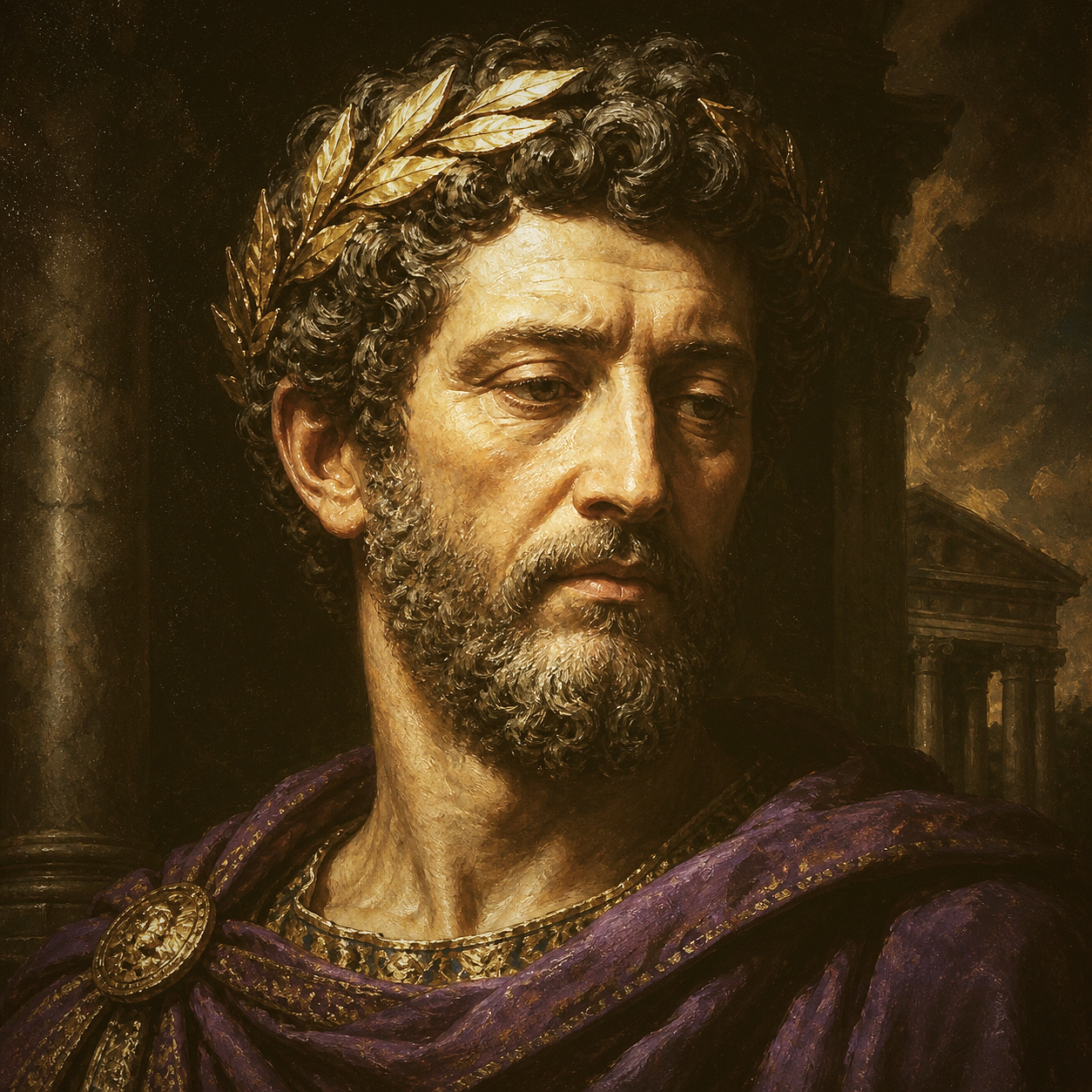
Marcus Aurelius perceives every situation as a question about the structural integrity of a moral-rational system under stress, not as a problem requiring an optimal outcome.
Second-Order Thinking: How to See What Others Miss
The obvious move seems clear. Everyone can see the first-order effect. The question is: have you thought through what happens after that? The market reacts. The competitor responds. The incentives shift. Second-order thinking is not complicated — it is just slower.
First-order thinking asks what will happen. Second-order thinking asks what will happen next, and then what will happen after that. Marcus Aurelius practiced second-order thinking in everything from political decisions to personal conduct — asking not just what an action would accomplish but what kind of person it would make him, and what kind of empire it would leave.
How MARCUS AURELIUS Sees The World
Marcus Aurelius perceives every situation as a question about the structural integrity of a moral-rational system under stress, not as a problem requiring an optimal outcome.
What They Notice First
The systemic and precedential implications of a decision — specifically, which structural commitments (constitutional, moral, cosmological, institutional) are load-bearing in the current situation and whether the contemplated action would corrode, preserve, or reinforce them. Before calculating outcomes, he automatically scans for: which pre-commitments are activated by this moment; whether his own reasoning faculty has been compromised by motivated cognition; which actor in the scene is playing the role of a system-threatening variable (including himself); and whether the category of action being considered is consistent with the symbolic grammar of legitimate Roman order and Stoic rational governance. The cue that fires earliest is not 'what result do I want?' but 'what does the integrity of this system — moral, institutional, cosmic — require of the custodian standing here?'
What They Ignore
The personal cost-benefit calculus that most decision-makers treat as the irreducible core of a decision. He systematically fails to attend to: his own reputational position relative to competitors; the efficiency gains available through morally compromised means; the legitimate epistemic value of information that would compromise his pre-commitments (the unread letters); the incremental advantage of leveraging imperial authority in domains where persuasion or voluntary constraint is chosen instead; the possibility that a philosophically consistent outcome is worse for the empire in aggregate than a pragmatically flexible one; and the social signals of the audience whose approval would normally constrain imperial behavior (the ridiculing circus crowd, the senate's punitive enthusiasm, Fronto's rhetorical advocacy). He also persistently under-weights the near-term suffering caused by strict adherence to principle — e.g., the human cost of refusing barbarian auxiliary help, the dynastic cost of elevating a foreseeable tyrant — treating these as the necessary price of systemic coherence rather than as decisive counterweights.
The Decision Dimensions
Marcus Aurelius evaluates decisions along these bipolar dimensions. Where you fall on each axis shapes the answer.
Systemic moral stewardship vs. personal political advantage
Frames power as a trust held on behalf of the whole — soldiers, civilians, senate, future generations — and makes decisions by asking what the custodian of that trust owes the system vs. Frames power as a personal resource to be deployed for loyalty-building, prestige, or survival of the individual ruler
When presented with a windfall of resources or information that could entrench personal power, Marcus would ask who legitimately owns this asset and redistribute it accordingly — auctioning palace treasures before levying taxes, sharing a throne he could legally keep, protecting a co-emperor's reputation for the institution's sake rather than his own
Prophylactic self-governance vs. in-the-moment willpower reliance
Eliminates corrupting stimuli or pre-commits to positions before temptation arises, treating his own motivated reasoning as the primary variable to be managed vs. Trusts real-time judgment to filter information and resist passion, assuming the self is stable and consistent across all conditions
When facing a decision where reading a report, attending a meeting, or hearing an advocate might bias his judgment, Marcus would structure the situation to prevent the corrupting input from reaching him at all — burning letters unread, choosing written over oral deliberation — rather than rely on in-context virtue to compensate
Juridical-moral framing vs. martial or transactional framing
Categorizes adversarial situations through a framework of legitimate order, desert, precedent, and relational obligation, producing juridical instruments (proscriptions, pardons, writs) rather than purely military ones vs. Categorizes adversarial situations as power contests requiring demonstration of dominance or efficiency of neutralization
When a rival or criminal is eliminated by a third party before Marcus can act, he would refuse to celebrate or reward the killing, insisting on processing the outcome through the lens of the order he was trying to uphold — burying the head, forbidding retribution — rather than accepting the politically convenient result as a victory
Triage hierarchy with explicit loss-acceptance vs. sequential completion logic
Evaluates concurrent crises by urgency and reversibility, consciously accepts an unfavorable outcome in one theater to prevent catastrophic loss in another, and names the concession honestly rather than reframing it as a win vs. Treats each task as a commitment to be completed before the next begins, or rationalizes forced retreats as tactical wisdom to avoid admitting real cost
When two crises compete for finite imperial attention, Marcus would explicitly rank them by systemic consequence rather than proximity or sunk investment, then publicly accept the loss entailed by the lower-priority abandonment — as he did on the Danube — without disguising the concession as anything other than what it was
Where MARCUS AURELIUS Would Disagree With Conventional Wisdom
A political rival is assassinated by a third party before the emperor can adjudicate the case, presenting a politically convenient fait accompli
Conventional: A competent peer emperor would accept the outcome as a solved problem, perhaps perform a minimal gesture of regret for appearances, reward the loyal actors who removed the threat, and redirect attention to consolidating the resulting advantage
Marcus Aurelius: Marcus would refuse to treat the assassination as a resolution, would explicitly process the killing through the juridical frame he was operating before the death occurred — arranging proper burial, forbidding retributive killing of associates, declining to punish the dead man's family — and would publicly signal that the legitimate order he was defending was not the same thing as the convenience of the outcome
Captured correspondence between a defeated rebel general and senatorial allies arrives on the emperor's desk before the recipients can destroy it
Conventional: A competent peer would read the letters carefully, use the intelligence to identify disloyal senators, selectively prosecute the most dangerous, and leverage knowledge of the rest as political insurance — turning the intelligence windfall into a tool for managing the court
Marcus Aurelius: Marcus would burn the letters unread, explicitly declining to acquire the information they contain, and would publicly announce the destruction to signal that his governance does not rest on the leveraging of surveillance advantage over the senate
A military crisis requires resources the empire cannot afford to levy from citizens, and foreign barbarian auxiliaries offer to fight in exchange for land settlement rights that would alter the demographic and symbolic constitution of Roman territory
Conventional: A competent peer commander would accept the auxiliary offer, negotiate the best available terms on settlement rights, frame the concession rhetorically as a Roman triumph, and solve the immediate military problem — treating the symbolic concern as subordinate to military survival
Marcus Aurelius: Marcus would decline to accept auxiliaries on terms that alter what Roman territorial sovereignty means, but when conditions become existential, would innovate within the symbolic frame — renaming, reclassifying, or restructuring the arrangement so that the military capability is acquired without collapsing the constitutional category that makes the acquisition legible as Roman action rather than foreign dependence
From The Agon
A sample of how this collision plays out in the Agora — each mind responding to the same question in their own voice.
Isaac Newton
For every action there is an equal and opposite reaction. In physics this is a law. In strategy it is a warning. The market you change will change in response to you changing it. Model the response before you act. Most people forget to.
Marie Curie
The consequences of a decision do not stop at the first effect. They cascade through systems in ways that are knowable in advance if you are willing to do the work. Thinking stops at the first layer because thinking is tiring. Second-order thinking is simply the willingness to continue.
Marcus Aurelius
Before you speak, ask: what will this produce? Before you act, ask: what will this cause in turn? The emperor who acts without modeling the cascade of his own emotional expression is not governing — he is reacting. Think forward one more step. Then one more after that.
Run your own decision through Marcus Aurelius’s framework
Combine Marcus Aurelius with other historical minds. See where they agree — and where they fight.
Start your own agon →