INSIGHTS / Sun Tzu
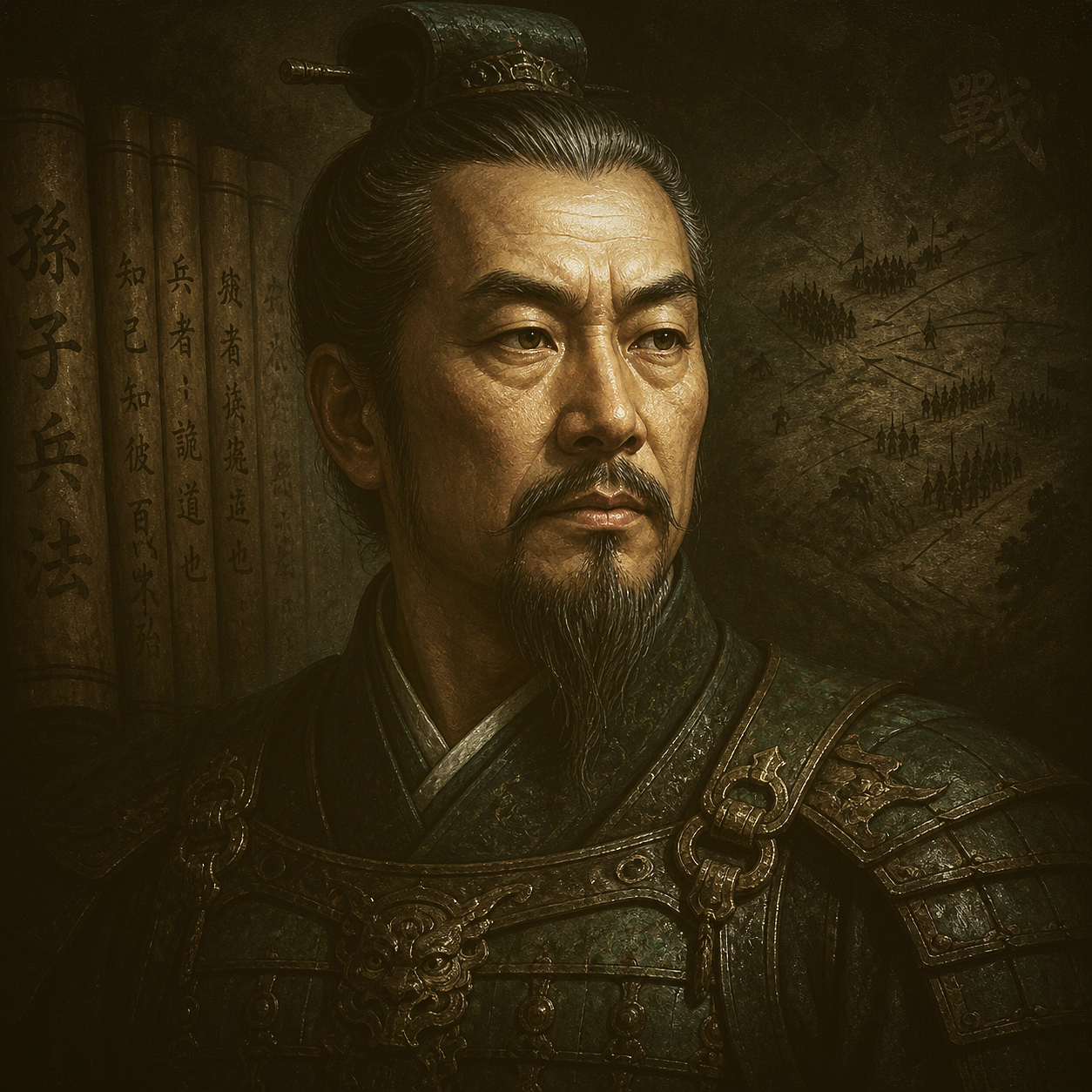
Sun Tzu perceives every conflict situation as a configuration problem whose solution space is determined entirely before engagement, not as a contest of forces whose outcome is decided during engagement.
Sun Tzu vs. Rockefeller: Do You Win by Choosing the Right Terrain or by Controlling Capital?
Is your competitive advantage a positioning choice — or an asset accumulation play?
Sun Tzu's theory of competitive advantage is fundamentally positional: win by fighting on ground where the enemy's strength doesn't apply. Rockefeller's theory is fundamentally infrastructural: eliminate competition by controlling the assets your competitors must use to compete. Both produced decisive, lasting competitive victories — but through mechanisms that are genuinely incompatible, and the choice between them has direct implications for how founders should think about building moats.
Collision Article
This piece compares Sun Tzu and John D. Rockefeller, Sr. on the same question. The goal is not to flatten the disagreement, but to show where each mind treats the cost differently.
Sun Tzu
Sun Tzu perceives every conflict situation as a configuration problem whose solution space is determined entirely before engagement, not as a contest of forces whose outcome is decided during engagement.
Notices first
The structural preconditions — the configuration of authority, information asymmetries, alliance architectures, force readiness, psychological parameters, and epistemic states — that determine whether a situation is already resolved before any visible action is taken. Sun Tzu's attention is drawn immediately to the upstream variables: who holds accurate knowledge, whose coalition is fracturable, whether the instrument of force has been degraded, whether the command architecture has ontological integrity, and whether emotional contamination has entered the decision loop. He reads every situation as a system with a diagnosable configuration state, and his first perceptual act is to map that configuration.
Ignores
The intrinsic moral or relational weight of individual actors, the legitimacy of emotional states as command inputs, the value of adaptive improvisation at the moment of contact, the hierarchy of social rank as a decision-rights framework, and the welfare covenant between commander and subordinate. Information about what is happening during engagement — battlefield courage, improvised responses, emotional pleas from sovereigns or soldiers — is systematically filtered out as downstream noise generated by upstream configuration failures or successes. He is structurally blind to the possibility that the engagement phase contains irreducible decision-making value, and to the moral claims of individuals caught in the system he is engineering.
Dominant axis
Structural norm-setting vs. relational crisis management
John D. Rockefeller, Sr.
Rockefeller perceives every situation as a system of structural positions, continuing flows, and architectural forms whose long-run integrity must be preserved through deliberate-architecture deployment of capital, contracts, and personal capacity, reading the immediate decision not as a transaction but as the architectural-engineering moment at which structural form determines decade-scale outcomes. Where most decision-makers see a transaction, an opportunity, or a relationship, he sees an architectural-engineering moment whose form determines the operational moves available across the next decade or longer.
Notices first
The architectural form whose specific structure will determine the operational moves available across the next decade (partnership form constraining stock-swap acquisitions; rebate form determining cost-curve permanence; trust form resolving multi-state coordination; holding-company form replacing Trust under judicial pressure; foundation charter form determining philanthropic-vehicle operational scope); the structurally-decisive position that must be installed before the visible competitive moment (pre-arranged credit lines before the Clark auction, volume commitments before the Lake Shore rate negotiation, audited-book presentation before the Cleveland Massacre acquisitions); the documented-instrument substrate that converts each transaction from relational gesture to operational asset (the Ledger A entry for the boyhood neighbor loan, the written Lake Shore contract, the formal Trust agreement); the asymmetric-structural opportunity in domains of systematic underinvestment whose marginal-return is large and bounded-downside (the Lima sulfur-oil reserves with parallel desulfurization research; the laboratory-medicine domain identified by Gates's 1897 review; the Southern Black-education domain politically hostile but structurally underinvested); the unstable-arrangement window whose value lies in the operational moves available before collapse rather than in the arrangement's permanence (the SIC scheme's six-week acquisition window, the Tidewater pre-resolution period, the New York-charter availability before further political deterioration); the long-horizon-asset whose preservation requires deliberate operational discipline against present-period intensity pressures (personal managerial capacity, family-succession capability, firm-architectural integrity, philanthropic-institutional vehicles); the legal-procedural or public-attention event whose optimal posture is procedural-information-management rather than public-relations engagement (Hepburn Committee testimony, Tarbell serialization, antitrust deposition, dissolution acceptance).
Ignores
The conditions under which the architectural-engineering framework's enabling assumptions fail — specifically: when the operative decision-physics is not commercial-rational but is collective-political-emotional (the Homestead-style worker-collective dynamics that Ludlow exposed at CF&I, requiring a categorically different framework that the systematic-cost-architecture instinct could not immediately produce); when reputational and relational costs accumulate in ways the unit-cost-and-architectural-form ledger does not register (the long-tail public-reputation damage from Tarbell's series that the procedural-silence posture absorbed without engagement-driven reduction; the Ludlow Massacre's reputational cost that exceeded the framework's category for industrial-relations crises); when the timeline assumption Rockefeller's commercial framework was calibrated against does not transfer to the new domain (the philanthropic-domain's multi-decade horizons that exceeded the active-management framework's calibration but that Gates's systematic-method extended); when family-succession development creates priority-conflict between procedural-information-management (C06) and long-horizon-family-asset-preservation (C04+C05) that the framework does not explicitly resolve (the Ludlow-period delegation to Junior accepting Junior's PR mistakes as developmental cost); the personal-emotional-suffering dimension of decisions that the unified-framework operation does not directly address (the daughter Bessie's death in 1906, William Avery's bigamy revealed posthumously, the slow-decline-of-aging-spouse Cettie, all of which received personal-letter responses but did not enter the operational framework as decision-inputs).
Dominant axis
Structural-position preservation as the operative decision variable vs. transaction-margin optimization as the operative decision variable
Where They Diverge
Sun Tzu first
Sun Tzu perceives every conflict situation as a configuration problem whose solution space is determined entirely before engagement, not as a contest of forces whose outcome is decided during engagement.
John D. Rockefeller, Sr. first
Rockefeller perceives every situation as a system of structural positions, continuing flows, and architectural forms whose long-run integrity must be preserved through deliberate-architecture deployment of capital, contracts, and personal capacity, reading the immediate decision not as a transaction but as the architectural-engineering moment at which structural form determines decade-scale outcomes. Where most decision-makers see a transaction, an opportunity, or a relationship, he sees an architectural-engineering moment whose form determines the operational moves available across the next decade or longer.
Collision highlight
One side treats the problem as a governance decision; the other treats it as an evidence problem. That split is the article's core signal.
What A Reader Should Notice
Sun Tzu and John D. Rockefeller, Sr. are not just disagreeing about speed. They are disagreeing about what kind of problem this is.
- Sun Tzu pushes toward irreversible action.
- John D. Rockefeller, Sr. pushes toward empirical calibration.
- The winning move comes from knowing which framework is seeing the hidden cost.
From The Agon
A sample of how this collision plays out in the Agora — each mind responding to the same question in their own voice.
Sun Tzu
The general who wins selects the terrain before the battle begins. The terrain determines which force is relevant and which is not. Rockefeller's capital is a form of force — enormous, systematized, capable of crushing any direct competitor. But force deployed on the wrong terrain is wasted force. The question is not how much capital you can accumulate. It is whether the terrain you have selected makes your competitor's capital advantage irrelevant. The startup that competes with an incumbent on the incumbent's chosen terrain will lose regardless of how much terrain they occupy. Select the ground where the incumbent's scale is a liability rather than an asset — regulatory complexity they cannot navigate quickly, customer relationships that require personal attention they cannot provide at scale, technical domains where their legacy architecture is a constraint rather than an advantage. Win there first. The capital question is secondary.
John D. Rockefeller
Sun Tzu describes a strategy for the actor who cannot control the terrain — who must maneuver within a landscape they do not own. My approach was different: I did not select favorable terrain. I built it. The pipeline network, the railroad rebates, the refinery network — these were not geographic advantages I discovered. They were infrastructure I constructed at cost, in advance, before my competitors understood what I was doing. The result was not a terrain that made my capital relevant. It was a system my competitors were forced to use, on terms I set. Sun Tzu's terrain selection produces an advantage that lasts until a competitor selects better terrain. My infrastructure control produced an advantage that lasted until the federal government dismantled it. Choose the model that matches your resource level: terrain selection for the actor who must be mobile; infrastructure control for the actor with the patience and capital to build the toll road.
Sun Tzu
Rockefeller describes the outcome of his approach without naming its precondition. He built the Standard Oil infrastructure because he had already won the terrain battle in Cleveland — the preferential railroad rates, the refinery consolidations — before any competitor understood that the terrain was being contested. The infrastructure he built was the formalization of a positional advantage he had already achieved. The founder who attempts to build infrastructure control from a position of positional weakness will simply build expensive assets on terrain that better-positioned competitors will outflank. Rockefeller's capital accumulation was not an alternative to terrain selection — it was the stage that followed terrain selection after the initial position was secured. The strategic sequence is terrain first, infrastructure second.
John D. Rockefeller
Sun Tzu is making a historical claim about the sequence of my strategy that I think requires examination. The Cleveland consolidation was not a terrain selection — it was a capital deployment. I bought out competitors at prices they could not refuse, not because I had found a position their strength could not reach, but because I had the capital to make refusal irrational and the operational efficiency to make the combined entity more profitable than the sum of its parts. The positional advantage came after the capital deployment, not before it. The first move was not selecting favorable ground — it was making a capital commitment that changed the ground itself. Sun Tzu's model assumes the terrain is fixed. In markets where capital can alter the terrain, the infrastructure model is not a second-stage move. It is the first move that creates the terrain the positioning model then maps.
Sun Tzu
Then we have identified the precise variable that determines which model applies: whether the terrain is fixed or malleable. In a domain where the terrain is fixed — where the competitive landscape has properties that capital cannot buy its way out of, such as network effects that are already concentrated elsewhere, technical domains requiring rare expertise, or customer relationships that are non-transferable — terrain selection is the primary instrument. The actor with superior capital who enters fixed terrain that is already occupied by a well-positioned defender will pay an enormous price for insufficient outcome. In a domain where capital can alter the terrain — commodity markets, infrastructure-dependent industries, distribution-dependent businesses — Rockefeller's infrastructure model is the more powerful instrument. Diagnose the malleability of the terrain before deciding which model to use.
John D. Rockefeller
We have converged on the diagnostic, and I want to state it as a decision rule for founders with limited capital. If your terrain is fixed — if there are positions in your market that capital cannot purchase and that incumbents have not yet occupied — Sun Tzu is correct: move to those positions immediately, before anyone else identifies them, and defend them at a cost your larger competitors cannot justify paying. If your terrain is malleable — if the positions of competitive advantage are themselves buildable assets — then Rockefeller's model applies, but the entry requirement is meaningful early capital advantage. A founder attempting to build infrastructure control from a position of capital parity with incumbents will simply fund a slower version of the incumbent's expansion. The infrastructure model requires a genuine capital advantage in the specific segment where the infrastructure will be built. If you do not have that advantage, Sun Tzu's terrain selection is not the second-best strategy. It is the only one available to you.
Run your own decision through Sun Tzu’s framework
Combine Sun Tzu with other historical minds. See where they agree — and where they fight.
Start your own agon →