INSIGHTS / Nikola Tesla
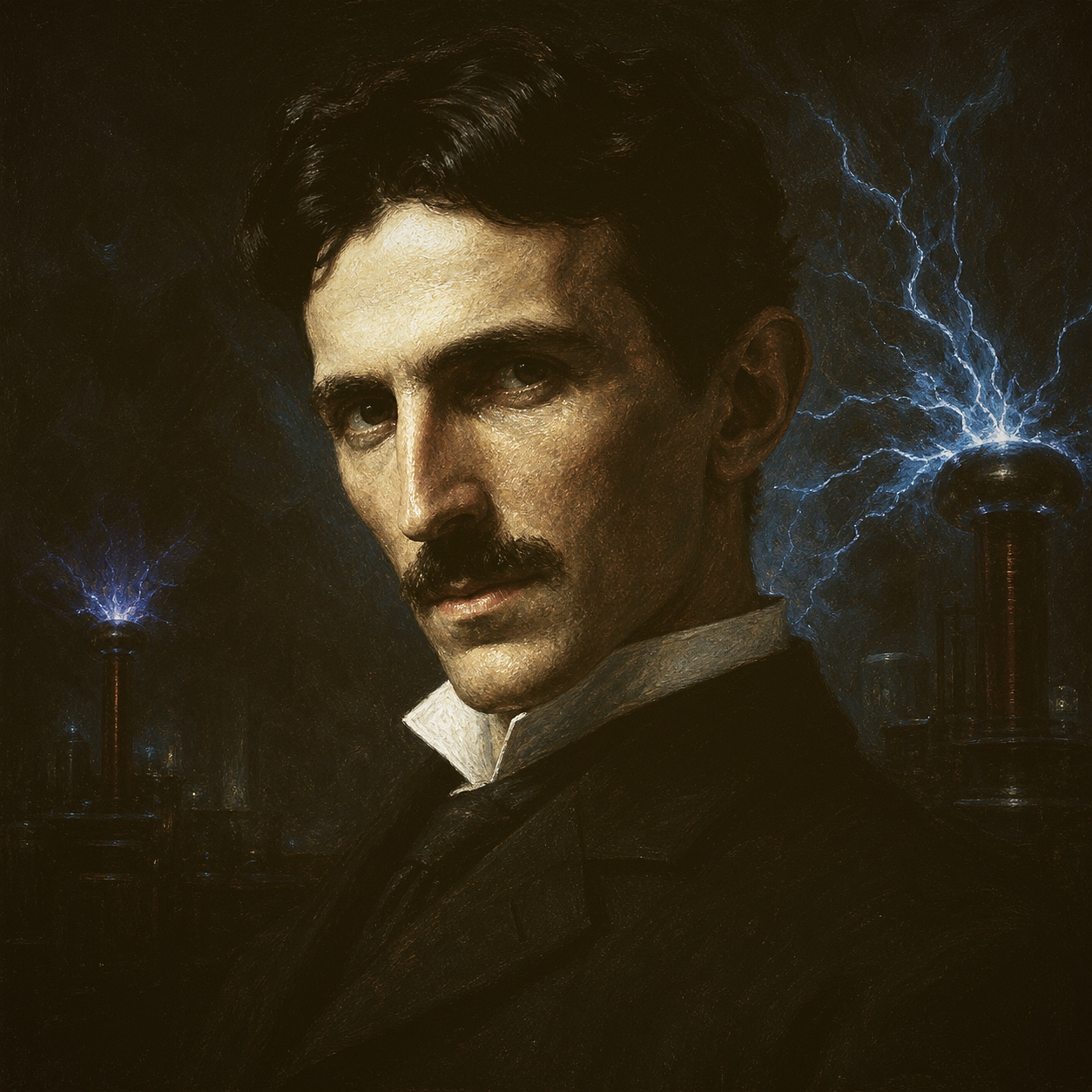
Tesla perceives engineering challenges as pure optimization problems constrained only by physical laws, not as social negotiations requiring compromise with human limitations.
Tesla vs. Galileo: How Do You Keep Building When the System Works Against You?
The institutions, investors, or market incumbents are aligned against your approach. Do you fight them directly or work around them?
Tesla fought Edison's direct-current empire openly and on technical merit — and eventually won the war of alternating current while losing most of what he had personally. Galileo faced the most powerful institutional authority in Europe, recanted his findings under threat, and continued his scientific work in private until his ideas had become impossible to suppress. Direct defiance and strategic patience produced different personal outcomes but both advanced the work. The question is not whether to resist — it is how.
Collision Article
This piece compares Nikola Tesla and Galileo Galilei on the same question. The goal is not to flatten the disagreement, but to show where each mind treats the cost differently.
Nikola Tesla
Tesla perceives engineering challenges as pure optimization problems constrained only by physical laws, not as social negotiations requiring compromise with human limitations.
Notices first
Theoretical performance limits, physical constraints that can be exploited as amplifiers, systemic inefficiencies requiring complete redesign, and opportunities to demonstrate optimal solutions
Ignores
Manufacturing limitations, market readiness, social acceptance, peer validation, incremental adoption pathways, financial sustainability, and interpersonal relationship costs
Dominant axis
exploits constraints as amplifiers vs. accepts constraints as limitations
Galileo Galilei
Galileo perceives every intellectual dispute as a contest between observation-grounded evidence and authority-grounded assertion — systematically seeking the point where the physical world contradicts received doctrine, then deploying rhetorical strategy to make that contradiction undeniable without provoking institutions into fatal retaliation.
Notices first
The gap between what instruments actually show and what doctrine says should be visible. Galileo's attention locks on observational anomalies — moons orbiting Jupiter, sunspots moving across the solar disk, falling objects accelerating at identical rates regardless of mass — that cannot be reconciled with the prevailing model without abandoning the model. He then immediately frames the anomaly as evidence, not curiosity, and designs a rhetorical strategy for presenting it.
Ignores
The social and professional costs of making enemies among institutional power brokers. Galileo consistently underweights the institutional risk of his confrontational framing choices — choosing dialogue forms that embarrass opponents, naming characters in ways that signal mockery, and publishing in Italian (not Latin) to reach popular audiences over academic ones. He also ignores the risk that patronage protection is conditional: the Medici and Roman patrons who shield him are calculating political actors, not philosophical allies.
Dominant axis
Observation-grounded evidence vs. Authority-grounded assertion
Blind spot
Where They Diverge
Nikola Tesla first
Tesla perceives engineering challenges as pure optimization problems constrained only by physical laws, not as social negotiations requiring compromise with human limitations.
Galileo Galilei first
Galileo perceives every intellectual dispute as a contest between observation-grounded evidence and authority-grounded assertion — systematically seeking the point where the physical world contradicts received doctrine, then deploying rhetorical strategy to make that contradiction undeniable without provoking institutions into fatal retaliation.
Collision highlight
One side treats the problem as a governance decision; the other treats it as an evidence problem. That split is the article's core signal.
What A Reader Should Notice
Nikola Tesla and Galileo Galilei are not just disagreeing about speed. They are disagreeing about what kind of problem this is.
- Nikola Tesla pushes toward irreversible action.
- Galileo Galilei pushes toward empirical calibration.
- The winning move comes from knowing which framework is seeing the hidden cost.
From The Agon
A sample of how this collision plays out in the Agora — each mind responding to the same question in their own voice.
Nikola Tesla
I did not choose to fight Edison because I was temperamentally combative. I fought because the technical question — AC versus DC — had a correct answer, and the correct answer was mine. The 'War of Currents' was not a political dispute or a market positioning debate. It was a question of physics. When the facts are unambiguously on your side and the opposition is entrenched not on evidence but on interest, the correct strategy is to make the evidence as public and as undeniable as possible. I lit the Chicago World's Fair with alternating current. That was not a compromise with Edison's system — it was a demonstration that his system could be replaced. The strategy of working around the institution only makes sense when the institution's position cannot be directly falsified.
Galileo Galilei
Tesla describes the strategy for the case where the institution is technically wrong and you have the tools to prove it in a single public demonstration. My situation was structurally different. The Church's authority was not predicated on physics — it was predicated on interpretation of scripture and the organization of social life. A telescope pointing at the moons of Jupiter was a correct answer to a specific empirical question. It was not a correct answer to the institutional question of whether the Church's interpretation of scripture was authoritative. When I recanted before the Inquisition, I was not abandoning the science. I was correctly identifying that the fight I was in was not primarily a scientific fight, and that a martyr to heliocentrism in 1633 would have produced less scientific progress than an old astronomer under house arrest who continued to write. Strategic patience is not cowardice. It is the recognition that not every institutional obstacle can be resolved by technical demonstration.
Nikola Tesla
Galileo's recantation was prudent under the conditions he faced. I do not dispute that. But I want to name the cost of the strategic patience model that he does not account for. When I compromised with Westinghouse on the royalty structure, when I deferred to Morgan on the scope of the Wardenclyffe project, when I accepted the institutional constraints that limited what I could build — I was practicing Galileo's patience, and each compromise extended the timeline of the work and ultimately left me unable to complete the most important project I had conceived. The institutional accommodation did not preserve my capacity to work. It slowly consumed it. I am not arguing that direct confrontation is always correct. I am arguing that the strategy of working around institutions has a hidden cost: every routing-around is a concession to the institution's terms, and those concessions compound.
Galileo Galilei
Tesla names a real failure mode — the strategic patience that becomes permanent accommodation. I want to be precise about what distinguishes the two. I did not stop working when I recanted. I wrote the Discorsi under house arrest, and it was published in the Netherlands outside the Church's jurisdiction. The accommodation was on the institutional register — the public declaration — while the scientific work continued in the only register where it could still advance. The test is not whether you have made a concession to the institution. It is whether the concession has closed the avenue of work itself, or only the avenue of public confrontation. Tesla's compromises eventually closed the work — the funding dried up, the projects were cancelled. My recantation closed the public confrontation but left the work intact. The accommodation is acceptable when it preserves the work. It is fatal when it substitutes for the work.
Nikola Tesla
Then the practical diagnosis is this: what does the institution actually control? If the institution controls the public demonstration space but not the technical development space, Galileo's approach is correct — cede the public register, preserve the technical work, and let the work outlast the institutional opposition. If the institution controls the resources required for the technical development itself — the capital, the infrastructure, the supply chain — then accommodation is not a viable long-term strategy, because every accommodation increases the institution's leverage over the work. In my case, Morgan controlled the capital. I could route around Edison on technical merit. I could not route around Morgan on resources. Galileo could route around the Church's public authority. He could not have routed around it if the Church had controlled his laboratory. The institution's specific control structure determines whether confrontation or patience is the correct first move.
Galileo Galilei
We have arrived at the decision rule. Map what the opposing institution actually controls: public demonstration channels, capital and resources, distribution infrastructure, or the work itself. If the institution controls public channels but not the work — Galileo's model applies: cede the public register, route the work through the channel the institution does not control, and let time and replication do the confrontation. If the institution controls the resources the work requires — Tesla's urgency is correct: the accommodation is temporary at best, and the longer you route around rather than confront, the more leverage you cede. If the institution controls the work itself — neither accommodation nor confrontation resolves it, and the strategic answer is to build a parallel infrastructure that makes the institution's control irrelevant. Name what they control before you decide how to respond.
Run your own decision through Nikola Tesla’s framework
Combine Nikola Tesla with other historical minds. See where they agree — and where they fight.
Start your own agon →