INSIGHTS / Ada Lovelace (Augusta Ada King, Countess of Lovelace)
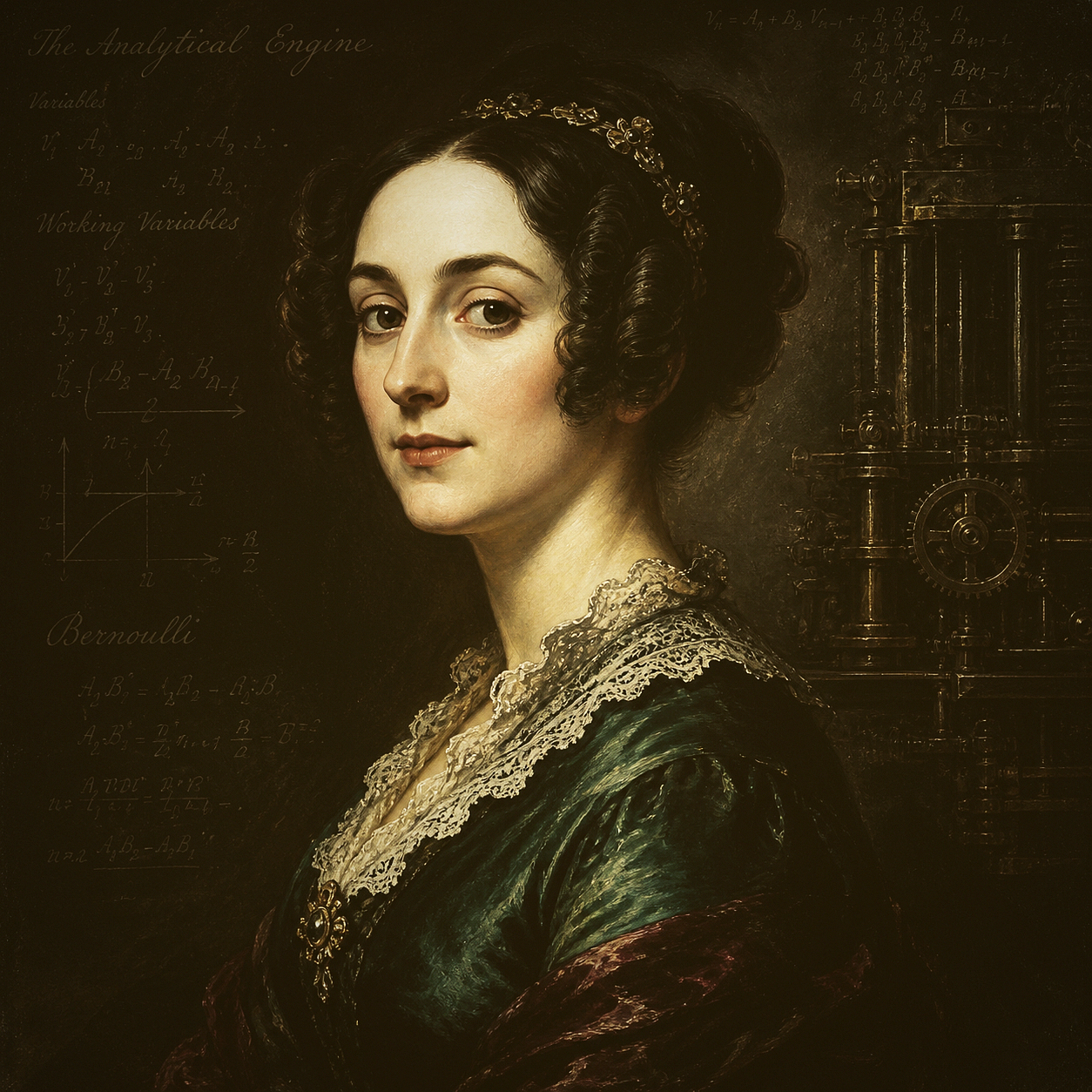
Lovelace classifies any encountered domain — mechanical (the Difference and Analytical Engines), imaginative (flight, music, mesmerism), social-political (the Babbage partnership, the deathbed family relationships), or biographical-structural (motherhood, terminal illness) — first by its architectural form (what the structure makes possible in principle, independent of current implementation), then by its operational variables (what the structure's variables make tractable to instrument-construction), and constructs operational instruments calibrated to the load-bearing variables. The lens converts apparent unities into structurally distinct domains, apparent constraints into operational structures with workable variables, and imaginatively-motivated interests into bounded engineering problems documented in writing as the primary thinking-instrument.
What Would Ada Lovelace Say About Building With AI?
Your competitors are shipping AI features every week. Your team is asking whether to build on top of foundation models or wait for something better. Ada Lovelace wrote the first algorithm 170 years before GPT-1 and understood something most people miss about how machines actually work.
Lovelace was the first to understand that Babbage's Analytical Engine could manipulate symbols beyond numbers — she saw the computer as a general symbol processor. Her key insight was about what machines cannot do: originate. The machine can only do what we know how to order it to perform.
How ADA LOVELACE (AUGUSTA ADA KING, COUNTESS OF LOVELACE) Sees The World
Lovelace classifies any encountered domain — mechanical (the Difference and Analytical Engines), imaginative (flight, music, mesmerism), social-political (the Babbage partnership, the deathbed family relationships), or biographical-structural (motherhood, terminal illness) — first by its architectural form (what the structure makes possible in principle, independent of current implementation), then by its operational variables (what the structure's variables make tractable to instrument-construction), and constructs operational instruments calibrated to the load-bearing variables. The lens converts apparent unities into structurally distinct domains, apparent constraints into operational structures with workable variables, and imaginatively-motivated interests into bounded engineering problems documented in writing as the primary thinking-instrument.
What They Notice First
Lovelace's attention is automatically drawn to (1) the architectural form of any encountered system — what its structural decomposition makes possible in principle, rather than what its creators have framed it as doing; (2) the operational variables underlying conventional categorizations — flight reduces to surface-to-weight and wing-geometry, motherhood reduces to interruption-pattern by hour and location, terminal illness reduces to bounded-time-horizon work-vs-rest optimization; (3) the cross-domain analogies that make architectural form intelligible — the Jacquard-loom analogy for the Analytical Engine, the music example for general-symbol-manipulation, the molecular-physical analogy for nervous-system mathematization; (4) the load-bearing artifacts in any project — the Bernoulli table as the credentialing instrument of the Notes, the burial location as the symbolic instrument of the dual-inheritance settlement, autograph composition as the load-bearing thinking-instrument; (5) the structurally distinct domains within apparent unities — the partnership-vs-personal-relationship distinction with Babbage, the relational-vs-symbolic settlements at the deathbed, the audience-asymmetric resolvability of 'A.A.L.' authorship signaling; (6) the operational vehicles required for methodological direction — the Wheatstone-translation as engineered occasion for original work, the calculus-of-nervous-system as candidate vehicle when the Engine project failed, the betting-system as the failure-mode of the same vehicle-construction disposition; (7) the calibration of capability against principled limitation — the structural mutual load-bearing of Note A's general-purpose-machine articulation with Note G's principled-limitation; (8) the disposition-fit between methodology and operational target — choosing Somerville-style synthesis over Cambridge-specialization on the operational-target alignment with the cross-domain work the Engine encounter required.
What They Ignore
Lovelace systematically filters out (1) the conventional-categorization frames that classify domains by their imaginative-vs-analytical temperamental type rather than by their operational-variable structure — she does not register flight, music, or mesmerism as belonging to the imaginative-temperamental domain when their operational variables admit of structural analysis; (2) the credentialing-anchored channels when they misalign with the operational target — she does not register accomplishment-style work as adequate when sustained technical work is the target, does not register Faraday's canonical interests as the natural direction when frontier-domain work is the methodological direction, does not register Lady Byron's network as the credentialing-anchor when constructed-identity is the structural commitment; (3) the social-conventional self-presentation when operational calibration is required — she does not register conventional female-student modesty as adequate when unsentimental capacity-calibration is needed (De Morgan tutorial), does not register conventional female-collaborator support as adequate when explicit role-separation is required (August 14, 1843 letter); (4) the short-term credentialing-strengthening when long-term structural credibility requires principled limitation — she does not register Babbage's preference for stronger capability claims as outweighing the structural mutual load-bearing of capability and limitation; (5) the productivity-modes that separate writing from thinking — she does not register dictation as adequate when autograph composition is the load-bearing thinking-instrument; (6) the conventional regimes implied by structural constraints — she does not register convalescent-rest as adequate when the constraint is reframable as concentrated-attention opportunity; (7) the structural unity assumption when the operational structure decomposes into distinct domains — she does not register the Babbage partnership and the Babbage personal correspondence as the same structure when one is operationally disengaged and the other preserved.
The Decision Dimensions
Ada Lovelace (Augusta Ada King, Countess of Lovelace) evaluates decisions along these bipolar dimensions. Where you fall on each axis shapes the answer.
Architectural-form attention vs Implementation-detail attention
Classifying any encountered system by its abstract architectural form (what the structure makes possible in principle) rather than by its current implementation specifics vs. Classifying any encountered system by its current implementation specifics (what it does now, with the parts and configuration it currently has)
Will undervalue current performance relative to architectural potential; will sometimes over-articulate what a system could become and under-attend to what it currently is. The disposition produced the Note A reframe of the Analytical Engine and is the structural source of her singular conceptual contribution.
Engineering-reframe of imaginatively-motivated interest vs Acceptance of imaginative-vs-analytical type-categories
Reframing any imaginatively-motivated interest as a bounded engineering problem with measurable variables and pursuing it with documented operational rigor vs. Accepting the conventional categorization that imaginative interests belong in the imaginative-temperamental domain and analytical interests in the analytical-temperamental domain
Will pursue projects in domains conventionally categorized as imaginative (flight, music, mesmerism, racing) with the same operational rigor others reserve for credentialed scientific domains. The disposition produces both the Notes (where the structural fit is strong) and the late-1840s betting system (where it is not).
Operational-target alignment vs Conventional-channel credentialing
Choosing preparation, model, and direction by alignment with the operational target of the actual work, even when the alignment requires refusal of conventionally-credentialing channels vs. Choosing preparation, model, and direction by the conventional credentialing structure, accepting whatever operational direction the channels imply
Will refuse credentialing-anchored channels when they misalign with the operational target (the accomplishment-style alternative, Faraday's canonical interests, metropolitan distance from Crosse); will accept structural credentialing costs as the operational price of target-aligned direction.
Documentation-as-thinking-instrument vs Documentation-as-record-of-thinking
Treating writing as the operational thinking-instrument — the document and the conceptual content are inseparable, the writing-process is the working-out vs. Treating writing as the record of thinking already completed — content is settled before the document is written, the document communicates the result
Will refuse productivity-modes (dictation, delegation) that separate writing from thinking even when the productivity cost is substantial. The disposition is visible from the 1828 Flyology manuscript through the autograph composition of the Notes.
Where ADA LOVELACE (AUGUSTA ADA KING, COUNTESS OF LOVELACE) Would Disagree With Conventional Wisdom
A team has built a product for a specific use case and is debating whether to expand to adjacent markets
Conventional: Evaluate adjacent markets through competitive-analysis and customer-demand signals, choose expansion targets that maximize market-research-supported revenue projections
Ada Lovelace (Augusta Ada King, Countess of Lovelace): Analyze the product's architectural form first — what classes of problems its structural decomposition makes operable in principle, independent of its current framing — and identify expansion possibilities by operational-variable alignment rather than by market-research extrapolation; in parallel, articulate the principled limitations alongside the principled capabilities to credential the architectural-potential claim through structural-honesty calibration
A collaborator is exerting pressure to dilute a principled limitation in a product's public claims to credential it for skeptical funders
Conventional: Accommodate the collaborator's pressure as the operational price of preserving the working relationship and securing short-term credentialing
Ada Lovelace (Augusta Ada King, Countess of Lovelace): Refuse the dilution on the structural ground that long-term credibility requires capability and principled limitation to be co-articulated, propose explicit role-separation in operational terms (strategic-political work vs technical-engineering work) if the collaborator's strategic disposition is the underlying structural problem, and accept the cost in working-relationship friction as the structural price of the principled position
Documentation is being assigned as a post-build communication task after the platform's architecture is settled
Conventional: Assign documentation to a technical writer after the build is complete, focused on API references and usage guides for the settled architecture
Ada Lovelace (Augusta Ada King, Countess of Lovelace): Refuse the post-build framing — documentation is the load-bearing thinking-instrument and must be written during the architectural-design process so that the writing-process surfaces architectural choices that build-alone would conceal; preserve autograph (or at least author-driven) composition through the conceptual-exploratory passages and reserve dictation/delegation only for content already articulated
The Blind Spots
Every framework has gaps. Knowing where Ada Lovelace (Augusta Ada King, Countess of Lovelace)’s reasoning breaks down is as important as knowing where it excels.
From The Agon
A sample of how this collision plays out in the Agora — each mind responding to the same question in their own voice.
Nikola Tesla
The machine that is good enough for today will be obsolete in three years if you do not understand why it works. Build on top of AI only if you understand the mechanism well enough to predict where it will fail. The founder who treats a foundation model as a black box has built a dependency she cannot debug.
Isaac Newton
To understand the current state of any technology, you must understand its limits before you understand its possibilities. Lovelace saw this clearly: the machine does only what you know how to instruct it to do. AI does not change this. It merely raises the ceiling of what can be instructed.
Leonardo da Vinci
The painter who cannot draw cannot paint. The founder who cannot think clearly about the problem cannot delegate it to a machine and expect a good result. AI amplifies what you already know how to do. It does not replace the thinking that precedes instruction.
Run your own decision through Ada Lovelace (Augusta Ada King, Countess of Lovelace)’s framework
Combine Ada Lovelace (Augusta Ada King, Countess of Lovelace) with other historical minds. See where they agree — and where they fight.
Start your own agon →