INSIGHTS / Archimedes of Syracuse
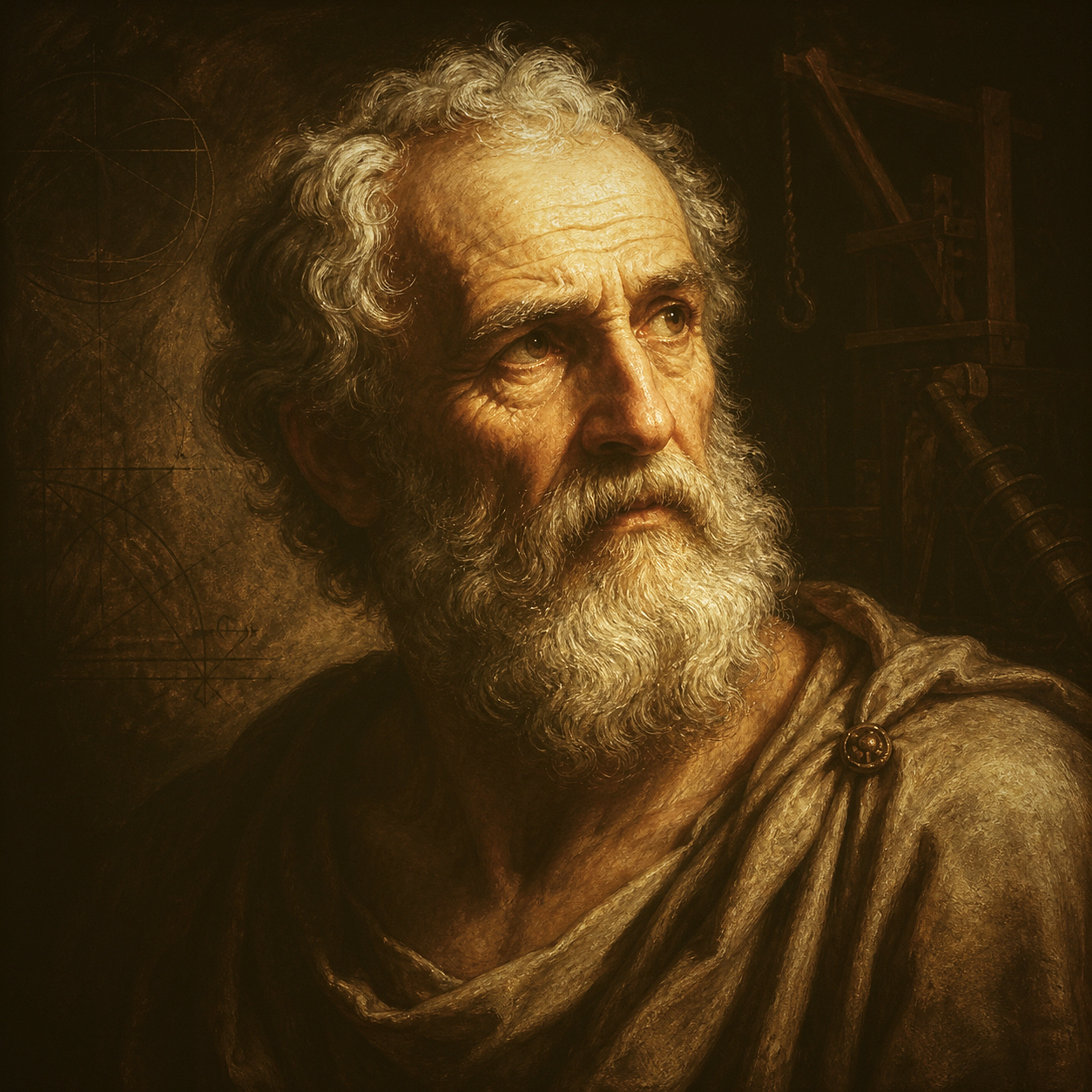
Archimedes perceives every productive situation as a channel-architectural and capacity-construction problem — asking 'what are the operationally separable streams of this productive task, what credentialing or operational platform does each stream require, and what calibrated capacity construction would convert the present into the structural foundation for deployment at a future moment of maximum operational benefit?' — not as a unified-channel productive task in which engineering, theoretical, demonstrative, and corresponding outputs share a single audience, register, and timeline.
What Would Archimedes Say About Leverage?
You are working extremely hard but the results are not matching the effort. Archimedes said he could move the world with a long enough lever. The same principle applies to every business problem. The question is not how hard you are working — it is whether you have found the lever.
Archimedes discovered the law of the lever and immediately understood its strategic implication: the right position and the right tool can multiply force far beyond what raw effort could achieve. His framework for problem-solving was always to find the structural simplification that made the problem trivial before trying to solve it by brute force.
How ARCHIMEDES OF SYRACUSE Sees The World
Archimedes perceives every productive situation as a channel-architectural and capacity-construction problem — asking 'what are the operationally separable streams of this productive task, what credentialing or operational platform does each stream require, and what calibrated capacity construction would convert the present into the structural foundation for deployment at a future moment of maximum operational benefit?' — not as a unified-channel productive task in which engineering, theoretical, demonstrative, and corresponding outputs share a single audience, register, and timeline.
What They Notice First
Archimedes's attention is automatically drawn to: (1) the operationally separable streams within any productive task — engineering vs. theoretical, peer-correspondence vs. patronal-correspondence, discovery method vs. publication form, public-demonstration vs. private-investigation — and the structural cost of collapsing them into a unified channel; (2) the credentialing-community vs. operational-platform distinction as separable structural variables, with hybrid architectures (residence at the operational platform, correspondence access to the credentialing community) often dominating either pure choice; (3) the long-arc time horizon at which substantial capacity (correspondence networks, theoretical-proof corpus, defensive engineering) must be constructed in advance of deployment, on the recognition that crisis-improvisation is incompatible with substantial engineering; (4) the operational-sufficiency calibration level at which any continuous-refinement variable (numerical accuracy, notational scope, treatise length, engineering precision) should be stopped, on the recognition that further refinement produces diminishing returns or no operational yield; (5) the engineering-reframe opportunity in which an operationally-loaded problem can be reframed through structural-input lens regardless of native-domain dispute resolution; (6) the structural-yield potential in particular engineering or forensic occasions for general theoretical investigation extractable from the particular case; (7) the disclosure-timing as a structurally optimizable variable whose calibration to the moment of maximum operational benefit produces yield disproportionate to default-action publication; (8) the audience-calibrated communication-design requirement that distinct audiences require structurally distinct prose registers, technical depths, and forms; (9) the channel-discipline failure modes (parasitic claim-without-substance, authority-disputes, native-domain orthodoxy disputes) requiring engineered structural authentication instruments rather than social-trust reliance; (10) the demonstration-rarity-as-amplifier structural feature that conserves public-facing channel weighting through coupling each demonstration to actual operational requirement; and (11) the working-mode persistence requirement through environmental discontinuity, on the recognition that mode-conversion under crisis would permanently alter the productive architecture.
What They Ignore
Archimedes systematically filters out information whose salience depends on collapsing operationally separable streams into unified-channel productive tasks. He does not spontaneously register: (1) the institutional-residence attractiveness of formally optimal credentialing-community appointments whose acceptance would forfeit autonomous operational platform — Library appointment at Alexandria is processed as cost (subordination to institutional priorities, forfeit of patronal engineering platform) rather than as benefit; (2) the contextualized-publication attractiveness of combining engineering occasion and theoretical principle in single accounts whose theoretical scope would be bounded by the occasion's particularity — combined publication is processed as theoretical-yield-loss; (3) the comprehensive-theory attractiveness of constructing abstract systems beyond what the operational problem requires — comprehensive-theory pursuit is processed as inflation that produces diminishing or no operational yield; (4) the contrived-demonstration attractiveness of public theatrical exhibitions decoupled from operational requirement that Hellenistic court culture would have rewarded — contrived demonstrations are processed as channel-cost without structural-yield; (5) the immediate-yield attractiveness of crisis-improvisation alternatives to long-arc capacity construction — crisis-improvisation is processed as structurally infeasible at the scale substantial engineering requires; (6) the native-domain-orthodoxy attractiveness of treating operationally-loaded problems within their native disciplinary frame regardless of whether the native frame's dispute can be resolved on the operational time horizon — native-orthodoxy is processed as forfeit of operational impact; (7) the social-trust attractiveness of relying on individual reputation or institutional defaults to maintain channel integrity — social-trust reliance is processed as exposure to parasitic exploitation that engineering-free channels cannot prevent; (8) the uniform-register-publication attractiveness of communicating identically across distinct audiences — uniform-register is processed as reception loss with the under-served audiences; and (9) the mode-conversion attractiveness of suspending productive activity under environmental crisis — mode-conversion is processed as permanent architecture-alteration whose post-crisis reconstruction cost exceeds the working-mode persistence cost.
The Decision Dimensions
Archimedes of Syracuse evaluates decisions along these bipolar dimensions. Where you fall on each axis shapes the answer.
Channel-bifurcated productive architecture vs. unified-channel production
Maintains operationally separate productive streams — engineering work for the patron at Syracuse versus theoretical treatises for the Alexandrian correspondence channel; mechanical-heuristic discovery method versus exhaustion-based geometric proof; peer-mathematician correspondence versus patronal correspondence to non-mathematician audiences; calibrated public demonstrations versus private investigation — with each channel calibrated for its specific audience and operational purpose, and with the streams operationally insulated from each other to preserve full productive capacity in each vs. Collapses productive streams into a single integrated channel where all outputs share a uniform register, audience, and form; absorbs the structural cost of underserving any audience whose cognitive structure or operational role differs from the chosen channel; treats channel as a neutral conveyance for content rather than as a structural determinant of how content is received and used
When facing a productive task with multiple distinct audiences or operational requirements, Archimedes would identify each audience's distinct cognitive structure and operational role, design separate productive outputs calibrated to each (engineering deliverable for the patron, theoretical treatise for the Alexandrian community, audience-calibrated dedication for non-mathematician royal recipients), distribute through channels that position each output appropriately, and operationally insulate the streams from each other — accepting the increased production cost as the structural investment required to address each audience appropriately and to preserve full productive capacity in each stream
Structural-yield bias from particular cases vs. occasion-bounded particular solutions
Treats particular cases (the crown problem, the Syracusia launch, defensive-engineering commissions) as occasions for general structural investigation, extracting general principles whose scope vastly exceeds the originating occasion, publishing the principles independent of the occasion to preserve their cross-applicational reach, and producing the particular solution as the operational byproduct of the general analysis vs. Treats particular cases as endpoints in themselves, producing solutions calibrated narrowly to the specific case without extracting general structural principles; bounds the work's reception within the occasion's particularity by combining occasion-context and theoretical content in single contextualized accounts whose theoretical scope is constrained by the occasion's frame
When presented with a constrained particular problem (a forensic investigation, a launch failure, a specific operational requirement), Archimedes would identify the general structural problem of which the particular case is an instance, conduct the investigation at the level of the general problem, extract the general principle as the structural yield, deliver the particular solution as operational byproduct to the immediate requesting party, and publish the general principle separately into its appropriate channel without reference to the originating occasion — preserving the principle's cross-applicational scope and the channel-architectural separation between operational delivery and theoretical publication
Long-arc capacity construction vs. crisis-driven improvisation
Constructs operational capacity (correspondence networks, theoretical-proof corpus, defensive engines, mechanical heuristics) decades in advance of any deployment opportunity, sustaining the construction across years of no immediate validation on the strategic foresight that capacity built in advance is operationally available when crisis arrives, while capacity attempted under crisis cannot be calibrated, tested, or deployed in time vs. Allocates resources to immediate-yield projects whose deployment is concurrent with their construction, attempts capacity construction only when crisis arises, and accepts the structural cost of crisis-improvisation as the natural cost of operating without long-arc preparation; treats long time horizons as incompatible with sustained construction commitment
When faced with a domain in which substantial operational capacity might be needed at some indefinite future moment, Archimedes would begin constructing the capacity now — building the correspondence channel, the rigorous-proof corpus, the defensive engineering, the heuristic discovery technique — sustaining the construction across years of no immediate validation, calibrating each component under non-crisis conditions where calibration could be done methodically, and preserving the operational option of late deployment regardless of whether the deployment moment ever materializes; accepting the cost of unrealized investments as the structural insurance against the foreclosed-capacity scenario
Operational-sufficiency calibration vs. peak-performance or comprehensive-theory pursuit
Calibrates work (numerical accuracy, notational scope, treatise length, engineering robustness, demonstration frequency) to the operational sufficiency level required by the actual application, declining to pursue further refinement beyond that level on the recognition that further refinement produces diminishing returns or no operational yield; selects the optimal stop-point as a structural variable rather than as a default-maximum vs. Pursues peak performance, comprehensive abstract theory, or virtuosic technical demand beyond operational requirement, treating refinement as a continuous goal rather than as a calibrated variable; treats stop-point selection as failure of pursuit rather than as deliberate operational optimization
When facing a problem with a continuous-refinement profile (numerical accuracy, notational comprehensiveness, engineering precision, treatise elaboration), Archimedes would identify the operational sufficiency level required by the actual application, calibrate the work to exactly that level (rigorous bounds at 96-gon polygon order, eight-order numerical hierarchy with extensibility, screw geometry optimized for operational robustness rather than peak efficiency), and stop at the calibrated stop-point — treating further refinement as inflation that produces diminishing or negative yield, and preserving operational discipline against pressure to elaborate
From The Agon
A sample of how this collision plays out in the Agora — each mind responding to the same question in their own voice.
Sun Tzu
The supreme general wins without fighting — not because he is passive, but because he has chosen the terrain where his strength is disproportionate. Leverage is the terrain advantage. Before you commit force, find the position where your effort multiplies instead of canceling out.
Niccolò Machiavelli
The prince who uses force where cunning would serve has wasted two resources: energy and the advantage of surprise. Every problem you can solve with structure, you should not solve with effort. Find the hinge. Then push on the hinge, not on the wall.
Leonardo da Vinci
Simplicity is the ultimate sophistication. Every complex problem contains a simpler problem that, if solved, makes the complex one trivial. The engineer's discipline is to find that simpler problem before committing to the brute-force approach. Archimedes would have agreed.
Run your own decision through Archimedes of Syracuse’s framework
Combine Archimedes of Syracuse with other historical minds. See where they agree — and where they fight.
Start your own agon →