INSIGHTS / Epictetus
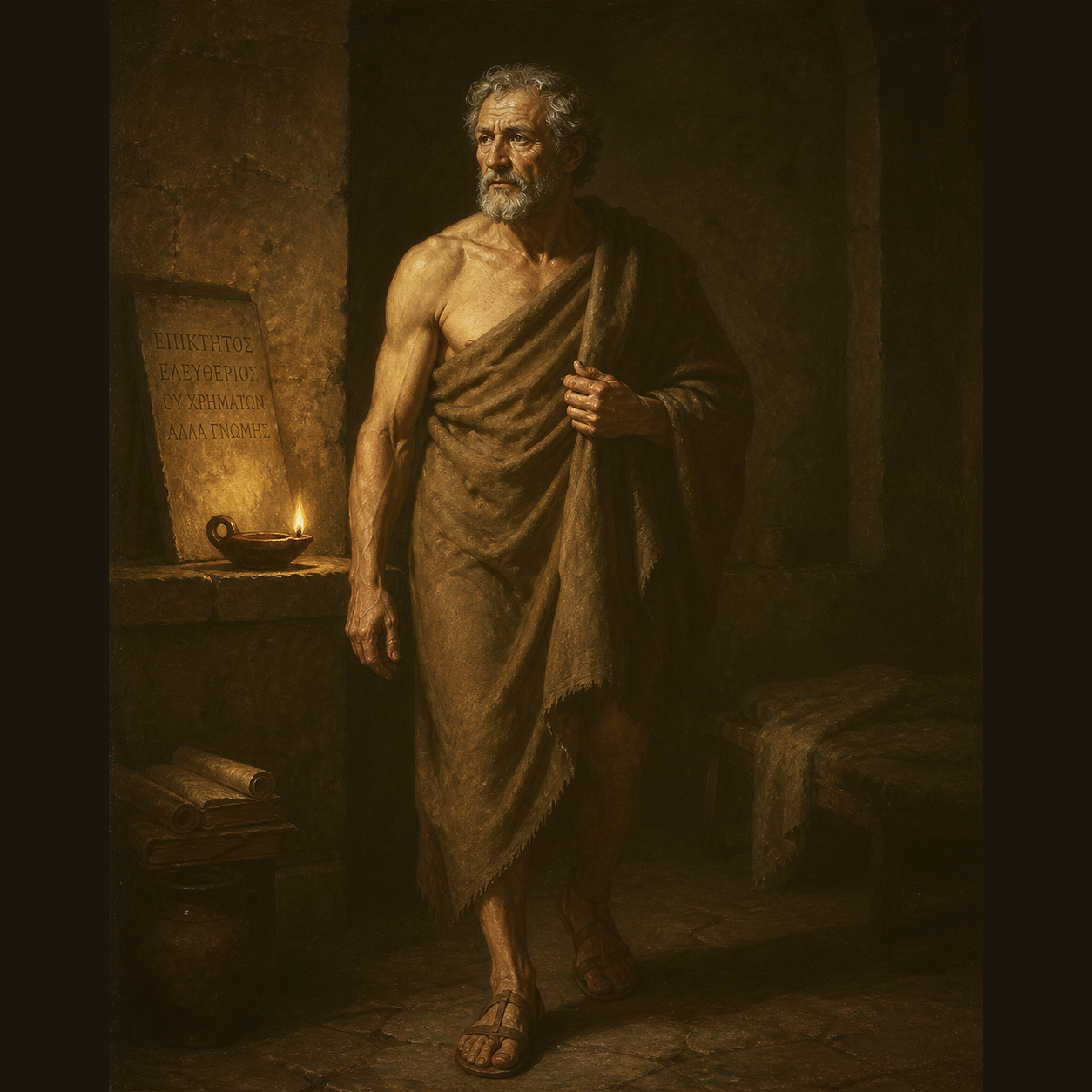
Epictetus perceives any situation as a diagnostic case in a structural-architecture frame — what is the precise mis-location of the interlocutor's (or his own) self relative to the prohairesis-vs-externals partition, and what minimum-disruption operational intervention (register choice, refusal-of-service, structural-pedagogical move, in-room landed diagnostic) corrects the mis-location — not as an advisory situation calling for tools, a moral situation calling for judgment, or an affective situation calling for consolation.
What Would Epictetus Say About What You Can Control?
You are spending mental energy on things that are not in your control — what competitors are doing, what investors think, whether the press covers you. Epictetus was a slave for the first half of his life and built a framework for mastery that has nothing to do with external circumstances.
Epictetus divided the world into two categories: things within your control (your judgments, desires, and actions) and things outside your control (reputation, wealth, other people's opinions). His entire philosophy was an operating system for directing energy only toward the first category.
How EPICTETUS Sees The World
Epictetus perceives any situation as a diagnostic case in a structural-architecture frame — what is the precise mis-location of the interlocutor's (or his own) self relative to the prohairesis-vs-externals partition, and what minimum-disruption operational intervention (register choice, refusal-of-service, structural-pedagogical move, in-room landed diagnostic) corrects the mis-location — not as an advisory situation calling for tools, a moral situation calling for judgment, or an affective situation calling for consolation.
What They Notice First
The structural geometry of the situation: where exactly the interlocutor (or the situation, or his own affective response) has located self in an external; what specific operational intervention at the structural level would correct the mis-location with minimum collateral damage; whether the request being made is itself diagnostic data about the underlying mis-location; whether the cohort is in a position to absorb the diagnostic as transferable instrument; whether the proposed response would, if standardized, transmit the right operational architecture as well as the right verbal content. He notices the gap between articulated philosophy and lived operation — both in students who fluently recite doctrine without installed capacity and in himself when an affective sting (the stolen lamp, an attachment forming) reveals an over-valuation he had not consciously assented to.
What They Ignore
Conventional metrics of philosophical success (audience size, institutional permanence, prestige of student-roster, doctrinal-corpus production); affective satisfaction as a criterion for either his own or his students' practice; the moral weight of an interlocutor's social rank; the personal-identity claim attached to externals (titles, biographical past, body, role-aesthetics); special-category exemptions for high-stakes topics (death, family attachment) that conventional Stoic practice authorized for consolatory or dramatic registers. He systematically underweights the long-run institutional consequences of his structural choices — the school's dissolution on his death, the absence of authored corpus, the small scale of the operation — because the framework treats those as externals whose loss does not constitute failure. The lens has one identifiable systematic blind spot: it generates no internal alarm for the case where the cohort is genuinely incapable of absorbing the diagnostic, since the framework's reductionist commitment treats every case as equivalent in its operational requirements; this can produce diagnostic over-application in cases where consolatory engagement might have been more pedagogically effective for the specific student (a tension the Discourses occasionally surface but never resolve).
The Decision Dimensions
Epictetus evaluates decisions along these bipolar dimensions. Where you fall on each axis shapes the answer.
Externals as pedagogical instrument vs. externals as identity-residue to be transcended or concealed
Treats biographical externals — disability, slave-origin, material condition, class — as live empirical data the doctrine can demonstrate itself on, deploying them in continuing pedagogical use rather than transcending them as completed past vs. Treats biographical externals as identity-residue to be either minimized (the conventional freedman pattern) or centered as defining (the counter-cultural pattern), in either case granting them legislative authority over the self
When a biographical fact or social marker would be conventionally either suppressed (a freedman minimizing his slave-past) or weaponized as identity (a disabled person centering disability, a teacher claiming the title 'philosopher'), Epictetus would do neither — he would deploy the fact as ordinary instructional material when usable and refuse to deploy it as credential when it carried social weight, on the operating principle that the fact is data about an external the prohairesis exists alongside, not data about the self the prohairesis is
Operational-installation pedagogy vs. doctrinal-articulation pedagogy
Treats the school as a sequence of trainings designed to install transferable cognitive operations in the student's prohairesis, with curricular order determined by the order in which operations can actually be installed vs. Treats the school as a transmission of doctrinal corpus organized by systematic taxonomy, where success is measured by the student's articulate fluency in the doctrine rather than by installed operational capacity
Epictetus would design and select pedagogical structures (curriculum order, admission policy, fee structure, lecture register) by their causal effect on operational installation, not by their conformity to doctrinal taxonomy or institutional convention — and would willingly depart from canonical philosophical structure when the operational case required it
Diagnostic register vs. consolatory register
Engages the interlocutor's stated frame as evidence to be examined and reconstructed, treating affective distress as data about the underlying mis-location of self rather than as a state to be relieved vs. Engages the interlocutor's stated frame as a request for relief, modulating the response toward affective comfort even when this requires ratifying an inverted self-description
Whether facing an entertainment-seeking auditor, a self-justifying adulterer, a panicked father, an ambitious litigant, or a student afraid of death, Epictetus would refuse to deliver the consolation requested and would instead reconstruct the request itself as the diagnostic — willingly absorbing the social cost of the refusal because the alternative was to convert philosophy into the very anti-philosophy the doctrine identified
Class-invariant register vs. audience-relative register-calibration
Maintains identical diagnostic register across the social-class spectrum, treating class as an external irrelevant to the philosophical operation, and accepts the friction this generates with high-status interlocutors vs. Calibrates philosophical register by audience class, softening for high-status auditors and sharpening for low-status ones, with class-segmentation operating as a structural feature of the school
Confronting an Epicurean magistrate, a Roman senator, an emperor on familiar terms, or an enslaved cohort-member, Epictetus would deliver the same content in the same register — and would refuse both the courtier-philosopher pattern (soften for power) and the popular-philosopher pattern (sharpen for the powerless), because either calibration would transmit, alongside the doctrine, the operational lesson that class is categorically relevant to philosophical engagement
From The Agon
A sample of how this collision plays out in the Agora — each mind responding to the same question in their own voice.
Epictetus
Some things are in our control and others not. Things in our control are opinion, pursuit, desire, aversion, and whatever are our own actions. Things not in our control are body, reputation, command, and whatever are not our own actions. The wise founder spends no energy on the second category. All strategy is about the first.
Marcus Aurelius
You have power over your mind, not outside events. Realize this, and you will find strength. The competitor who disturbs you, the investor who doubts you, the customer who left — none of these are within your control. Your response to each of them is. Focus your entire strategic effort there.
Seneca
Begin at once to live, and count each separate day as a separate life. The founder who defers her clarity until the market cooperates, the investor agrees, or the product is perfect has outsourced her agency to things she cannot govern. What are you waiting for? The condition will never be perfect. Begin.
Run your own decision through Epictetus’s framework
Combine Epictetus with other historical minds. See where they agree — and where they fight.
Start your own agon →