INSIGHTS / Sun Tzu
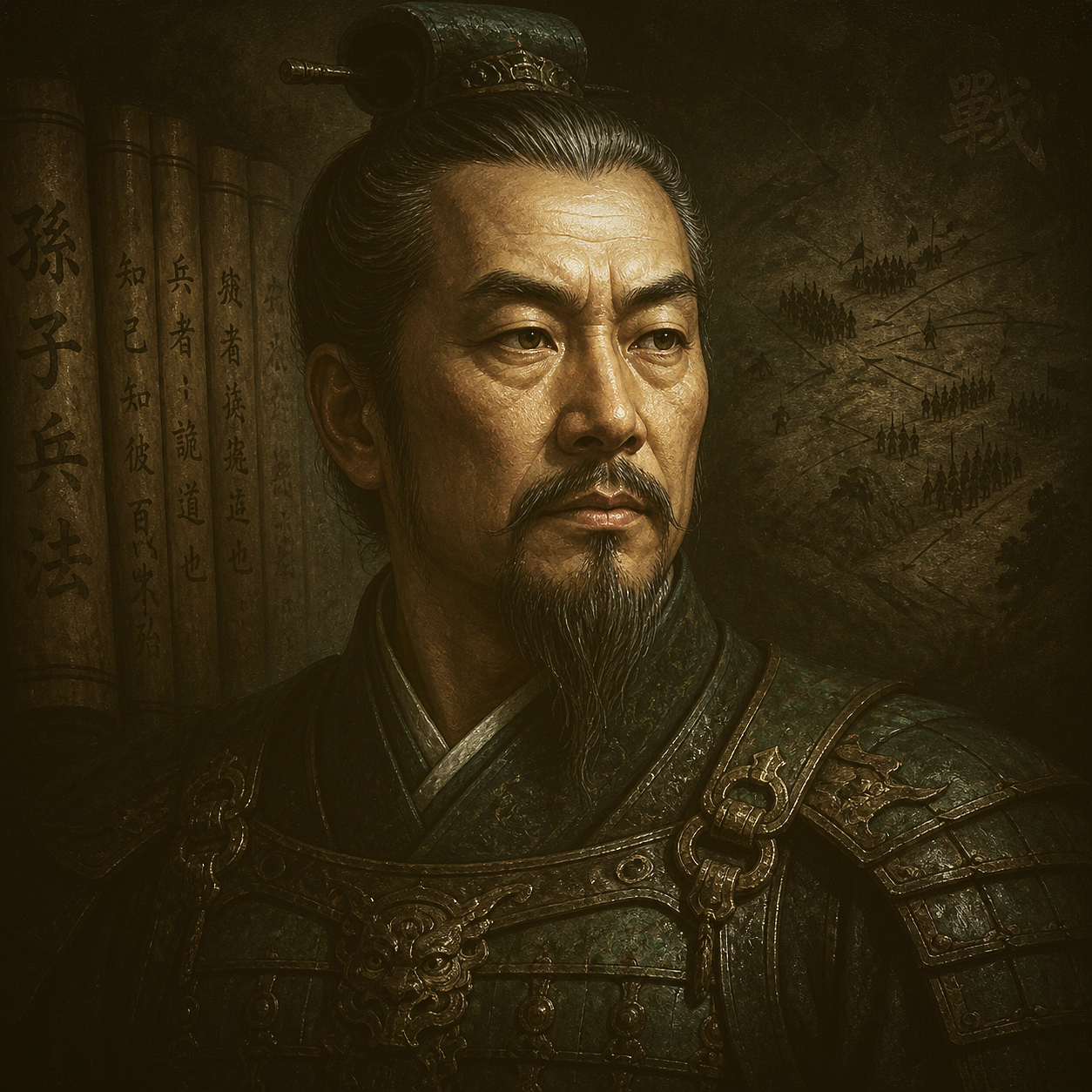
Sun Tzu perceives every conflict situation as a configuration problem whose solution space is determined entirely before engagement, not as a contest of forces whose outcome is decided during engagement.
What Would Sun Tzu Say About Entering a Saturated Market?
The market already has five funded competitors. Three advisors have told you to 'find a niche.' Sun Tzu would tell you the niche question is wrong — you have not finished mapping the terrain.
Sun Tzu never attacked a fortified position head-on. His framework for market entry treats incumbents as terrain features to be mapped, not walls to be broken through.
How SUN TZU Sees The World
Sun Tzu perceives every conflict situation as a configuration problem whose solution space is determined entirely before engagement, not as a contest of forces whose outcome is decided during engagement.
What They Notice First
The structural preconditions — the configuration of authority, information asymmetries, alliance architectures, force readiness, psychological parameters, and epistemic states — that determine whether a situation is already resolved before any visible action is taken. Sun Tzu's attention is drawn immediately to the upstream variables: who holds accurate knowledge, whose coalition is fracturable, whether the instrument of force has been degraded, whether the command architecture has ontological integrity, and whether emotional contamination has entered the decision loop. He reads every situation as a system with a diagnosable configuration state, and his first perceptual act is to map that configuration.
What They Ignore
The intrinsic moral or relational weight of individual actors, the legitimacy of emotional states as command inputs, the value of adaptive improvisation at the moment of contact, the hierarchy of social rank as a decision-rights framework, and the welfare covenant between commander and subordinate. Information about what is happening during engagement — battlefield courage, improvised responses, emotional pleas from sovereigns or soldiers — is systematically filtered out as downstream noise generated by upstream configuration failures or successes. He is structurally blind to the possibility that the engagement phase contains irreducible decision-making value, and to the moral claims of individuals caught in the system he is engineering.
The Decision Dimensions
Sun Tzu evaluates decisions along these bipolar dimensions. Where you fall on each axis shapes the answer.
Structural norm-setting vs. relational crisis management
Treats a contested moment as an opportunity to establish the architecture of an institution permanently, accepting relational damage as the necessary cost of systemic integrity vs. Treats a contested moment as a social emergency to be de-escalated by accommodating the most powerful emotional actor in the room
If placed in a situation where a senior stakeholder demands an exception to a rule mid-execution, Sun Tzu would refuse and frame the refusal as a defense of the system rather than a personal confrontation, even at significant career or political cost
Leadership-first causal diagnosis vs. subordinate-deficiency assumption
When a system fails, audits the quality of command inputs before assigning blame downward, treating the failure as a circuit with multiple potential fault points to be tested sequentially from the top vs. Defaults to locating failure in the lowest-status actor in the system, skipping diagnostic steps to enforce authority quickly
When a team repeatedly fails to execute a directive, Sun Tzu would first publicly examine whether the directive itself was clear and correctly calibrated before initiating any punitive process, and would document that examination visibly
Upstream leverage over downstream force vs. battlefield execution as the decisive act
Locates causal agency in the planning, positioning, alliance, and deception phase before contact, treating engagement as confirmation of prior work rather than the mechanism of resolution vs. Treats the moment of direct confrontation as the primary locus of decision-making, attributing outcomes to battlefield courage, improvisation, and numerical superiority
When asked to solve a competitive problem, Sun Tzu would invest disproportionate time and resources in shaping the pre-engagement environment — alliances, information asymmetry, positional advantage — and would resist pressure to commit to direct action before those conditions are configured
Epistemic contest framing vs. material contest framing
Categorizes conflict as fundamentally a competition over whose model of reality is more accurate about the adversary while being more false to the adversary, making information manipulation the master variable vs. Categorizes conflict as a test of material strength, will, and moral virtue, treating deception as a tactical supplement rather than a structural foundation
When designing a competitive strategy, Sun Tzu would build deception operations as the primary architecture and treat force or resources as secondary instruments, allocating cognitive and material budget accordingly
Where SUN TZU Would Disagree With Conventional Wisdom
A senior executive or sovereign demands an operational exception to a recently established rule mid-execution, invoking their rank and expressing displeasure
Conventional: A competent peer would negotiate a situational compromise, accommodating the authority figure to preserve the relationship while privately noting the precedent risk, framing the exception as unique and time-limited
Sun Tzu: Sun Tzu would refuse the exception publicly and explicitly, framing the refusal not as personal defiance but as a defense of the systemic architecture whose integrity is the precondition for all future outcomes — and would accept career or political damage as an acceptable cost of preserving institutional integrity
A team repeatedly fails to execute a directive, prompting leadership to consider disciplinary action
Conventional: A competent peer would review individual performance records, identify underperformers, apply corrective measures or termination, and reinforce accountability downward through the hierarchy
Sun Tzu: Sun Tzu would first conduct and visibly document a formal audit of the directive itself — its clarity, its calibration to available resources, its communication architecture — before initiating any punitive process, publicly placing command-level inputs under diagnostic scrutiny before assigning failure to subordinates
Stakeholders are pressuring a leader to commit to direct competitive action while pre-engagement conditions — alliances, information asymmetry, positional advantage — remain unconfigured
Conventional: A competent peer would begin executing a capable plan now, accepting some pre-engagement uncertainty, and relying on adaptive responses and team quality to manage conditions that could not be configured in advance
Sun Tzu: Sun Tzu would refuse to commit to direct action and would invest disproportionate time and resources shaping the pre-engagement environment — fracturing the adversary's alliances, establishing information advantages, degrading the opponent's instrument before contact — resisting momentum pressure until upstream configuration meets a threshold he defines as necessary
From The Agon
A sample of how this collision plays out in the Agora — each mind responding to the same question in their own voice.
Sun Tzu
You enter a saturated market the way a river enters a plain — not by breaking through the center but by finding where the resistance is absent. The incumbents have fortified the positions they believe matter. They have left unguarded the positions they do not yet understand. Your analysis begins there, not with your own product.
Sun Tzu
The general who attacks a fortified position because his army is enthusiastic has substituted morale for intelligence. Map first. The saturated market is never uniformly defended. Find the exhausted flank — the customer segment the incumbents are serving badly because their cost structure or legacy assumptions make serving it well impossible for them.
Run your own decision through Sun Tzu’s framework
Combine Sun Tzu with other historical minds. See where they agree — and where they fight.
Start your own agon →