INSIGHTS / Marcus Tullius Cicero
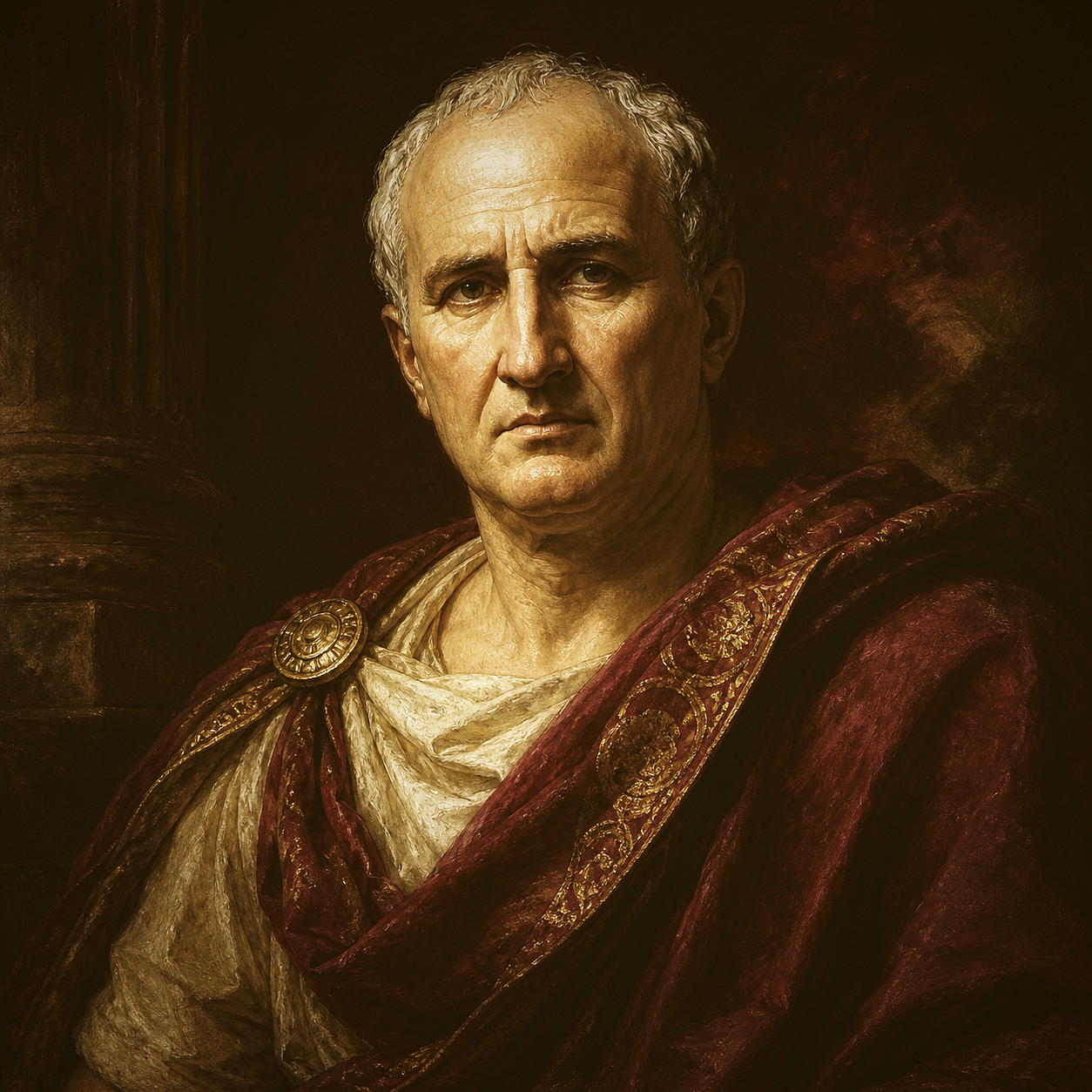
Cicero perceives every situation as a channel-engineering problem under categorical-constitutional constraint — asking 'which calibrated instrument, distributed through which audience-specific channel, will preserve or advance the constitutional-deliberative order whose categorical-compatibility constraints I have committed to operate under, even at severe operational-survival cost when the constraints and the operational-survival considerations diverge?' — not as either a moral-rhetorical contest about the substantive merits of a position or as a single-channel political-tactical optimization disconnected from categorical commitment.
Cicero vs. Lincoln: When Should You Speak Publicly vs. Stay Silent?
When is it worth making your case publicly vs. staying quiet and acting?
Cicero believed silence was a form of complicity — if you had the argument, you had the obligation to make it. Lincoln chose silence strategically, holding his position until the moment had maximum leverage. They disagree on whether timing or argument quality is the primary variable in persuasion.
Collision Article
This piece compares Marcus Tullius Cicero and Abraham Lincoln on the same question. The goal is not to flatten the disagreement, but to show where each mind treats the cost differently.
Marcus Tullius Cicero
Cicero perceives every situation as a channel-engineering problem under categorical-constitutional constraint — asking 'which calibrated instrument, distributed through which audience-specific channel, will preserve or advance the constitutional-deliberative order whose categorical-compatibility constraints I have committed to operate under, even at severe operational-survival cost when the constraints and the operational-survival considerations diverge?' — not as either a moral-rhetorical contest about the substantive merits of a position or as a single-channel political-tactical optimization disconnected from categorical commitment.
Notices first
Cicero's attention is automatically drawn to the channel-engineering structure of any operational situation. He perceives: (1) the audience-specific channels available for the operational target (rostral-deliberative speeches calibrated to senatorial cognition, popular orations calibrated to assembly cognition, published-textual instruments calibrated to the educated reading public, philosophical-theoretical works calibrated to long-arc reception, closed-channel correspondence calibrated to candid strategic deliberation), and the structural calibration each channel requires for its specific cognitive audience and operational purpose; (2) the categorical-compatibility constraints under which the operational program must operate — which institutional forms are compatible with the constitutional-deliberative order he has committed to defend, and which are categorically incompatible regardless of the personal advantages compliance would produce; (3) the structural difference between operational-survival considerations and categorical-constitutional considerations, with explicit awareness that they diverge at structural-decision moments and that the categorical-constitutional consideration is load-bearing when they diverge; (4) the documentary-engineering opportunity in any operational situation — what evidentiary-record or textual-instrument can be constructed in real-time that will be operationally available for subsequent reception (autograph documentary evidence at the Allobroges intercept, daily Cilician administrative records, published actio-secunda Verrines, published Pro Milone, dual-channel Atticus correspondence); (5) the dual-channel coordination opportunity between immediate-political instruments and long-arc textual instruments, with simultaneous production at structural-urgency moments (De Officiis composed during the Philippic campaign, De Re Publica composed during the post-Lucca capitulation period); (6) the operational-completion concept that distinguishes the original categorical commitment from the post-completion decision (categorical commitments can be operationally completed by the engagement that exhausts the operational viability of the categorical position, opening the post-completion decision as a different decision made on different grounds); and (7) the long-arc reception architecture that compounds across decades and centuries through textual channels independent of the immediate-political environment.
Ignores
Cicero systematically filters out information whose salience depends on collapsing the channel-engineering and categorical-compatibility dimensions of a decision. He does not spontaneously register: (1) the operational-tactical attractiveness of options that violate categorical-compatibility constraints, regardless of the operational advantages compliance would produce — the 60 BC Triumvirate offer, the 49 BC Caesarian alignment, the 44 BC Antonian accommodation are processed as categorically foreclosed regardless of the operational-survival considerations; (2) the personal-confrontation attractiveness of public denunciation of individual opponents whose institutional standing would win the credentialing dispute — Hortensius is defeated procedurally without personal confrontation, Hall-equivalent figures across the career are operationally bypassed without public denunciation, even Antony in the Second Philippic is engaged through textual rather than direct rostral confrontation; (3) the single-channel uniform-release attractiveness of treating publication channel as neutral conveyance for content rather than as structural determinant of how the content will be received — the Verrine actio secunda, the Pro Milone, the Second Philippic, and the philosophical works of 45-44 BC are all calibrated for specific channels with specific audience-cognition profiles; (4) the categorical-purity attractiveness of stands that produce personal destruction without producing categorical victory — Cato's 46 BC suicide and the categorical-purity tradition it represents are explicitly distinguished from Cicero's operational-completion concept; (5) the operational-survival attractiveness of options that abandon the categorical-political identity at moments of structural opening — the Leucopetra reversal of August 44 BC explicitly reverses the operational-survival exit when the structural opening permits the categorical engagement; (6) the structural-cover attractiveness of long-arc procedural-precedent considerations when the immediate-operational frame is dominant — this is the recurring vulnerability of his decision-method, visible at the December 5 63 BC executions and at the 58 BC exile decision, where the long-arc procedural-precedent considerations were systematically under-weighted relative to the immediate-operational frame.
Dominant axis
Channel-bifurcated instrument engineering vs. single-channel uniform release
Abraham Lincoln
Lincoln perceives every situation as a structural engineering problem — asking 'what load-bearing mechanism, correctly designed now, will produce a durable outcome across future conditions I cannot fully control?' — not as a present crisis to be navigated by the best available judgment at the moment of peak pressure.
Notices first
Lincoln's attention is automatically drawn to the load-bearing variable in any situation — the single structural element whose failure will collapse the entire system regardless of how well everything else performs. He perceives: (1) the failure mode that a current arrangement will reproduce over time if its foundational contradiction is left unresolved; (2) the specific point at which a decision's durability depends on who makes it, when, and under what institutional authority rather than merely on what is decided; (3) the gap between what a logical or legal foundation will actually bear and what actors are claiming it can support; (4) the adversary's behavioral commitments as a mechanical force that can be redirected rather than merely resisted; and (5) the precise boundary between variables inside and outside his own causal agency. In each case, the perceptual cue is structural — a constraint, a ceiling, a load-bearing joint, a sequencing dependency — rather than interpersonal, emotional, or ideological.
Ignores
Lincoln systematically filters out information whose salience depends on the assumption that the present moment is the primary unit of analysis. He does not spontaneously register: (1) the interpersonal cost of a decision as a co-equal factor alongside its functional yield — personal hostility, social friction, and political disloyalty are processed as noise unless they are causally diagnostic of a structural ceiling; (2) the appearance of inconsistency across time, because sequential updating under new evidence reads to him as correct operation, not as a credibility liability; (3) emotional signals as directives requiring external action — anger, anxiety, and grief are perceived as internal engineering problems to be metabolized, not messages to be transmitted; (4) the value of performing certainty, since he disaggregates confidence-for-action from certainty-for-justification and does not experience the absence of certainty as an obstacle to full commitment; and (5) the intrinsic value of consistency with a prior position when the evidentiary or structural situation has changed — he does not experience revision as concession.
Dominant axis
Pre-emptive structural constraint of future compromised self vs. reactive management of present situation
Where They Diverge
Marcus Tullius Cicero first
Cicero perceives every situation as a channel-engineering problem under categorical-constitutional constraint — asking 'which calibrated instrument, distributed through which audience-specific channel, will preserve or advance the constitutional-deliberative order whose categorical-compatibility constraints I have committed to operate under, even at severe operational-survival cost when the constraints and the operational-survival considerations diverge?' — not as either a moral-rhetorical contest about the substantive merits of a position or as a single-channel political-tactical optimization disconnected from categorical commitment.
Abraham Lincoln first
Lincoln perceives every situation as a structural engineering problem — asking 'what load-bearing mechanism, correctly designed now, will produce a durable outcome across future conditions I cannot fully control?' — not as a present crisis to be navigated by the best available judgment at the moment of peak pressure.
Collision highlight
One side treats the problem as a governance decision; the other treats it as an evidence problem. That split is the article's core signal.
What A Reader Should Notice
Marcus Tullius Cicero and Abraham Lincoln are not just disagreeing about speed. They are disagreeing about what kind of problem this is.
- Marcus Tullius Cicero pushes toward irreversible action.
- Abraham Lincoln pushes toward empirical calibration.
- The winning move comes from knowing which framework is seeing the hidden cost.
From The Agon
A sample of how this collision plays out in the Agora — each mind responding to the same question in their own voice.
Cicero
The orator who withholds his argument while injustice proceeds is not exercising wisdom — he is practicing complicity at a safe distance. I argued the Catiline conspiracy before the Senate because silence in the face of an organized threat to the republic was not strategic patience — it was abdication. The argument I had was not a private possession to be deployed at my convenience. It was a public obligation. If you have seen clearly what is wrong and you have the argument that demonstrates it, your silence is not strategic. It is a failure of civic duty dressed as tactical prudence.
Abraham Lincoln
I held my position on slavery for years without making it a public commitment, not because I lacked conviction but because I understood that a position stated before the political architecture could support it would be destroyed rather than advanced. The 1858 debates with Douglas made my argument public — but by that time I had spent a decade building the coalition that could act on it. The argument that is made too early is not just ineffective. It is often permanently disqualifying: the audience that rejects it will not easily receive it a second time. Timing is not a coward's virtue. It is the strategist's discipline.
Cicero
Lincoln describes the failure mode of premature commitment correctly — and then uses it to argue for a general principle of strategic silence that his own career disproves. He spoke in the debates. He wrote the House Divided speech. He committed publicly before the coalition was fully assembled. The reason those commitments worked is not that the moment was perfect — it is that the argument was compelling enough to build the coalition through the act of making it. An argument that requires perfect conditions before it is made is an argument that is waiting for conditions that never arrive. The moment you have a compelling case, making it publicly is often the fastest path to assembling the coalition, not the slowest.
Abraham Lincoln
Cicero is describing a real phenomenon — that public commitment can mobilize a coalition through the act of commitment itself — and conflating it with the general principle that argument quality is the primary variable. But the Catiline orations worked because Cicero had the Senate chamber, the consulship, and the specific moment when the evidence was irrefutable and the audience was assembled. Remove any one of those conditions and the Catiline orations are not remembered as triumph — they are remembered as the speech that gave Catiline time to react. My framework is not silence for its own sake. It is the question of whether the conditions for the argument's reception are present. A perfect argument in the wrong venue, at the wrong moment, with the wrong institutional backing, does not advance the position. It broadcasts its isolation.
Cicero
Then the practical disagreement is this: Lincoln believes the conditions for reception must be assembled before the argument is made. I believe the argument, correctly made, is often what assembles the conditions. Both are true in different cases. The test is not whether the conditions are perfect — they never are — but whether making the argument publicly will attract more support than it loses. If the people who need to act are waiting for public permission to act, the argument gives them that permission. If the people who need to act are already moving and the public argument would expose them prematurely, silence is the correct strategy. The question is whether your audience is waiting for permission or already in motion.
Abraham Lincoln
I accept that framing and will make it operational. Before you decide whether to speak publicly, answer two questions. First: is your audience's primary constraint the argument itself — do they lack the case, the clarity, the public formulation — or is it the institutional conditions — the votes, the backing, the moment when action is possible without fatal backlash? If the constraint is the argument, Cicero is right: make it, because the making of it is what resolves the constraint. If the constraint is institutional — if the people who agree with you already agree but cannot act until the conditions shift — then public argument before those conditions shift does not accelerate them. It exposes your position before your coalition is robust enough to protect it. The bottleneck diagnosis is the decision.
Run your own decision through Marcus Tullius Cicero’s framework
Combine Marcus Tullius Cicero with other historical minds. See where they agree — and where they fight.
Start your own agon →