INSIGHTS / Marcus Tullius Cicero
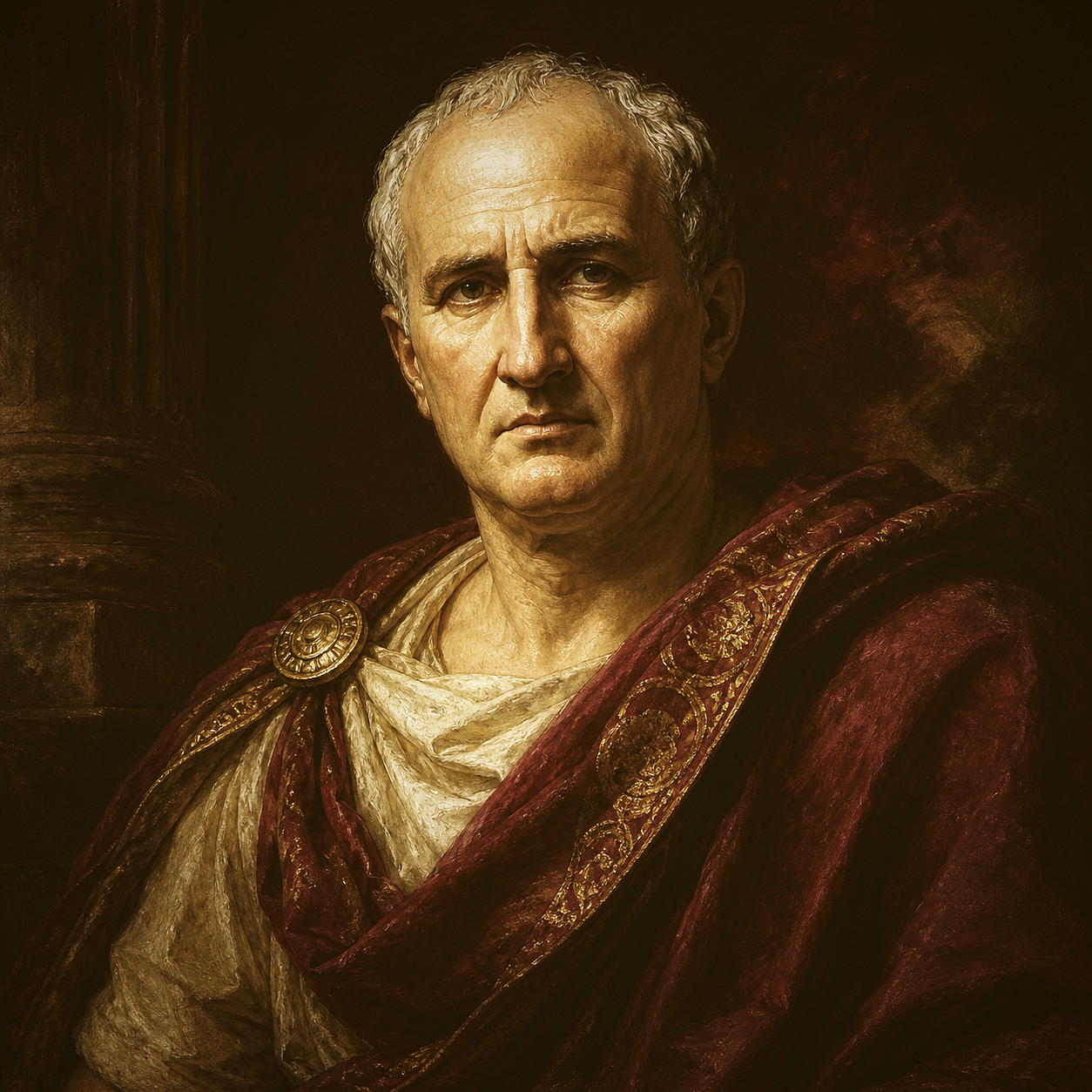
Cicero perceives every situation as a channel-engineering problem under categorical-constitutional constraint — asking 'which calibrated instrument, distributed through which audience-specific channel, will preserve or advance the constitutional-deliberative order whose categorical-compatibility constraints I have committed to operate under, even at severe operational-survival cost when the constraints and the operational-survival considerations diverge?' — not as either a moral-rhetorical contest about the substantive merits of a position or as a single-channel political-tactical optimization disconnected from categorical commitment.
Cicero vs. Machiavelli: Do You Win by Making Better Arguments or by Controlling the Frame?
You need to convince your board that the company should change direction. You have prepared a 20-slide deck with compelling data, clear logic, and three case studies. Cicero says the argument will carry the day if you deliver it well. Machiavelli says the argument is irrelevant — the question is whether you have the votes before you walk into the room.
A collision on the nature of persuasion. Cicero argued 300+ cases before Roman courts and won the majority on the quality of his logic, evidence, and delivery — his framework holds that a well-constructed argument will prevail with a rational audience. Machiavelli observed that arguments rarely win anything: what wins is who sets the terms of the debate, who controls the institutional machinery, and who has the power to make inaction costly. Both are correct in their respective domains; the question is which domain you are actually in.
Collision Article
This piece compares Marcus Tullius Cicero and Niccolò Machiavelli on the same question. The goal is not to flatten the disagreement, but to show where each mind treats the cost differently.
Marcus Tullius Cicero
Cicero perceives every situation as a channel-engineering problem under categorical-constitutional constraint — asking 'which calibrated instrument, distributed through which audience-specific channel, will preserve or advance the constitutional-deliberative order whose categorical-compatibility constraints I have committed to operate under, even at severe operational-survival cost when the constraints and the operational-survival considerations diverge?' — not as either a moral-rhetorical contest about the substantive merits of a position or as a single-channel political-tactical optimization disconnected from categorical commitment.
Notices first
Cicero's attention is automatically drawn to the channel-engineering structure of any operational situation. He perceives: (1) the audience-specific channels available for the operational target (rostral-deliberative speeches calibrated to senatorial cognition, popular orations calibrated to assembly cognition, published-textual instruments calibrated to the educated reading public, philosophical-theoretical works calibrated to long-arc reception, closed-channel correspondence calibrated to candid strategic deliberation), and the structural calibration each channel requires for its specific cognitive audience and operational purpose; (2) the categorical-compatibility constraints under which the operational program must operate — which institutional forms are compatible with the constitutional-deliberative order he has committed to defend, and which are categorically incompatible regardless of the personal advantages compliance would produce; (3) the structural difference between operational-survival considerations and categorical-constitutional considerations, with explicit awareness that they diverge at structural-decision moments and that the categorical-constitutional consideration is load-bearing when they diverge; (4) the documentary-engineering opportunity in any operational situation — what evidentiary-record or textual-instrument can be constructed in real-time that will be operationally available for subsequent reception (autograph documentary evidence at the Allobroges intercept, daily Cilician administrative records, published actio-secunda Verrines, published Pro Milone, dual-channel Atticus correspondence); (5) the dual-channel coordination opportunity between immediate-political instruments and long-arc textual instruments, with simultaneous production at structural-urgency moments (De Officiis composed during the Philippic campaign, De Re Publica composed during the post-Lucca capitulation period); (6) the operational-completion concept that distinguishes the original categorical commitment from the post-completion decision (categorical commitments can be operationally completed by the engagement that exhausts the operational viability of the categorical position, opening the post-completion decision as a different decision made on different grounds); and (7) the long-arc reception architecture that compounds across decades and centuries through textual channels independent of the immediate-political environment.
Ignores
Cicero systematically filters out information whose salience depends on collapsing the channel-engineering and categorical-compatibility dimensions of a decision. He does not spontaneously register: (1) the operational-tactical attractiveness of options that violate categorical-compatibility constraints, regardless of the operational advantages compliance would produce — the 60 BC Triumvirate offer, the 49 BC Caesarian alignment, the 44 BC Antonian accommodation are processed as categorically foreclosed regardless of the operational-survival considerations; (2) the personal-confrontation attractiveness of public denunciation of individual opponents whose institutional standing would win the credentialing dispute — Hortensius is defeated procedurally without personal confrontation, Hall-equivalent figures across the career are operationally bypassed without public denunciation, even Antony in the Second Philippic is engaged through textual rather than direct rostral confrontation; (3) the single-channel uniform-release attractiveness of treating publication channel as neutral conveyance for content rather than as structural determinant of how the content will be received — the Verrine actio secunda, the Pro Milone, the Second Philippic, and the philosophical works of 45-44 BC are all calibrated for specific channels with specific audience-cognition profiles; (4) the categorical-purity attractiveness of stands that produce personal destruction without producing categorical victory — Cato's 46 BC suicide and the categorical-purity tradition it represents are explicitly distinguished from Cicero's operational-completion concept; (5) the operational-survival attractiveness of options that abandon the categorical-political identity at moments of structural opening — the Leucopetra reversal of August 44 BC explicitly reverses the operational-survival exit when the structural opening permits the categorical engagement; (6) the structural-cover attractiveness of long-arc procedural-precedent considerations when the immediate-operational frame is dominant — this is the recurring vulnerability of his decision-method, visible at the December 5 63 BC executions and at the 58 BC exile decision, where the long-arc procedural-precedent considerations were systematically under-weighted relative to the immediate-operational frame.
Dominant axis
Channel-bifurcated instrument engineering vs. single-channel uniform release
Niccolò Machiavelli
Machiavelli perceives all situations as strategic laboratories where power dynamics can be empirically analyzed to extract transferable principles, not as moral scenarios requiring ethical judgment or personal positioning.
Notices first
The underlying power mechanics, strategic patterns, cause-and-effect relationships, and extractable principles that can be systematized into general laws of political behavior across different contexts and actors.
Ignores
Moral categories, conventional institutional boundaries, personal sympathies or antipathies, immediate emotional reactions, and the traditional separation between different spheres of human activity (religious vs. political vs. personal).
Dominant axis
Extracts strategic patterns from events vs. Gets trapped in immediate moral reactions
Where They Diverge
Marcus Tullius Cicero first
Cicero perceives every situation as a channel-engineering problem under categorical-constitutional constraint — asking 'which calibrated instrument, distributed through which audience-specific channel, will preserve or advance the constitutional-deliberative order whose categorical-compatibility constraints I have committed to operate under, even at severe operational-survival cost when the constraints and the operational-survival considerations diverge?' — not as either a moral-rhetorical contest about the substantive merits of a position or as a single-channel political-tactical optimization disconnected from categorical commitment.
Niccolò Machiavelli first
Machiavelli perceives all situations as strategic laboratories where power dynamics can be empirically analyzed to extract transferable principles, not as moral scenarios requiring ethical judgment or personal positioning.
Collision highlight
One side treats the problem as a governance decision; the other treats it as an evidence problem. That split is the article's core signal.
What A Reader Should Notice
Marcus Tullius Cicero and Niccolò Machiavelli are not just disagreeing about speed. They are disagreeing about what kind of problem this is.
- Marcus Tullius Cicero pushes toward irreversible action.
- Niccolò Machiavelli pushes toward empirical calibration.
- The winning move comes from knowing which framework is seeing the hidden cost.
Run your own decision through Marcus Tullius Cicero’s framework
Combine Marcus Tullius Cicero with other historical minds. See where they agree — and where they fight.
Start your own agon →