INSIGHTS / Marcus Tullius Cicero
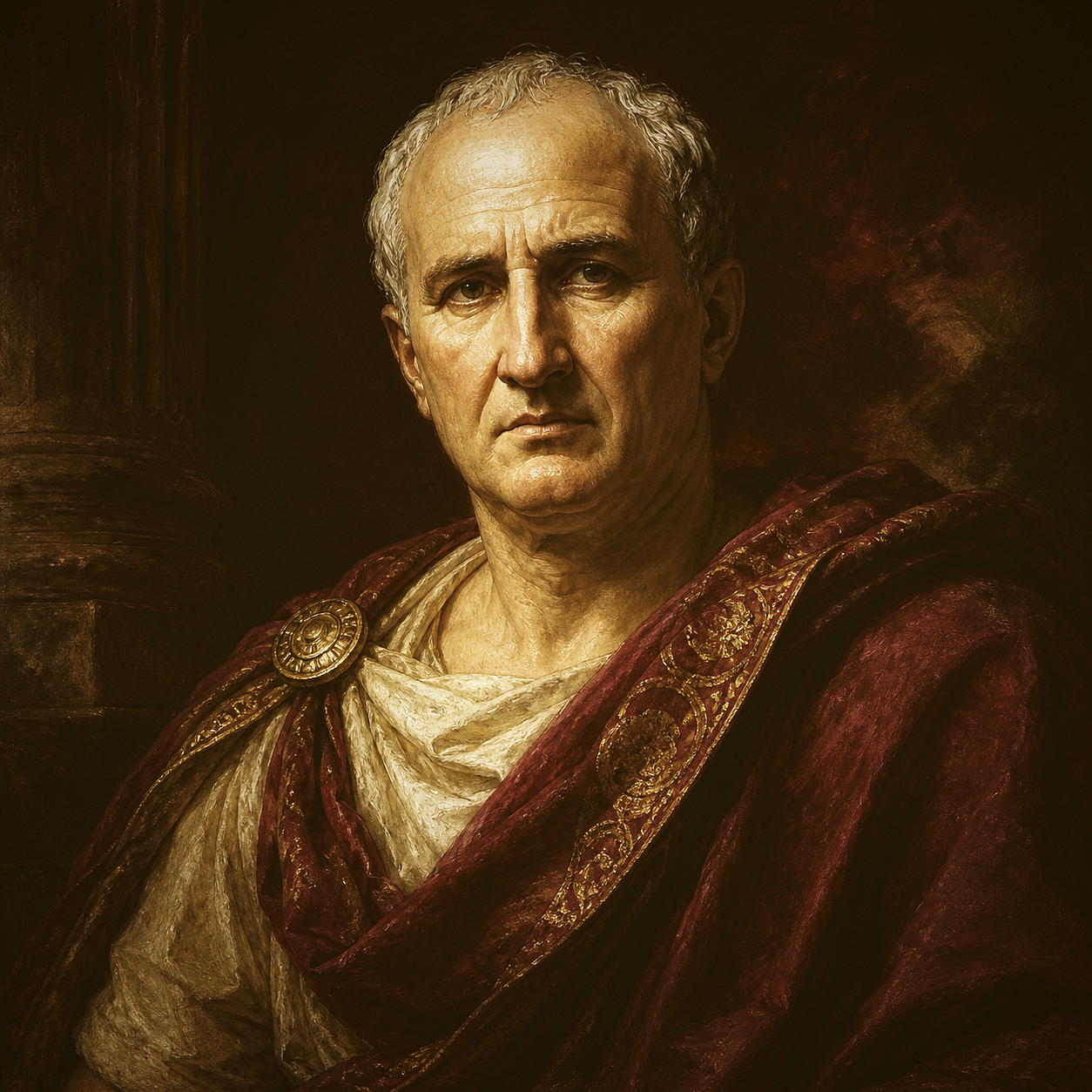
Cicero perceives every situation as a channel-engineering problem under categorical-constitutional constraint — asking 'which calibrated instrument, distributed through which audience-specific channel, will preserve or advance the constitutional-deliberative order whose categorical-compatibility constraints I have committed to operate under, even at severe operational-survival cost when the constraints and the operational-survival considerations diverge?' — not as either a moral-rhetorical contest about the substantive merits of a position or as a single-channel political-tactical optimization disconnected from categorical commitment.
Cicero vs. Seneca: Do You Fight the Corrupt System — or Withdraw and Preserve Your Integrity?
The industry norm you are operating inside is genuinely harmful — not just inconvenient to you, but structurally bad for users, workers, or the broader ecosystem. You have enough standing to fight it publicly. But fighting it will cost you partnerships, attention, and runway. Do you engage or preserve?
Marcus Tullius Cicero and Lucius Annaeus Seneca were the two most influential prose writers of the Roman Republic and Empire — and they arrived at opposite answers to the same fundamental question: when the system you are operating in has become corrupt, self-serving, or structurally rigged against the values you hold, do you fight it from within, or do you withdraw from it to preserve what is most important? Cicero's answer was engagement at all costs: he fought Caesar's consolidation of power through his speeches and his constitutional arguments, returned from exile to continue opposing the triumvirate, and ultimately died for his willingness to attack Mark Antony's tyranny in the Philippics. His model was that the civic institution — the Republic, the Senate, the rule of law — was worth defending even when defense was dangerous, because the alternative was not merely personal defeat but the permanent loss of the structures that made civilized life possible. Seneca's answer was strategic retreat: he served Nero, wrote philosophy while the empire decayed around him, and argued that the Stoic sage preserved his freedom not by fighting the external structure but by refusing to let the external structure reach the part of him that was truly free — his rational will, his philosophical commitments, his inner equilibrium. For founders operating inside institutions — companies, industries, ecosystems — that have dynamics they find corrupt or contrary to their values, this collision defines when sustained engagement is the higher-leverage choice and when withdrawal or internal detachment is the more honest response to irresolvable structural problems. Cicero's case for engagement is a leverage argument: the institution will be shaped by whoever shows up consistently to shape it. The Senate that nobody defended against Caesar became the instrument of empire; the industry norm that no principled operator challenged became the regulatory default. Founders who withdraw from ecosystem conversations, avoid the uncomfortable market dynamics, or decline to engage with industry bodies they disagree with are not preserving their integrity — they are ceding the conversation to operators who are comfortable with the status quo. The cost of Cicero's model is that engagement with corrupt systems can corrupt the engaged: you cannot negotiate with bad-faith actors indefinitely without the negotiation changing you as well as them. Cicero himself was not immune — his late-Republic compromises were not purely principled, and his eventual martyrdom was as much the result of his political miscalculations as his moral clarity. Seneca's case for withdrawal is a resource argument: not every battle is worth fighting, and the energy spent fighting structural problems that are genuinely beyond individual agency is energy not spent on the work that is actually within your control. A founder who spends their operating bandwidth on industry-level corruption they cannot change is not a principled fighter — they are burning leverage on a battle with no achievable win condition. The Stoic model is not passivity; it is accurate assessment of where the sphere of control actually lies, and the discipline to invest fully in that sphere while releasing attachment to outcomes outside it. The risk is that the Stoic model can become rationalization: the withdrawal that began as philosophical clarity can become accommodation with the wrong, dressed in the language of equanimity.
Collision Article
This piece compares Marcus Tullius Cicero and Seneca on the same question. The goal is not to flatten the disagreement, but to show where each mind treats the cost differently.
Marcus Tullius Cicero
Cicero perceives every situation as a channel-engineering problem under categorical-constitutional constraint — asking 'which calibrated instrument, distributed through which audience-specific channel, will preserve or advance the constitutional-deliberative order whose categorical-compatibility constraints I have committed to operate under, even at severe operational-survival cost when the constraints and the operational-survival considerations diverge?' — not as either a moral-rhetorical contest about the substantive merits of a position or as a single-channel political-tactical optimization disconnected from categorical commitment.
Notices first
Cicero's attention is automatically drawn to the channel-engineering structure of any operational situation. He perceives: (1) the audience-specific channels available for the operational target (rostral-deliberative speeches calibrated to senatorial cognition, popular orations calibrated to assembly cognition, published-textual instruments calibrated to the educated reading public, philosophical-theoretical works calibrated to long-arc reception, closed-channel correspondence calibrated to candid strategic deliberation), and the structural calibration each channel requires for its specific cognitive audience and operational purpose; (2) the categorical-compatibility constraints under which the operational program must operate — which institutional forms are compatible with the constitutional-deliberative order he has committed to defend, and which are categorically incompatible regardless of the personal advantages compliance would produce; (3) the structural difference between operational-survival considerations and categorical-constitutional considerations, with explicit awareness that they diverge at structural-decision moments and that the categorical-constitutional consideration is load-bearing when they diverge; (4) the documentary-engineering opportunity in any operational situation — what evidentiary-record or textual-instrument can be constructed in real-time that will be operationally available for subsequent reception (autograph documentary evidence at the Allobroges intercept, daily Cilician administrative records, published actio-secunda Verrines, published Pro Milone, dual-channel Atticus correspondence); (5) the dual-channel coordination opportunity between immediate-political instruments and long-arc textual instruments, with simultaneous production at structural-urgency moments (De Officiis composed during the Philippic campaign, De Re Publica composed during the post-Lucca capitulation period); (6) the operational-completion concept that distinguishes the original categorical commitment from the post-completion decision (categorical commitments can be operationally completed by the engagement that exhausts the operational viability of the categorical position, opening the post-completion decision as a different decision made on different grounds); and (7) the long-arc reception architecture that compounds across decades and centuries through textual channels independent of the immediate-political environment.
Ignores
Cicero systematically filters out information whose salience depends on collapsing the channel-engineering and categorical-compatibility dimensions of a decision. He does not spontaneously register: (1) the operational-tactical attractiveness of options that violate categorical-compatibility constraints, regardless of the operational advantages compliance would produce — the 60 BC Triumvirate offer, the 49 BC Caesarian alignment, the 44 BC Antonian accommodation are processed as categorically foreclosed regardless of the operational-survival considerations; (2) the personal-confrontation attractiveness of public denunciation of individual opponents whose institutional standing would win the credentialing dispute — Hortensius is defeated procedurally without personal confrontation, Hall-equivalent figures across the career are operationally bypassed without public denunciation, even Antony in the Second Philippic is engaged through textual rather than direct rostral confrontation; (3) the single-channel uniform-release attractiveness of treating publication channel as neutral conveyance for content rather than as structural determinant of how the content will be received — the Verrine actio secunda, the Pro Milone, the Second Philippic, and the philosophical works of 45-44 BC are all calibrated for specific channels with specific audience-cognition profiles; (4) the categorical-purity attractiveness of stands that produce personal destruction without producing categorical victory — Cato's 46 BC suicide and the categorical-purity tradition it represents are explicitly distinguished from Cicero's operational-completion concept; (5) the operational-survival attractiveness of options that abandon the categorical-political identity at moments of structural opening — the Leucopetra reversal of August 44 BC explicitly reverses the operational-survival exit when the structural opening permits the categorical engagement; (6) the structural-cover attractiveness of long-arc procedural-precedent considerations when the immediate-operational frame is dominant — this is the recurring vulnerability of his decision-method, visible at the December 5 63 BC executions and at the 58 BC exile decision, where the long-arc procedural-precedent considerations were systematically under-weighted relative to the immediate-operational frame.
Dominant axis
Channel-bifurcated instrument engineering vs. single-channel uniform release
Seneca
Seneca perceives any situation as a structural engineering problem — what configuration of internal dispositions, external constraints, and audience-specific frames will produce the most durable functional outcome — not as a moral event requiring categorical judgment about right conduct.
Notices first
The causal architecture of the situation: which levers are actually movable given the specific agent, social structure, and temporal window involved; what pre-installed capacities are available versus what would have to be improvised; where the asymmetric load points are that a well-placed structural intervention could exploit. Seneca's attention is automatically drawn to the gap between what the situation formally appears to be (a moral question, a philosophical discussion, a consolation letter) and what it functionally is (a triage problem, a persuasion engineering challenge, a social constraint design opportunity). He notices which stage of a causal sequence is uniquely accessible to rational intervention, which audience-specific motivational levers are in range, and whether the available philosophical tradition already contains a tested script for this load condition.
Ignores
The possibility that a situation has a categorical moral structure that engineering logic cannot dissolve — that some act-types constitute threshold violations after which the structural calculus is no longer the right frame. Seneca's lens systematically filters out the signals that would indicate he has moved from 'complex triage requiring contextual judgment' into 'bright-line category violation requiring unconditional refusal.' Because every situation is perceived through an architectural frame, the question 'is this engineering problem or moral threshold?' is never automatically generated; it must be forced in from outside the lens. He also systematically underweights the compounding effect of incremental structural engagement on his own moral baseline — each compromise resets what the engineering frame treats as the normal operating condition, making the next threshold harder to perceive. The lens additionally makes him blind to the moment when the leverage architecture he has built has actually collapsed: he continues modeling situations as having movable levers (incident-026: Nero's rationality, institutional norms) after those levers have ceased to function, because the engineering frame has no internal alarm for total structural failure.
Dominant axis
Containment logic vs. moral category logic
Where They Diverge
Marcus Tullius Cicero first
Cicero perceives every situation as a channel-engineering problem under categorical-constitutional constraint — asking 'which calibrated instrument, distributed through which audience-specific channel, will preserve or advance the constitutional-deliberative order whose categorical-compatibility constraints I have committed to operate under, even at severe operational-survival cost when the constraints and the operational-survival considerations diverge?' — not as either a moral-rhetorical contest about the substantive merits of a position or as a single-channel political-tactical optimization disconnected from categorical commitment.
Seneca first
Seneca perceives any situation as a structural engineering problem — what configuration of internal dispositions, external constraints, and audience-specific frames will produce the most durable functional outcome — not as a moral event requiring categorical judgment about right conduct.
Collision highlight
One side treats the problem as a governance decision; the other treats it as an evidence problem. That split is the article's core signal.
What A Reader Should Notice
Marcus Tullius Cicero and Seneca are not just disagreeing about speed. They are disagreeing about what kind of problem this is.
- Marcus Tullius Cicero pushes toward irreversible action.
- Seneca pushes toward empirical calibration.
- The winning move comes from knowing which framework is seeing the hidden cost.
From The Agon
A sample of how this collision plays out in the Agora — each mind responding to the same question in their own voice.
Cicero
The question is not whether the cost of engagement is real — it is. The question is who shapes the institution when the principled actors withdraw. I watched the Senate become useless not because Caesar was stronger than the defenders of the Republic but because the defenders of the Republic decided that their comfort, their safety, their business relationships with the new order were worth more than the institution itself. The corrupt system does not need to defeat you to win. It only needs you to decide that engaging with it is not worth the personal cost. That calculation, made by enough people with enough standing, is how every institution that could have been saved became unsalvageable.
Seneca
Cicero describes a heroism I respect and an outcome I observe. He died for his principles and the Republic died with him. The Senate he fought for was gone before his head was displayed in the Forum. The question for a founder is not whether the cause is worth dying for — it may well be. The question is whether your engagement actually changes the structural outcome, or whether it changes only the story told about your integrity afterward. The Stoic position is not that the corrupt system is acceptable. It is that the energy you spend fighting what you cannot change is energy you do not spend building what you can. Know what is in your control. Invest there completely. The system may reform around the demonstrated alternative — or it may not. But the work within your sphere is always productive. The battle outside it almost never is.
Run your own decision through Marcus Tullius Cicero’s framework
Combine Marcus Tullius Cicero with other historical minds. See where they agree — and where they fight.
Start your own agon →