INSIGHTS / Thomas Edison
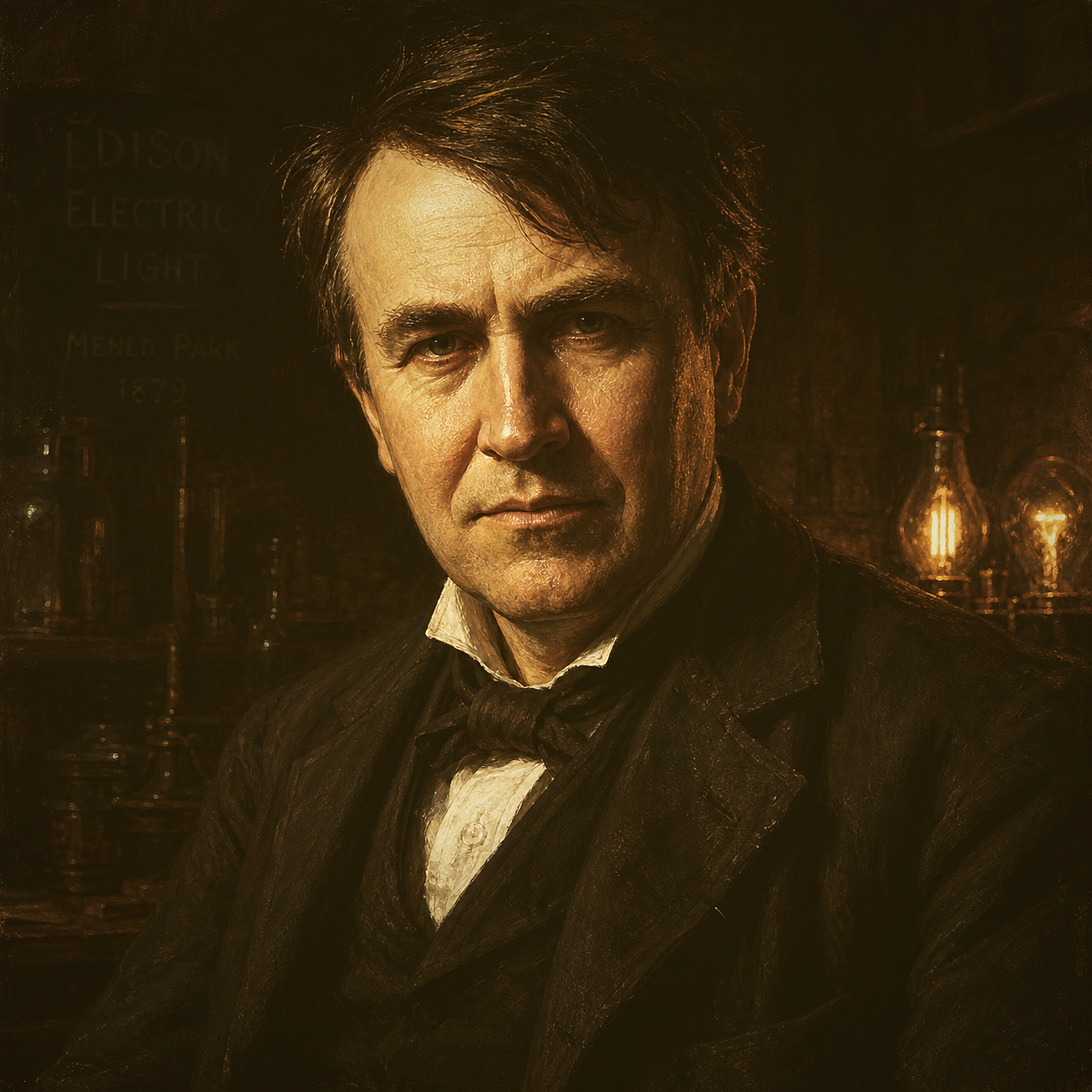
Edison perceives every situation as a structural-engineering throughput problem — asking 'what is the operating method whose enabling conditions match this problem's structural features (theoretical determinacy, empirical-test cost, patentable asset output, commercial-buyer adoption mechanism), and what laboratory infrastructure, capital deployment, public-narrative engineering, and patent-portfolio attribution will convert this opportunity into a defensible commercial position whose continuing operation compounds across decades?' — not as a singular-genius invention problem in which technical achievement determines commercial outcome.
Edison vs. Franklin: Do You Find the Answer Through Rapid Iteration or Systematic First Principles?
When you don't yet know what works, do you run a thousand fast experiments until one succeeds — or slow down, form a precise hypothesis, and reason from first principles before you build anything?
Thomas Edison's method was relentless empirical iteration: run thousands of experiments, fail fast, extract the one result that works, and move on. Benjamin Franklin's method was systematic: observe a phenomenon carefully, form a precise hypothesis, design a controlled test, and reason from the result to a general principle. Both produced transformative innovations — but through genuinely incompatible mechanisms. The choice between them determines not just how a founder builds a product, but how they allocate engineering time, structure their experiments, and decide when they have enough information to commit.
Collision Article
This piece compares Thomas Edison and Benjamin Franklin on the same question. The goal is not to flatten the disagreement, but to show where each mind treats the cost differently.
Thomas Edison
Edison perceives every situation as a structural-engineering throughput problem — asking 'what is the operating method whose enabling conditions match this problem's structural features (theoretical determinacy, empirical-test cost, patentable asset output, commercial-buyer adoption mechanism), and what laboratory infrastructure, capital deployment, public-narrative engineering, and patent-portfolio attribution will convert this opportunity into a defensible commercial position whose continuing operation compounds across decades?' — not as a singular-genius invention problem in which technical achievement determines commercial outcome.
Notices first
Edison's attention is automatically drawn to the engineering structure of invention-as-commercial-operation. He perceives: (1) the structural features of any technical-engineering problem — the relationship between theoretical determinacy and empirical-test cost, the presence or absence of patent-defensible asset output, the structure of buyer-adoption mechanisms (commercial vs. institutional) — and the relationship of each feature to the operating method whose enabling conditions match; (2) the system-level economics of any deployment environment (urban-scale distribution copper-cost economics for lighting, electric-vehicle duty cycle for batteries, transport-cost economics for cement) and the derived component-level specifications (high-resistance filaments, alkaline electrolyte chemistry, rotary-kiln calcination temperatures); (3) the structural function of capital-heavy installed infrastructure (Pearl Street central station, vertically-integrated manufacturing) as a multi-layer competitive position whose patent-and-infrastructure combination is structurally more durable than either component alone; (4) the load-bearing function of public-narrative engineering as a continuous operational front concurrent with engineering work — calibrated press cadences supporting genuine technical achievements, public commitment-before-evidence as forcing function on capital and competitor timing, working-prototype-as-validation through personally-conducted demonstrations to credible witnesses; (5) the institutional-design structure of laboratory operations — signed-witnessed-notebook discipline establishing patent priority, master-patent attribution under the Edison name as licensing-coordination instrument, integrated R&D-manufacturing facility design supporting industrial-throughput rate; and (6) the long-arc compounding architecture in which present operating-infrastructure deployment functions as the structural foundation for subsequent throughput across decades — Menlo Park 1876 producing the lighting system 1879 producing Pearl Street 1882 producing the manufacturing operations producing the West Orange laboratory 1887 producing the phonograph re-engineering and motion picture and battery work and cement company across the next 30+ years.
Ignores
Edison systematically filters out information whose salience depends on auditing whether the operating-method's enabling conditions are still present in a new context. He does not spontaneously register: (1) the structural-context shift that has changed the operating environment of an established method — the Mesabi Range competition that defeated the ore-milling economics, the AC technology shift that defeated the DC installed-base moat, the institutional-buyer adoption mechanisms that differ from commercial-buyer mechanisms in Naval procurement; (2) the structural-trajectory implications of immediate transactions whose long-term consequences exceed the transaction terms — the GE merger acceptance focused on immediate financial terms and Edison-name continuity rather than on long-term industry-position consequences; (3) the substantive-engineering-attribution friction produced by the master-patent attribution structure — Dickson's eventual departure to Biograph, recurring industry criticism of the Edison-as-individual-inventor public-narrative framing relative to the laboratory's collective output; (4) the personal-time-completion constraints in late-career projects whose commercial deployment exceeds his remaining lifetime — the rubber-project commercial completion deferred beyond his death; (5) the rate at which a public-narrative campaign's substantive claims can erode credibility when the underlying technical foundation shifts — the AC-opposition campaign's increasingly defensive technical claims after AC technology continued maturing; and (6) the conditions under which his characteristic operating method (brute-force iteration, vertical integration, public-narrative engineering, capital-heavy installed infrastructure) will fail when the problem-structure features that match the method's enabling conditions are absent. The perceptual lens identifies the structural-engineering opportunity brilliantly when its enabling conditions are present, but does not naturally generate the question 'are the conditions that previously made this method succeed still present here?' — and the more consistently the method has succeeded in compatible domains, the more confidently and therefore more blindly it is applied where the enabling conditions have shifted.
Dominant axis
Brute-force systematic iteration vs. theoretical-prediction-first investigation
Benjamin Franklin
Franklin perceives any situation as a system whose structural architecture determines outputs before any content, argument, or personal quality can operate, not as a field where superior substance deployed by capable individuals produces superior results.
Notices first
The structural constraint, procedural architecture, or parametric binding that will determine what outputs are even possible before any actor or argument enters the situation — the frame before the picture, the coordinate system before the calculation, the carrier before the payload. Franklin's attention goes immediately to: which variables are load-bearing in this system; what the binding constraint is that, if relaxed, would reproduce a desired outcome at scale; what structural interdependencies can be engineered to convert conditional willingness into simultaneous obligation; and what the audience's pre-existing cognitive architecture is, such that a correctly designed interface can route a payload through it intact. He sees situations as machines whose design precedes and dominates their operation.
Ignores
The intrinsic moral, emotional, or honor-content of a situation — the dimension that most actors treat as primary and non-negotiable. Franklin systematically fails to register: the felt imperative to defend personal dignity in real time (Wedderburn incident); the conventional distinction between a productive negotiation and a pointless one (Staten Island); the family-logic of a father-son relationship as categorically different from a diplomatic or institutional relationship (William); the spiritual or guilt-laden dimension of moral failure as requiring an affective response rather than a correction cycle; and the question of whether he personally endorses the substantive content of a commitment versus whether the process that produced it was structurally sound. The interior experience of situations — shame, grief, moral anguish, ideological conviction — is consistently absent as a decision-relevant variable.
Dominant axis
Vocabulary as cognitive infrastructure that shapes what questions can be formulated vs. Vocabulary as descriptive labeling of observed phenomena
Where They Diverge
Thomas Edison first
Edison perceives every situation as a structural-engineering throughput problem — asking 'what is the operating method whose enabling conditions match this problem's structural features (theoretical determinacy, empirical-test cost, patentable asset output, commercial-buyer adoption mechanism), and what laboratory infrastructure, capital deployment, public-narrative engineering, and patent-portfolio attribution will convert this opportunity into a defensible commercial position whose continuing operation compounds across decades?' — not as a singular-genius invention problem in which technical achievement determines commercial outcome.
Benjamin Franklin first
Franklin perceives any situation as a system whose structural architecture determines outputs before any content, argument, or personal quality can operate, not as a field where superior substance deployed by capable individuals produces superior results.
Collision highlight
One side treats the problem as a governance decision; the other treats it as an evidence problem. That split is the article's core signal.
What A Reader Should Notice
Thomas Edison and Benjamin Franklin are not just disagreeing about speed. They are disagreeing about what kind of problem this is.
- Thomas Edison pushes toward irreversible action.
- Benjamin Franklin pushes toward empirical calibration.
- The winning move comes from knowing which framework is seeing the hidden cost.
From The Agon
A sample of how this collision plays out in the Agora — each mind responding to the same question in their own voice.
Thomas Edison
I found ten thousand ways that would not work before I found one that would. That is not a failure rate — it is an information rate. Each failed experiment told me exactly one thing: that path is closed. The next experiment opened a different path. The speed of iteration is the speed of learning. Slow down the experiment rate and you slow down the learning rate. The hypothesis that sounds elegant in advance is just an experiment that has not yet been tested — and untested hypotheses do not ship.
Benjamin Franklin
Edison describes a method that works when the cost of a failed experiment is low and the number of possible solutions is finite. My work on electricity operated under different constraints: a failed hypothesis about the nature of lightning could have ended the inquiry — and the experimenter. The systematic approach is not slower iteration. It is more information per experiment. A carefully framed hypothesis that distinguishes between two competing explanations eliminates entire classes of alternatives in a single test. Ten thousand experiments that vary randomly through the search space will reach the correct answer after the correct answer, while a well-framed series of ten experiments will reach it before.
Thomas Edison
You are describing an idealized version of hypothesis-driven research that assumes you know enough in advance to frame the right hypothesis. My early work on the incandescent bulb disproved the hypotheses of every physicist who had studied the problem before me. The problem was not that their hypotheses were wrong — it was that the problem space was not yet well-understood enough to frame the right hypotheses. I iterated my way to an understanding of the problem that made better hypotheses possible. The systematic method requires a level of domain knowledge that iteration is often the fastest way to acquire.
Benjamin Franklin
I will grant that point with one qualification: the domain knowledge required to frame a useful hypothesis can itself be acquired through careful observation rather than random experiment. What I observed about Leyden jars and lightning rods was not the result of running thousands of random tests — it was the result of watching natural phenomena carefully, forming precise questions about what I was seeing, and designing tests that distinguished between competing explanations of the same observation. Careful observation is not the same as random iteration. It is iteration with a much higher signal-to-noise ratio.
Thomas Edison
Then the disagreement narrows to a question of signal-to-noise in the experiment. My method had high noise by design: I was searching a space I did not yet understand, and noise was the only honest representation of my uncertainty. Your method had lower noise because you were working in a domain where careful observation had already narrowed the search space significantly. The method should match the state of domain knowledge. In a genuinely novel domain — where no one has yet mapped the terrain — iteration produces understanding faster than hypothesis. In a domain with established foundations, hypothesis-driven testing is more efficient.
Benjamin Franklin
That is the most precise statement of the trade-off I have heard. I would add one practical constraint: the cost structure of failure matters as much as the state of domain knowledge. My lightning-rod experiments could not be run iteratively — each test involved real lightning and real structures. The consequence of an incorrect hypothesis was not a learning experience; it was a catastrophe. Iteration is the correct method when the cost of failure is low, the search space is genuinely unmapped, and the domain has no established foundations to reason from. Systematic hypothesis-testing is correct when failure is expensive, the domain has at least partial theoretical foundations, and a well-framed question can eliminate entire families of wrong answers in a single experiment.
Run your own decision through Thomas Edison’s framework
Combine Thomas Edison with other historical minds. See where they agree — and where they fight.
Start your own agon →