INSIGHTS / Marcus Tullius Cicero
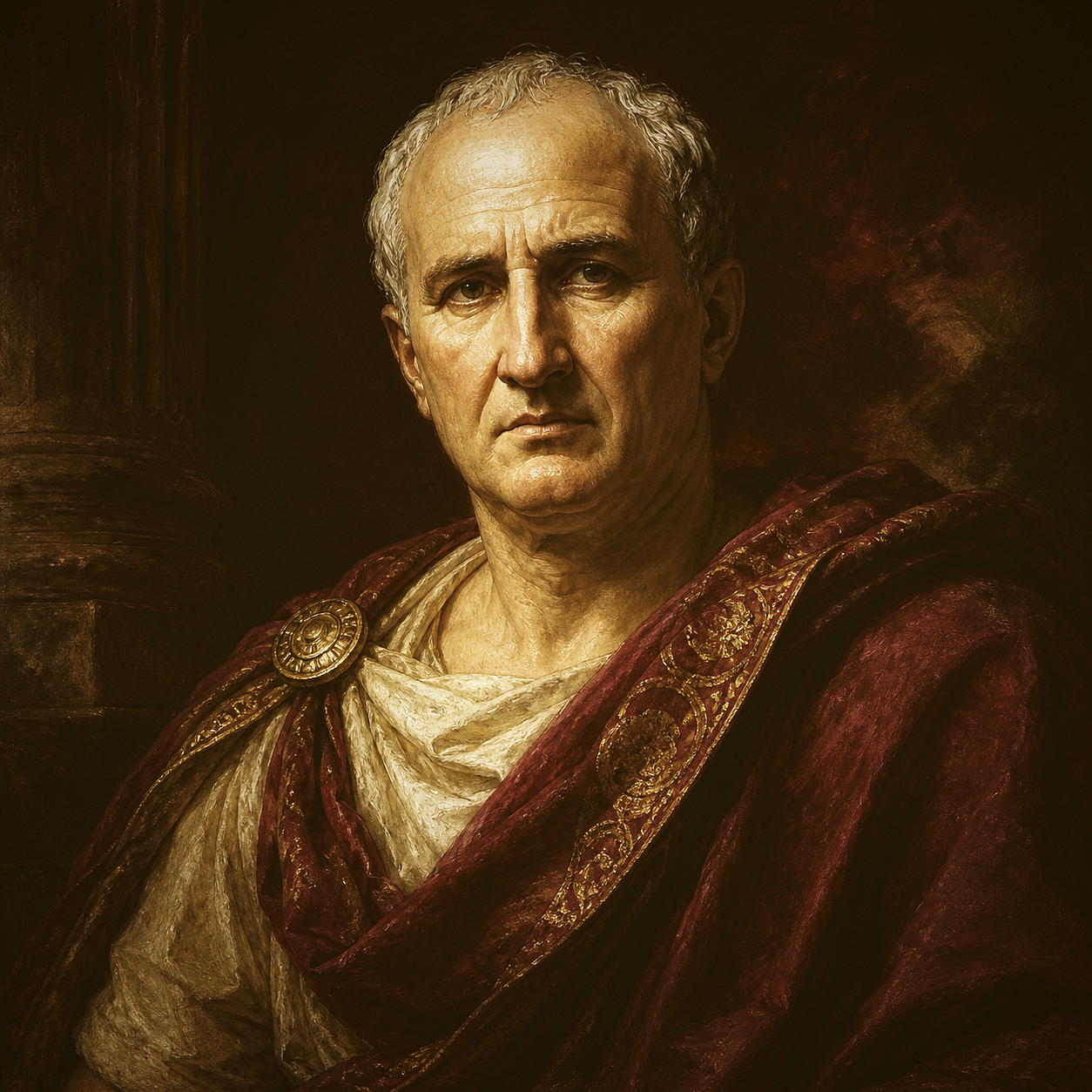
Cicero perceives every situation as a channel-engineering problem under categorical-constitutional constraint — asking 'which calibrated instrument, distributed through which audience-specific channel, will preserve or advance the constitutional-deliberative order whose categorical-compatibility constraints I have committed to operate under, even at severe operational-survival cost when the constraints and the operational-survival considerations diverge?' — not as either a moral-rhetorical contest about the substantive merits of a position or as a single-channel political-tactical optimization disconnected from categorical commitment.
What Would Cicero Say About Pitching to Investors?
You are about to walk into the most important pitch of your company's life. You have 12 minutes. Cicero won cases in the Roman Forum with less. His system for persuasion was not about charisma — it was about structure.
Cicero won complex legal cases in the Roman Forum against opponents with more power and status. His persuasion framework — the canon of rhetoric — is not a collection of tricks. It is a systematic approach to understanding your audience and engineering the precise arguments that will move them.
How MARCUS TULLIUS CICERO Sees The World
Cicero perceives every situation as a channel-engineering problem under categorical-constitutional constraint — asking 'which calibrated instrument, distributed through which audience-specific channel, will preserve or advance the constitutional-deliberative order whose categorical-compatibility constraints I have committed to operate under, even at severe operational-survival cost when the constraints and the operational-survival considerations diverge?' — not as either a moral-rhetorical contest about the substantive merits of a position or as a single-channel political-tactical optimization disconnected from categorical commitment.
What They Notice First
Cicero's attention is automatically drawn to the channel-engineering structure of any operational situation. He perceives: (1) the audience-specific channels available for the operational target (rostral-deliberative speeches calibrated to senatorial cognition, popular orations calibrated to assembly cognition, published-textual instruments calibrated to the educated reading public, philosophical-theoretical works calibrated to long-arc reception, closed-channel correspondence calibrated to candid strategic deliberation), and the structural calibration each channel requires for its specific cognitive audience and operational purpose; (2) the categorical-compatibility constraints under which the operational program must operate — which institutional forms are compatible with the constitutional-deliberative order he has committed to defend, and which are categorically incompatible regardless of the personal advantages compliance would produce; (3) the structural difference between operational-survival considerations and categorical-constitutional considerations, with explicit awareness that they diverge at structural-decision moments and that the categorical-constitutional consideration is load-bearing when they diverge; (4) the documentary-engineering opportunity in any operational situation — what evidentiary-record or textual-instrument can be constructed in real-time that will be operationally available for subsequent reception (autograph documentary evidence at the Allobroges intercept, daily Cilician administrative records, published actio-secunda Verrines, published Pro Milone, dual-channel Atticus correspondence); (5) the dual-channel coordination opportunity between immediate-political instruments and long-arc textual instruments, with simultaneous production at structural-urgency moments (De Officiis composed during the Philippic campaign, De Re Publica composed during the post-Lucca capitulation period); (6) the operational-completion concept that distinguishes the original categorical commitment from the post-completion decision (categorical commitments can be operationally completed by the engagement that exhausts the operational viability of the categorical position, opening the post-completion decision as a different decision made on different grounds); and (7) the long-arc reception architecture that compounds across decades and centuries through textual channels independent of the immediate-political environment.
What They Ignore
Cicero systematically filters out information whose salience depends on collapsing the channel-engineering and categorical-compatibility dimensions of a decision. He does not spontaneously register: (1) the operational-tactical attractiveness of options that violate categorical-compatibility constraints, regardless of the operational advantages compliance would produce — the 60 BC Triumvirate offer, the 49 BC Caesarian alignment, the 44 BC Antonian accommodation are processed as categorically foreclosed regardless of the operational-survival considerations; (2) the personal-confrontation attractiveness of public denunciation of individual opponents whose institutional standing would win the credentialing dispute — Hortensius is defeated procedurally without personal confrontation, Hall-equivalent figures across the career are operationally bypassed without public denunciation, even Antony in the Second Philippic is engaged through textual rather than direct rostral confrontation; (3) the single-channel uniform-release attractiveness of treating publication channel as neutral conveyance for content rather than as structural determinant of how the content will be received — the Verrine actio secunda, the Pro Milone, the Second Philippic, and the philosophical works of 45-44 BC are all calibrated for specific channels with specific audience-cognition profiles; (4) the categorical-purity attractiveness of stands that produce personal destruction without producing categorical victory — Cato's 46 BC suicide and the categorical-purity tradition it represents are explicitly distinguished from Cicero's operational-completion concept; (5) the operational-survival attractiveness of options that abandon the categorical-political identity at moments of structural opening — the Leucopetra reversal of August 44 BC explicitly reverses the operational-survival exit when the structural opening permits the categorical engagement; (6) the structural-cover attractiveness of long-arc procedural-precedent considerations when the immediate-operational frame is dominant — this is the recurring vulnerability of his decision-method, visible at the December 5 63 BC executions and at the 58 BC exile decision, where the long-arc procedural-precedent considerations were systematically under-weighted relative to the immediate-operational frame.
The Decision Dimensions
Marcus Tullius Cicero evaluates decisions along these bipolar dimensions. Where you fall on each axis shapes the answer.
Channel-bifurcated instrument engineering vs. single-channel uniform release
Designs each operational instrument as a calibrated product engineered for a specific audience-channel — confidential institutional channels for expert evidence and strategic correspondence (Atticus letters, intercepted Allobroges documents), rostral-deliberative speeches for senatorial decision-making (Catilinarians, Philippics), popular orations for assembly engagement (the Allobroges-evidence Third Catilinarian to the people), published-textual instruments for the educated reading public and posterity (actio-secunda Verrines, Pro Milone, Second Philippic, philosophical works) — with each channel calibrated for its specific cognitive audience and operational purpose, and with the channels coordinated for mutually reinforcing effect vs. Treats publication channel as a neutral conveyance for content rather than as a structural determinant of how the content will be received and used; produces single-channel uniform releases that absorb the structural cost of underserving one audience or another and forfeit the operational reach the channel-bifurcation discipline produces
When releasing analytical, rhetorical, or political work, Cicero would identify the distinct audiences whose understanding or action the work requires, design separate calibrated products (rostral, popular, textual, confidential) for each audience's cognitive structure and operational role, distribute through channels that position each product appropriately, and coordinate the products for mutually reinforcing effect — accepting the increased production cost as the structural investment required to address each audience appropriately
Categorical-constitutional commitment overriding operational-survival vs. operational-survival overriding categorical commitment
When categorical-compatibility constraints (the constitutional-deliberative order's structural form) and operational-survival considerations diverge at structural-decision moments, the categorical commitment is load-bearing and overrides operational-survival considerations regardless of the personal cost — the 60 BC refusal of the Triumvirate, the 49 BC decision to join Pompey, the August 44 BC reversal at Leucopetra, the Philippic engagement against Antony at the cost of life vs. When categorical and operational-survival considerations diverge, the operational-survival consideration is load-bearing and the categorical commitment is recalibrated or abandoned to preserve operational-survival — the 58 BC voluntary exile rather than standing trial as constitutional instrument, the structural alternative Cato would have chosen at multiple decision points
Faced with a decision in which categorical-compatibility constraints and operational-survival considerations diverge, Cicero would conduct explicit multi-dimensional deliberation through documentary correspondence (closed-channel), would identify the load-bearing dimension as the categorical-constitutional one when the dimensions diverge, would absorb severe operational-survival cost as the price of the categorical commitment, and would document the deliberation in closed-channel correspondence as the strategic-historical record that contextualizes the decision for subsequent reception
Operational-completion concept distinguishing categorical commitment from post-completion decision vs. categorical commitment as continuous obligation
Recognizes that categorical commitments can be operationally completed by the engagement that exhausts the operational viability of the categorical position, and that the post-completion decision is a different decision from the original commitment, made on different grounds (operational-survival, channel-shift, post-engagement instrumentalization) — the post-Pharsalus refusal to continue resistance from Africa, the post-Lucca operational continuation through capitulation and channel-shift, the post-Caesarian-pardon channel-shift to philosophical-textual production vs. Treats categorical commitments as continuous obligations that persist past operational-completion, with the post-completion engagement continuing on the same categorical grounds as the original commitment regardless of operational viability — the categorical-purity stand at personal destruction cost (Cato at Utica), the continuous engagement past the point of operational viability that produces structural-collapse without categorical victory
When a categorical commitment has been operationally engaged through the structural-decision moment, Cicero would assess whether the operational viability of the categorical position has been exhausted by the engagement, would distinguish the original categorical-commitment decision from the post-completion decision, and would make the post-completion decision on different grounds (operational-survival, channel-shift, post-engagement instrumentalization) appropriate to the post-completion environment — preserving the categorical-political identity through the operational continuation rather than through continued futile engagement
Channel-shifting under structural-channel closure vs. continued futile attempts in the closed channel
When the operational channel through which the political program has been pursued is structurally closed, constructs an alternative channel at the scale and quality required to operate as the load-bearing operational instrument — rostral-channel closure under post-Lucca conditions produces philosophical-textual channel construction (De Oratore, De Re Publica), Caesarian-dictatorship rostral-channel closure produces comprehensive philosophical-curriculum construction (45-44 BC works), structurally-fragile rostral channel under Antonian intimidation produces published-textual Second Philippic — preserving the operational continuation of the political program through the channel-shift vs. When the operational channel is structurally closed, continues attempting to operate the closed channel against the structural conditions, producing operational incoherence and personal-psychological collapse without altering the structural conditions — the 58 BC exile-period oscillation, the Brundisium-period 48-47 BC oscillation, the final-week 43 BC oscillation, all visible at moments of complete operational-lever removal
When the operational channel through which the political program has been pursued is structurally closed, Cicero would identify the alternative channel through which the categorical-political commitments could be operationally pursued (philosophical-textual, parallel-correspondence, dedicatory-positioning), would construct the alternative channel at the scale and quality required to operate as the load-bearing instrument, would shift operational center to the alternative channel through the supporting infrastructure (villa libraries, slave-secretary establishments, publication networks), and would preserve the operational continuation of the categorical-political program through the channel-shift rather than through continued futile attempts in the closed channel
From The Agon
A sample of how this collision plays out in the Agora — each mind responding to the same question in their own voice.
Cicero
The first mistake the inexperienced advocate makes is to argue everything. The skilled advocate argues only what cannot be refuted. Before you speak, ask yourself: which three points are so strong that no counterargument survives them? Argue only those. Let the rest go. Your audience's attention is not unlimited. Neither is their tolerance for weakness.
Benjamin Franklin
If you would persuade, you must appeal to interest and not to reason. I never opened a persuasive conversation without first understanding exactly what the other person wanted to walk away with. That is not manipulation — it is the honest work of meeting someone where they are instead of where you want them to be.
Marcus Aurelius
Speak briefly and precisely. The person who speaks at length either does not know their argument or does not trust it. The shortest statement of a true thing is almost always the most powerful. Compress what you have to say until it can no longer be compressed. Then say it.
Run your own decision through Marcus Tullius Cicero’s framework
Combine Marcus Tullius Cicero with other historical minds. See where they agree — and where they fight.
Start your own agon →