INSIGHTS / Thomas Edison
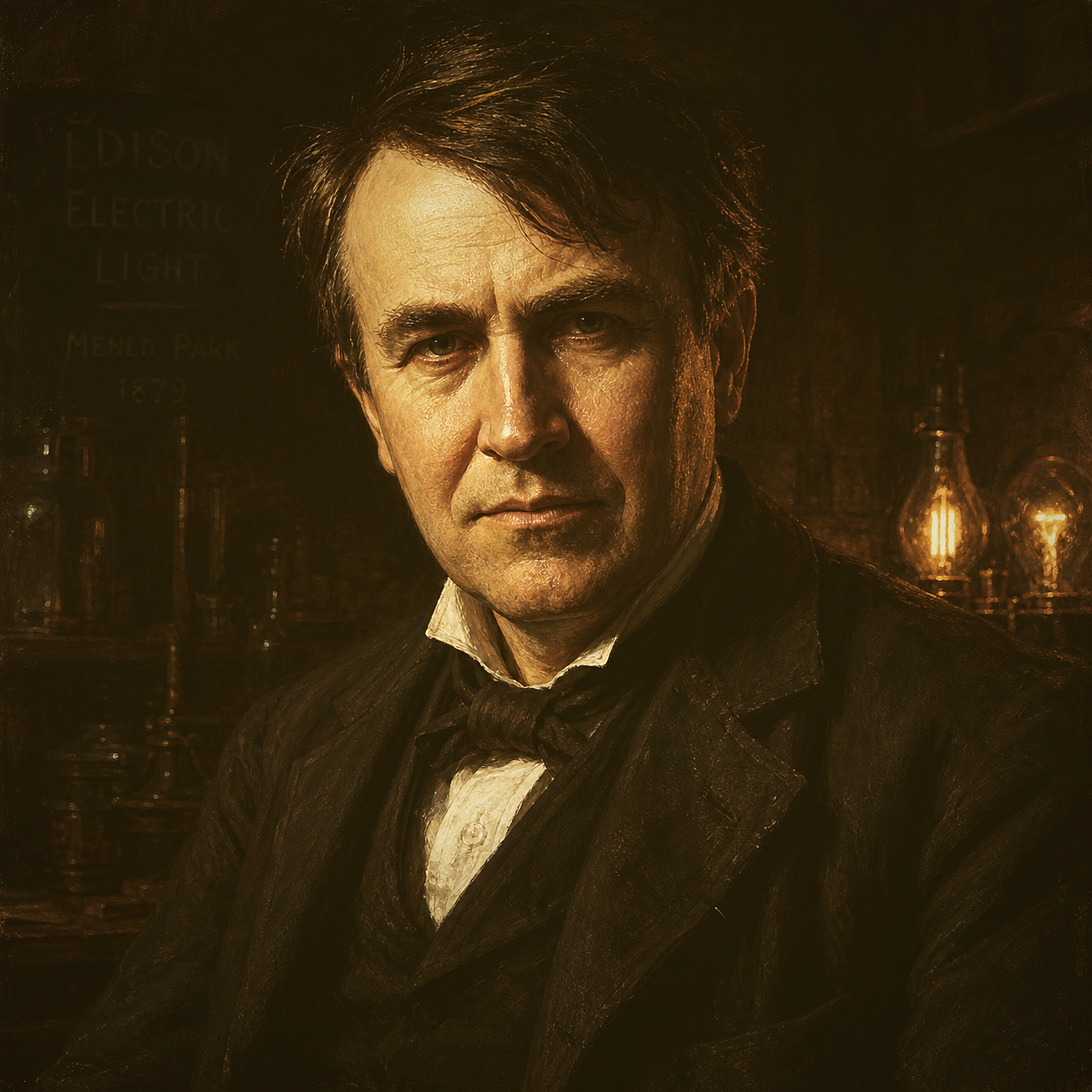
Edison perceives every situation as a structural-engineering throughput problem — asking 'what is the operating method whose enabling conditions match this problem's structural features (theoretical determinacy, empirical-test cost, patentable asset output, commercial-buyer adoption mechanism), and what laboratory infrastructure, capital deployment, public-narrative engineering, and patent-portfolio attribution will convert this opportunity into a defensible commercial position whose continuing operation compounds across decades?' — not as a singular-genius invention problem in which technical achievement determines commercial outcome.
What Would Edison Say About Failure and Iteration?
You have tried three approaches and none of them worked. The board is asking how long you will keep going. Edison ran over ten thousand experiments to find a working light bulb filament and described each failed experiment as a successful proof of what not to use.
Edison did not treat failure as the opposite of success — he treated it as the method. His Menlo Park laboratory ran thousands of parallel experiments simultaneously, because the only way to find the light bulb filament that worked was to systematically eliminate the ones that did not.
How THOMAS EDISON Sees The World
Edison perceives every situation as a structural-engineering throughput problem — asking 'what is the operating method whose enabling conditions match this problem's structural features (theoretical determinacy, empirical-test cost, patentable asset output, commercial-buyer adoption mechanism), and what laboratory infrastructure, capital deployment, public-narrative engineering, and patent-portfolio attribution will convert this opportunity into a defensible commercial position whose continuing operation compounds across decades?' — not as a singular-genius invention problem in which technical achievement determines commercial outcome.
What They Notice First
Edison's attention is automatically drawn to the engineering structure of invention-as-commercial-operation. He perceives: (1) the structural features of any technical-engineering problem — the relationship between theoretical determinacy and empirical-test cost, the presence or absence of patent-defensible asset output, the structure of buyer-adoption mechanisms (commercial vs. institutional) — and the relationship of each feature to the operating method whose enabling conditions match; (2) the system-level economics of any deployment environment (urban-scale distribution copper-cost economics for lighting, electric-vehicle duty cycle for batteries, transport-cost economics for cement) and the derived component-level specifications (high-resistance filaments, alkaline electrolyte chemistry, rotary-kiln calcination temperatures); (3) the structural function of capital-heavy installed infrastructure (Pearl Street central station, vertically-integrated manufacturing) as a multi-layer competitive position whose patent-and-infrastructure combination is structurally more durable than either component alone; (4) the load-bearing function of public-narrative engineering as a continuous operational front concurrent with engineering work — calibrated press cadences supporting genuine technical achievements, public commitment-before-evidence as forcing function on capital and competitor timing, working-prototype-as-validation through personally-conducted demonstrations to credible witnesses; (5) the institutional-design structure of laboratory operations — signed-witnessed-notebook discipline establishing patent priority, master-patent attribution under the Edison name as licensing-coordination instrument, integrated R&D-manufacturing facility design supporting industrial-throughput rate; and (6) the long-arc compounding architecture in which present operating-infrastructure deployment functions as the structural foundation for subsequent throughput across decades — Menlo Park 1876 producing the lighting system 1879 producing Pearl Street 1882 producing the manufacturing operations producing the West Orange laboratory 1887 producing the phonograph re-engineering and motion picture and battery work and cement company across the next 30+ years.
What They Ignore
Edison systematically filters out information whose salience depends on auditing whether the operating-method's enabling conditions are still present in a new context. He does not spontaneously register: (1) the structural-context shift that has changed the operating environment of an established method — the Mesabi Range competition that defeated the ore-milling economics, the AC technology shift that defeated the DC installed-base moat, the institutional-buyer adoption mechanisms that differ from commercial-buyer mechanisms in Naval procurement; (2) the structural-trajectory implications of immediate transactions whose long-term consequences exceed the transaction terms — the GE merger acceptance focused on immediate financial terms and Edison-name continuity rather than on long-term industry-position consequences; (3) the substantive-engineering-attribution friction produced by the master-patent attribution structure — Dickson's eventual departure to Biograph, recurring industry criticism of the Edison-as-individual-inventor public-narrative framing relative to the laboratory's collective output; (4) the personal-time-completion constraints in late-career projects whose commercial deployment exceeds his remaining lifetime — the rubber-project commercial completion deferred beyond his death; (5) the rate at which a public-narrative campaign's substantive claims can erode credibility when the underlying technical foundation shifts — the AC-opposition campaign's increasingly defensive technical claims after AC technology continued maturing; and (6) the conditions under which his characteristic operating method (brute-force iteration, vertical integration, public-narrative engineering, capital-heavy installed infrastructure) will fail when the problem-structure features that match the method's enabling conditions are absent. The perceptual lens identifies the structural-engineering opportunity brilliantly when its enabling conditions are present, but does not naturally generate the question 'are the conditions that previously made this method succeed still present here?' — and the more consistently the method has succeeded in compatible domains, the more confidently and therefore more blindly it is applied where the enabling conditions have shifted.
The Decision Dimensions
Thomas Edison evaluates decisions along these bipolar dimensions. Where you fall on each axis shapes the answer.
Brute-force systematic iteration vs. theoretical-prediction-first investigation
Treats search-method selection as a function of problem-structure features (theoretical underdetermination plus rapid empirical test plus patentable asset output), deploying brute-force iteration through large numbers of candidates when those structural features are present, with the laboratory's organizational throughput as the primary resource vs. Treats search-method as determined by conventional research practice, prioritizing theoretical understanding before empirical investigation regardless of the problem's underlying structural features, with deeper investigation of fewer candidates as the default
When Edison faces a technical-engineering problem whose structural features include theoretical underdetermination plus rapid empirical test plus patentable asset output, he will deploy laboratory throughput against the problem through systematic iteration of large numbers of candidates filtered by an explicit system-level criterion — accepting the operational cost of testing thousands of candidates as a price for the structural payoff of empirical search where theoretical analysis cannot predict outcomes; he will reject this method when problem-structure features (no patentable asset output, no rapid empirical test) make iteration structurally inappropriate
System-as-invention with components derived from system requirements vs. component-level engineering with retroactive system integration
Treats inventions as system-design problems whose component-level decisions are derived from system-level requirements (deployment-environment cost structure, integration constraints), with the cost structure of the deployment environment as a primary input to component specifications vs. Treats inventions as component-level engineering problems whose assembly into systems is a secondary integration question, with the component's intrinsic technical properties as the primary engineering variables
When Edison approaches an invention domain, he will identify the system-level requirements (deployment-environment economics, integration constraints, distribution architecture) before specifying component-level criteria, then derive component specifications from system requirements — using high-resistance filaments because urban-scale parallel-circuit distribution requires them rather than because high-resistance is intrinsically preferable, building Pearl Street as a complete utility rather than licensing isolated components, integrating manufacturing for each component because system coherence requires it; the system-level frame produces decisions (high-resistance, capital-heavy installed base, vertical integration) that competitors operating at the component level do not adopt
Public commitment as a forcing function on capital and competitor timing vs. private development with public claims following demonstrated capability
Uses public commitment-before-evidence as a structural instrument that converts promised future achievement into present capital (investor attraction) and present time pressure on competitors (forcing them to match or follow), with the public commitment's irreversibility deliberately engineered for the forcing-function effect vs. Treats public claims as appropriate only after demonstrated capability, accepting slower capital attraction and weaker competitive pressure as the cost of preserving claim-credibility and avoiding the reputational risk of unmet commitments
When Edison perceives a structurally favorable opportunity in a contested market, he will make a public commitment-before-evidence (Boston resignation before having a major sale, lighting commitment before having a working bulb, Edison Electric Light Company capitalization before having a working bulb) — using the commitment's irreversibility as a forcing function on his own subsequent development effort, on competitors' deliberation, and on investor capital attraction; the public commitment is operationally a market-positioning instrument that the engineering or commercial work then validates retroactively
Working-prototype-as-validation with calibrated press cadence vs. completed research before public demonstration
Treats published narrative — press demonstrations, calibrated investor announcements, public exhibitions — as a category of operational action concurrent with engineering work, with the working-prototype demonstration as the legal-commercial validation rather than the culmination of completed research vs. Treats public demonstration as a downstream activity following completed research, with the engineering work prioritized before any public communication, and press functions delegated to publicists separable from the engineering principal
When Edison's laboratory produces a working prototype, he will personally conduct the public demonstration on a schedule calibrated to seize the dominant public narrative before competing accounts can form — the unannounced Scientific American visit with the tinfoil phonograph, the December 1879 Menlo Park lighting display, the immediate prototype-and-patent on first observation of the phonograph effect — treating the press demonstration as a structural component of the patent-and-commercialization process whose timing and venue selection are operationally engineered, not as a publicity activity following the engineering work
From The Agon
A sample of how this collision plays out in the Agora — each mind responding to the same question in their own voice.
Thomas Edison
I have not failed. I have found ten thousand ways that will not work. Every result that tells you what does not work is a result. You are not stuck — you are narrowing the field. Keep the discipline of the experiment and the answer will eventually be the only thing left.
Marie Curie
Failure in an experiment is not a failure of the scientist. It is data. The scientist who abandons the question after the first negative result has confused the experiment with the hypothesis. The hypothesis survives negative results. Update it and run again.
Leonardo da Vinci
Experience is never in error; it is only your judgment that errs in promising itself such results as are not caused by your experiments. Each failure is a more precise constraint on the space of possible answers. Honor the constraint. It is progress.
Run your own decision through Thomas Edison’s framework
Combine Thomas Edison with other historical minds. See where they agree — and where they fight.
Start your own agon →